


The Modified WHO Analgesic Ladder: Is It Appropriate for Chronic Non-Cancer Pain?
- PMID: 32110089
- PMCID: PMC7038776
- DOI: 10.2147/JPR.S244173
The Modified WHO Analgesic Ladder: Is It Appropriate for Chronic Non-Cancer Pain?
Abstract
Introduction: From 1986, the World Health Organization (WHO) analgesic ladder has been used as the simple and valuable pain-relieving guidance in the pharmaceutical pain management, however, with the development of medical history, notions about pain physiology and pain management have already updated. Is the analgesic ladder still appropriate for chronic non-cancer pain (CNCP) patients? This study aims to analyse the current usage of the analgesic ladder in patients with CNCP by evaluating previously published pertinent studies.
Methods: Literature published in English from January 1980 to April 2019 and cited on PubMed database was included. Analysis on the analgesic ladder, current status of CNCP management, and a new revised ladder model were developed based on relevant literature.
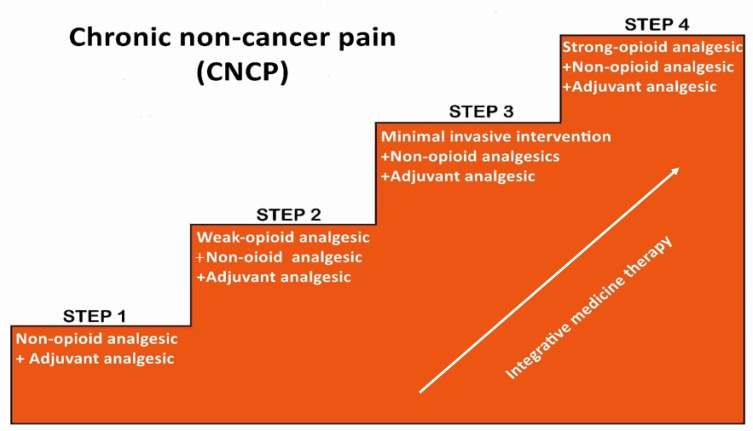
Results: The WHO analgesic ladder for cancer pain is not appropriate for current CNCP management. It is revised into a four-step ladder: the integrative therapies being adopted at each step for reducing or even stopping the use of opioid analgesics; interventional therapies being considered as step 3 before upgrading to strong opioids if non-opioids and weak opioids failed in CNCP management.
Discussion: A simple and valuable guideline in past years, the WHO analgesic ladder is inappropriate for the current use of CNCP control. A revised four-step analgesic ladder aligned with integrative medicine principles and minimally invasive interventions is recommended for control of CNCP.
Keywords: analgesic ladder; chronic non-cancer pain; chronic pain; opioid; pain management.
© 2020 Yang et al.
Conflict of interest statement
The authors have indicated that they have no conflicts of interest with regard to the content of this article.
Figures
References
-
- Merskey HE. Classification of chronic pain: descriptions of chronic pain syndromes and definitions of pain terms. Pain. 1986. - PubMed
LinkOut - more resources
Full Text Sources
Miscellaneous
