


Effects of Preconception Care and Periconception Interventions on Maternal Nutritional Status and Birth Outcomes in Low- and Middle-Income Countries: A Systematic Review
- PMID: 32110886
- PMCID: PMC7146400
- DOI: 10.3390/nu12030606
Effects of Preconception Care and Periconception Interventions on Maternal Nutritional Status and Birth Outcomes in Low- and Middle-Income Countries: A Systematic Review
Abstract
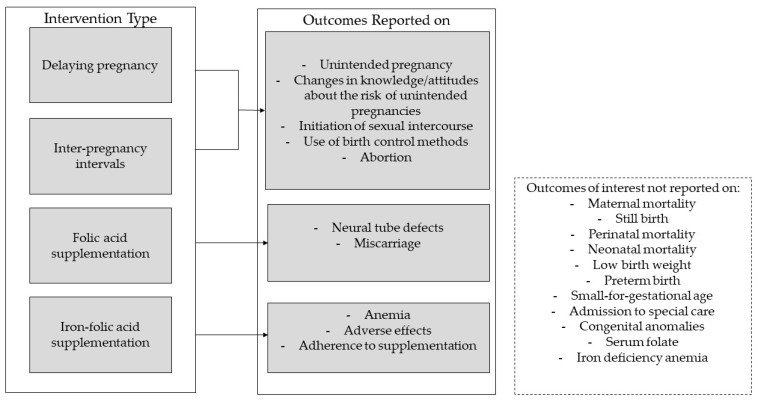
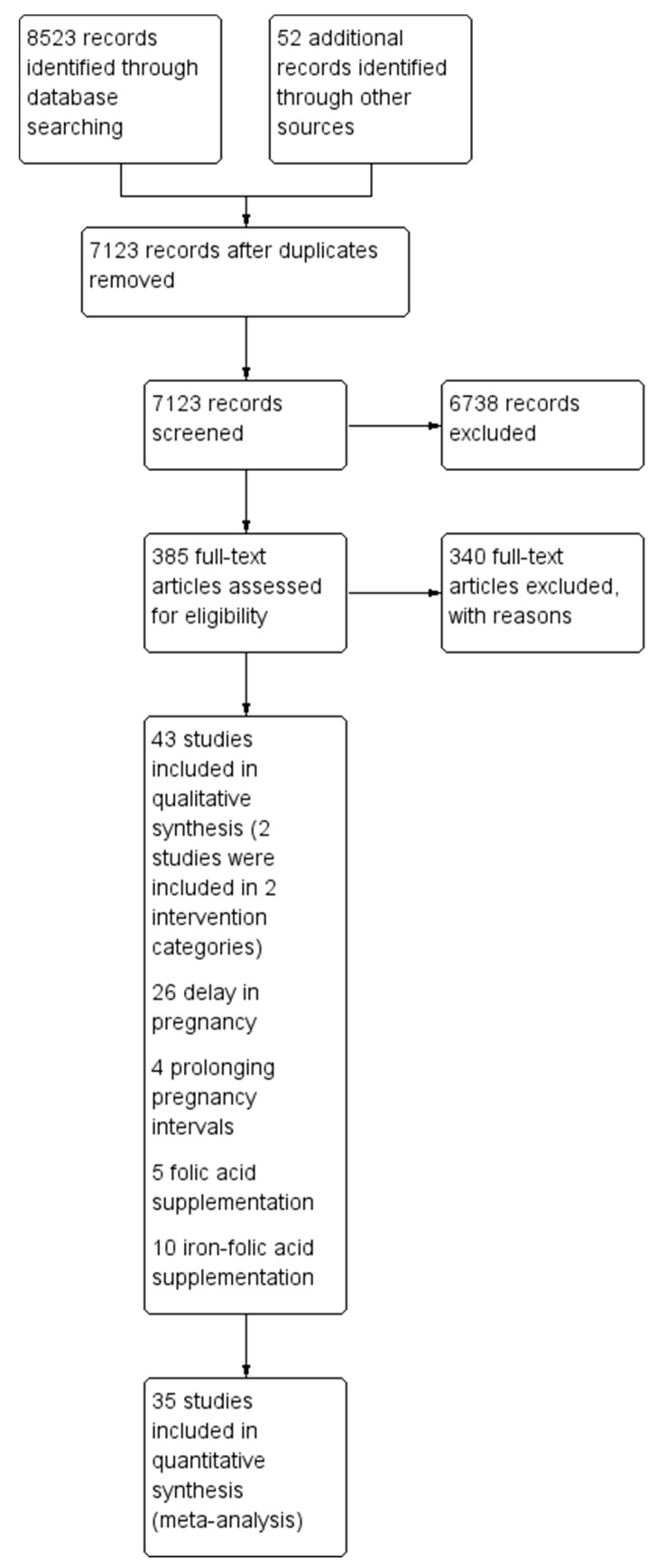
Pregnancy in adolescence and malnutrition are common challenges in low- and middle-income countries (LMICs), and are associated with many complications and comorbidities. The preconception period is an ideal period for intervention as a preventative tactic for teenage pregnancy, and to increase micronutrient supplementation prior to conception. Over twenty databases and websites were searched and 45 randomized controlled trials (RCTs) or quasi-experimental interventions with intent to delay the age at first pregnancy (n = 26), to optimize inter-pregnancy intervals (n = 4), and supplementation of folic acid (n = 5) or a combination of iron and folic acid (n = 10) during the periconception period were included. The review found that educational interventions to delay the age at first pregnancy and optimizing inter-pregnancy intervals significantly improved the uptake of contraception use (RR = 1.71, 95% CI = 1.42-2.05; two studies, n = 911; I2 = 0%) and (RR = 2.25, 95% CI = 1.29-3.93; one study, n = 338), respectively. For periconceptional folic acid supplementation, the incidence of neural tube defects were reduced (RR = 0.53; 95% CI = 0.41-0.77; two studies, n = 248,056; I2 = 0%), and iron-folic acid supplementation improved the rates of anemia (RR = 0.66, 95% CI = 0.53-0.81; six studies; n = 3430, I2 = 88%), particularly when supplemented weekly and in a school setting. Notwithstanding the findings, more robust RCTs are required from LMICs to further support the evidence.
Keywords: delaying pregnancy; family planning; folic acid; inter pregnancy interval; iron folic acid; maternal health; neonatal health; periconception.
Conflict of interest statement
The authors declare no conflict of interest.
Figures
References
-
- Johnson K., Posner S.F., Biermann J., Cordero J.F., Atrash H.K., Parker C.S., Curtis M.G. Recommendations to Improve Preconception Health and Health Care—United States: Report of the CDC/ATSDR Preconception Care Work Group and the Select Panel on Preconception Care. Morb. Mortal. Wkly. Rep. Recomm. Rep. 2006;55:1–23. - PubMed
-
- World Health Organization . Meeting to Develop a Global Consensus on Preconception Care to Reduce Maternal and Childhood Mortality and Morbidity. World Health Organization; Geneva, Switzerland: 2013. 6–7 February 2012 Meeting Report.
-
- Dean S., Rudan I., Althabe F., Girard A.W., Howson C., Langer A., Venkatraman C.M. Setting research priorities for preconception care in low-and middle-income countries: Aiming to reduce maternal and child mortality and morbidity. PLoS Med. 2013;10:e1001508. doi: 10.1371/journal.pmed.1001508. - DOI - PMC - PubMed
-
- Dean S.V., Imam A.M., Lassi Z.S., Bhutta Z.A. Maternal and Child Nutrition: The First 1000 Days. Volume 74. Karger Publishers; Basel, Switzerland: 2013. Importance of intervening in the preconception period to impact pregnancy outcomes; pp. 63–73. - PubMed
Publication types
MeSH terms
Substances
Grants and funding
LinkOut - more resources
Full Text Sources
Medical
