Review
. 2020 Aug;69(8):1520-1532.
doi: 10.1136/gutjnl-2019-320065. Epub 2020 Feb 28.

Big data in IBD: big progress for clinical practice

Affiliations
Review

Big data in IBD: big progress for clinical practice

Nasim Sadat Seyed Tabib et al. Gut. 2020 Aug.

Abstract

IBD is a complex multifactorial inflammatory disease of the gut driven by extrinsic and intrinsic factors, including host genetics, the immune system, environmental factors and the gut microbiome. Technological advancements such as next-generation sequencing, high-throughput omics data generation and molecular networks have catalysed IBD research. The advent of artificial intelligence, in particular, machine learning, and systems biology has opened the avenue for the efficient integration and interpretation of big datasets for discovering clinically translatable knowledge. In this narrative review, we discuss how big data integration and machine learning have been applied to translational IBD research. Approaches such as machine learning may enable patient stratification, prediction of disease progression and therapy responses for fine-tuning treatment options with positive impacts on cost, health and safety. We also outline the challenges and opportunities presented by machine learning and big data in clinical IBD research.

Keywords: Crohn's disease; IBD; ulcerative colitis.


Conflict of interest statement

Competing interests: BV received lecture fees from Abbvie, Ferring Pharmaceuticals, Janssen, R-Biopharm and Takeda; consultancy fees from Janssen and Sandoz. SV: research grant: MSD, AbbVie, Takeda, Pfizer, J&J; lecture fee: MSD, AbbVie, Takeda, Ferring, Centocor, Hospira, Pfizer, J&J, Genentech/Roche; consultancy: MSD, AbbVie, Takeda, Ferring, Centocor, Hospira, Pfizer, J&J, Genentech/Roche, Celgene, Mundipharma, Celltrion, SecondGenome, Prometheus, Shire, Prodigest, Gilead, Galapagos. SV is a senior clinical investigator of the Research Foundation–Flanders (FWO). The work of MM and TK is supported by BenevolentAI, and TK’s work is also supported by Unilever.

Figures

Figure 1
Figure 1
Precision medicine in IBD. Generation of big data from thousands of individuals, along with analytical advancements such as machine learning and systems biology, assists the application of precision medicine and therefore allows patient stratification for personalised therapeutic intervention and disease management strategies. MR, magnetic resonance; PCA, principal component analysis; RF, random forest.
Figure 2
Figure 2
Clinical management of IBD from the point of diagnosis to life-term monitoring and follow-up. Each stage of the disease management process can potentially be subjected to precision medicine-aided improvement of patient care to reduce the socioeconomic burden on patients, clinicians and the healthcare system.
Figure 3
Figure 3
Academic initiatives with cohorts/biobanks in IBD. The numbers in each circle represent the approximate patient cohort size.
Figure 4
Figure 4
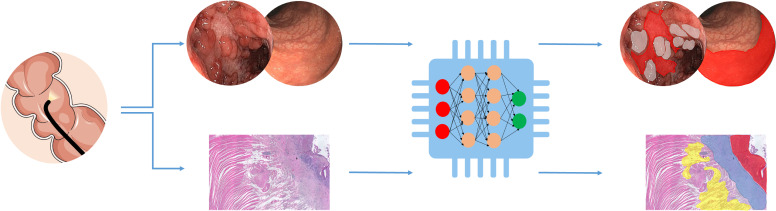
Artificial intelligence in medical imaging. Graphical representation of a simple deep learning-based image segmentation approach to predict boundaries of inflamed areas. The top section of the figure represents the endoscopic image of colonic CD demonstrating the ‘cobblestone’ appearance and ulceration. Using a simple deep learning-based image segmentation method inflamed boundaries could be predicted: cobblestone in grey and inflamed ulcer in red. The bottom section of the figure illustrates a histopathology image of inflamed stenosis from ileal CD. A deep learning-based method could be used for image segmentation and predicting boundaries of inflamed areas: acute infiltration (ulcer) in red, muscolari mucosae thickening in blue and adipocytes hyperplasia in yellow. CD, Crohn’s disease.
Figure 5
Figure 5
Opportunities and challenges in the use of machine learning and data integration to achieve improved and personalised healthcare in IBD. While challenges exist in generating good quality data in a standardised manner and at a volume deemed suitable for ensuring baseline performance of machine learning models, there remain difficulties in terms of the expertise needed to identify and employ appropriate tools for data integration and interpretation. However, with emerging advances in the data integration field, the incentives and opportunities to advance precision medicine with clinical implications are expected to drive integrative IBD research forward.

References

    1. Korcsmaros T, Schneider MV, Superti-Furga G. Next generation of network medicine: interdisciplinary signaling approaches. Integr Biol 2017;9:97–108. 10.1039/c6ib00215c - DOI - PubMed
    1. Weersma RK, Xavier RJ, Vermeire S, et al. Multiomics analyses to deliver the most effective treatment to every patient with inflammatory bowel disease. Gastroenterology 2018;155:e1–4. 10.1053/j.gastro.2018.07.039 - DOI - PubMed
    1. Ananthakrishnan AN. Epidemiology and risk factors for IBD. Nat Rev Gastroenterol Hepatol 2015;12:205–17. 10.1038/nrgastro.2015.34 - DOI - PubMed
    1. de Souza HSP, Fiocchi C. Immunopathogenesis of IBD: current state of the art. Nat Rev Gastroenterol Hepatol 2016;13:13–27. 10.1038/nrgastro.2015.186 - DOI - PubMed
    1. Ananthakrishnan AN, Bernstein CN, Iliopoulos D, et al. Environmental triggers in IBD: a review of progress and evidence. Nat Rev Gastroenterol Hepatol 2018;15:39–49. 10.1038/nrgastro.2017.136 - DOI - PubMed

Publication types