Habitual snoring, adiposity measures and risk of type 2 diabetes in 0.5 million Chinese adults: a 10-year cohort
- PMID: 32111718
- PMCID: PMC7050323
- DOI: 10.1136/bmjdrc-2019-001015
Habitual snoring, adiposity measures and risk of type 2 diabetes in 0.5 million Chinese adults: a 10-year cohort
Abstract
Objectives: The present study aimed to examine whether habitual snoring was independently associated with risk of type 2 diabetes among Chinese adults, and to assess the role that adiposity measures play in the snoring-diabetes association, as well as to evaluate the joint influence of snoring and adiposity measures on diabetes.
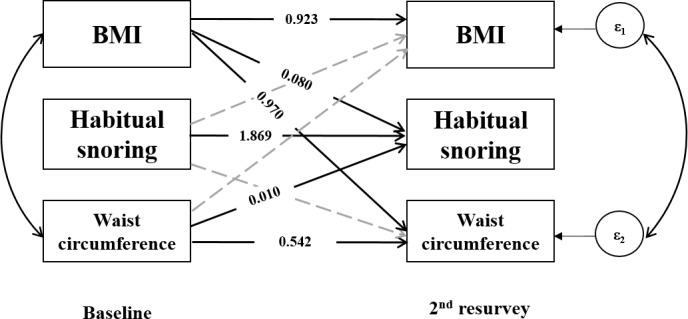
Research design and methods: The China Kadoorie Biobank study recruited 512 715 adults aged 30-79 years from 10 regions in China during 2004 and 2008. Data from 482 413 participants without baseline diabetes were analyzed in the present study. Autoregressive cross-lagged panel analysis was used to assess the longitudinal relationship between adiposity measures and habitual snoring. Cox proportional hazards models were used to examine the association between habitual snoring and diabetes risk.
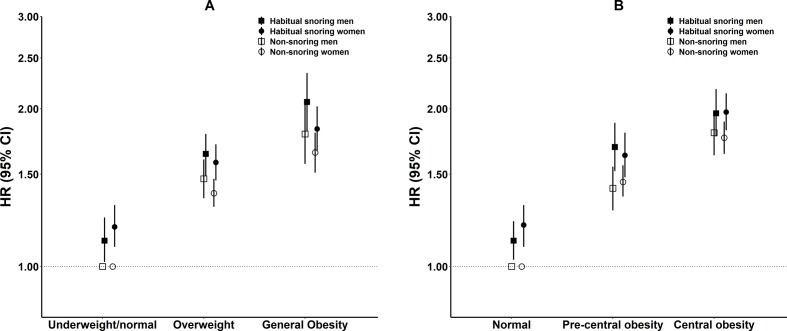
Results: Both higher body mass index and waist circumference were associated with higher risks of subsequent habitual snoring, whereas no reverse association was detected. A total of 16 479 type 2 diabetes cases were observed during a 10-year follow-up. Habitual snoring was independently associated with 12% (95% CI 6% to 18%) and 14% (95% CI 9% to 19%) higher risks of diabetes among men and women, respectively. Habitual snorers who had general obesity or central obesity were about twice as likely to develop diabetes as non-snorers at the lowest levels of adiposity measures.
Conclusion: Habitual snoring was independently associated with a higher risk of type 2 diabetes among Chinese adults. It is important to maintain both a healthy weight and a normal waist circumference to prevent or alleviate habitual snoring and ultimately prevent diabetes among Chinese adults.
Keywords: Chinese; adiposity; sleep; type 2 diabetes.
© Author(s) (or their employer(s)) 2020. Re-use permitted under CC BY-NC. No commercial re-use. See rights and permissions. Published by BMJ.
Conflict of interest statement
Competing interests: None declared.
Figures

References
-
- GBD 2017 Disease and Injury Incidence and Prevalence Collaborators Global, regional, and national incidence, prevalence, and years lived with disability for 354 diseases and injuries for 195 countries and territories, 1990-2017: a systematic analysis for the global burden of disease study 2017. Lancet 2018;392:1789–858. 10.1016/S0140-6736(18)32279-7 - DOI - PMC - PubMed
-
- Whyte KF, Allen MB, Jeffrey AA, et al. Clinical features of the sleep apnoea/hypopnoea syndrome. Q J Med 1989;72:659–66. - PubMed
-
- Aldrich MS. Sleep medicine. New York: Oxford University Press, 1999.
Publication types
MeSH terms
Grants and funding
LinkOut - more resources
Full Text Sources
Medical