Falls in older aged adults in 22 European countries: incidence, mortality and burden of disease from 1990 to 2017
- PMID: 32111726
- PMCID: PMC7571349
- DOI: 10.1136/injuryprev-2019-043347
Falls in older aged adults in 22 European countries: incidence, mortality and burden of disease from 1990 to 2017
Abstract
Introduction: Falls in older aged adults are an important public health problem. Insight into differences in fall-related injury rates between countries can serve as important input for identifying and evaluating prevention strategies. The objectives of this study were to compare Global Burden of Disease (GBD) 2017 estimates on incidence, mortality and disability-adjusted life years (DALYs) due to fall-related injury in older adults across 22 countries in the Western European region and to examine changes over a 28-year period.
Methods: We performed a secondary database descriptive study using the GBD 2017 results on age-standardised fall-related injury in older adults aged 70 years and older in 22 countries from 1990 to 2017.
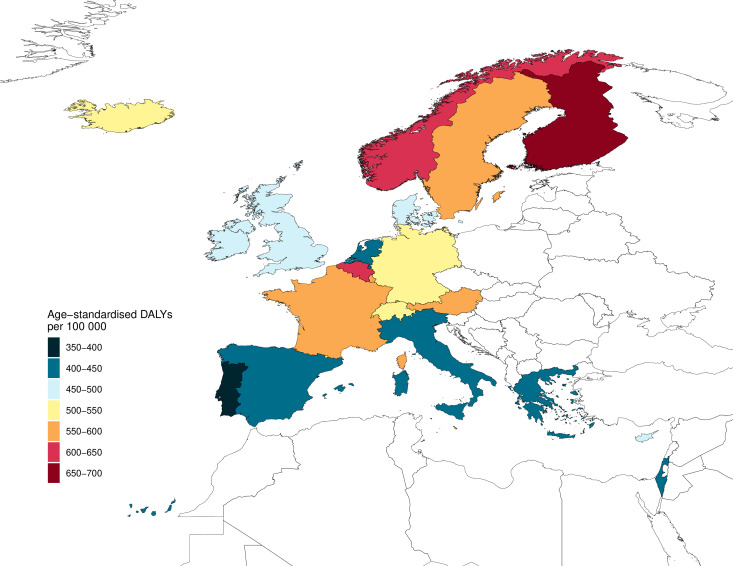
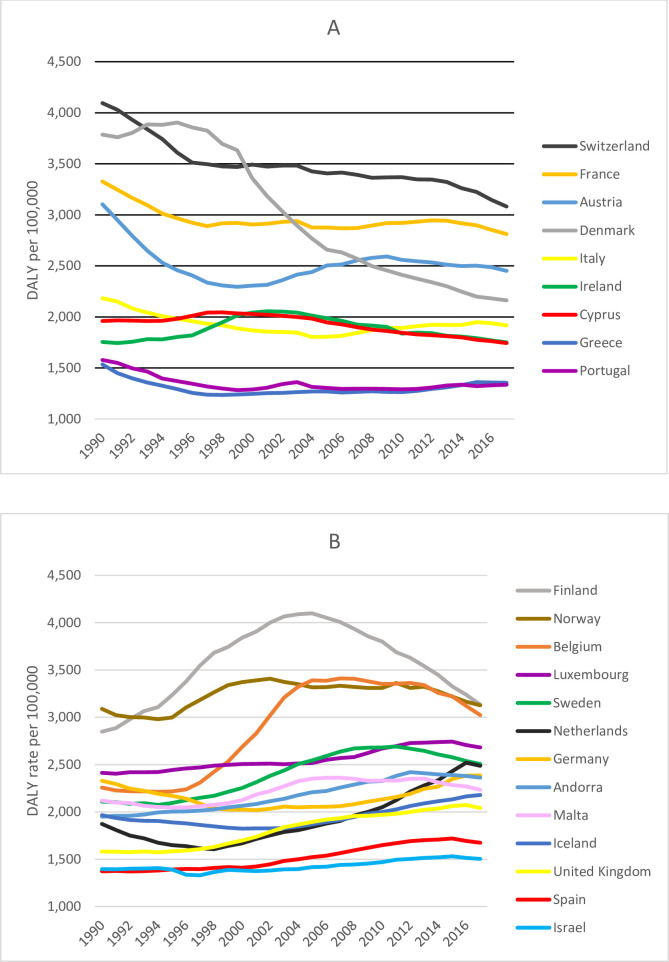
Results: In 2017, in the Western European region, 13 840 per 100 000 (uncertainty interval (UI) 11 837-16 113) older adults sought medical treatment for fall-related injury, ranging from 7594 per 100 000 (UI 6326-9032) in Greece to 19 796 per 100 000 (UI 15 536-24 233) in Norway. Since 1990, fall-related injury DALY rates showed little change for the whole region, but patterns varied widely between countries. Some countries (eg, Belgium and Netherlands) have lost their favourable positions due to an increasing fall-related injury burden of disease since 1990.
Conclusions: From 1990 to 2017, there was considerable variation in fall-related injury incidence, mortality, DALY rates and its composites in the 22 countries in the Western European region. It may be useful to assess which fall prevention measures have been taken in countries that showed continuous low or decreasing incidence, death and DALY rates despite ageing of the population.
Keywords: burden of disease; disability; metanalysis; time series.
© Author(s) (or their employer(s)) 2020. Re-use permitted under CC BY. Published by BMJ.
Conflict of interest statement
Competing interests: Dr. Briggs reports grants from Australian National Health and Medical Research Council, outside the submitted work. Professor Cooper reports personal fees from Alliance for Better Bone Health, Amgen, Eli Lilly, GSK, Medtronic, Merck, Novartis, Pfizer, Roche, Servier, Takeda and UCB. Dr. Haro reports personal fees from Lundbeck and from Roche, and that the institution for which they work provides scientific work for Eli Lilly and Co. Dr. James reports grants from Sanofi Pasteur, outside the submitted work.
Figures
References
Publication types
MeSH terms
Grants and funding
LinkOut - more resources
Full Text Sources
Medical