


Dose-Dependent Increases in Ellagitannin Metabolites as Biomarkers of Intake in Humans Consuming Standardized Black Raspberry Food Products Designed for Clinical Trials
- PMID: 32112501
- PMCID: PMC9496378
- DOI: 10.1002/mnfr.201900800
Dose-Dependent Increases in Ellagitannin Metabolites as Biomarkers of Intake in Humans Consuming Standardized Black Raspberry Food Products Designed for Clinical Trials
Abstract
Scope: Black raspberry (BRB) phytochemicals demonstrate anti-carcinogenic properties in experimental models, including prostate cancer. Two BRB foods, a confection and nectar, providing a consistent and reproducible product for human clinical studies are designed and characterized.
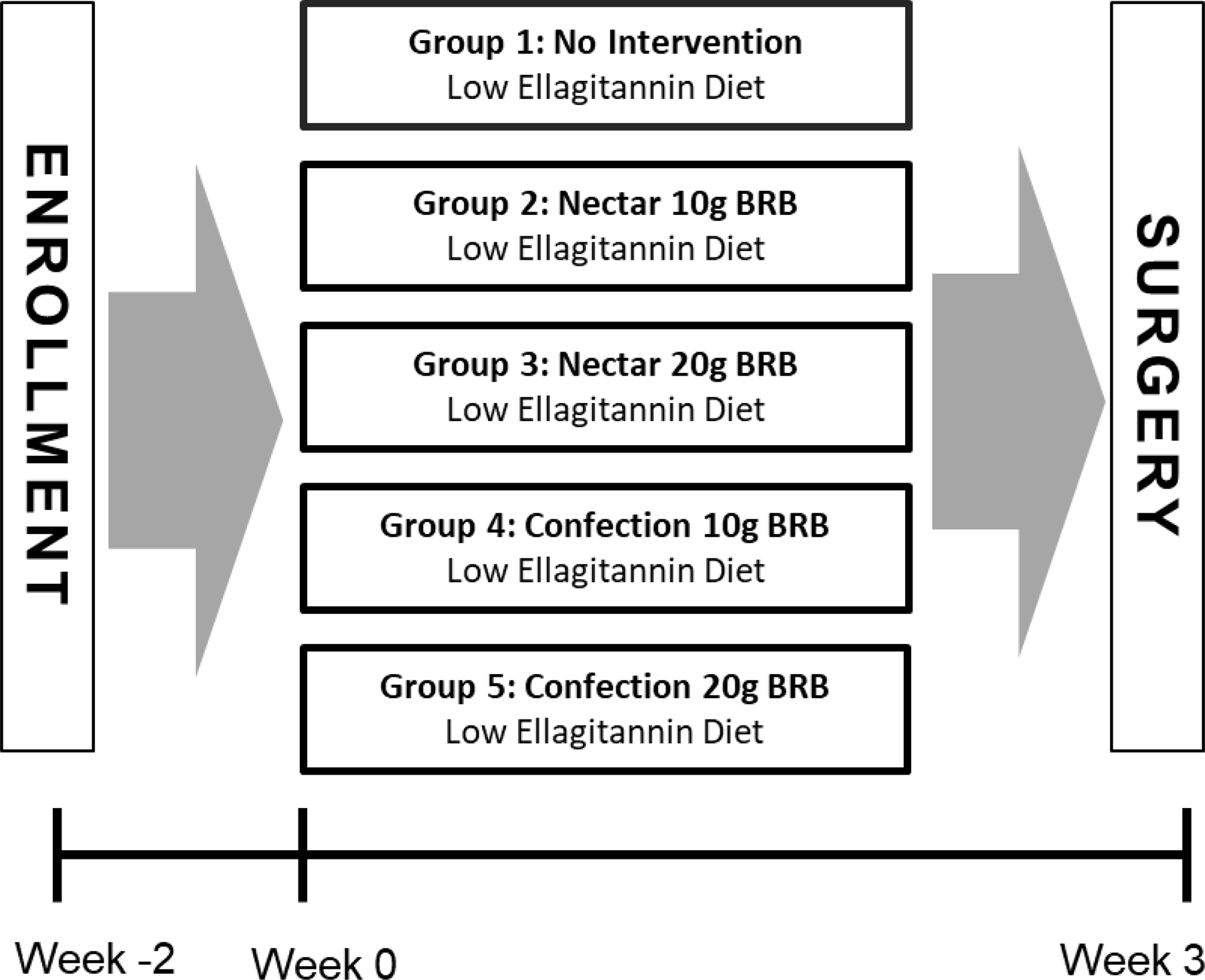
Methods and results: Men with clinically localized prostate cancer are sequentially enrolled to a control group or one of four intervention groups (confection or nectar, 10 or 20 g dose; n = 8 per group) for 4 weeks prior to prostatectomy. Primary outcomes include: safety, adherence, and ellagitannin metabolism. Adherence to the intervention is >96%. No significant (≥grade II) toxicities are detected. Urinary urolithins (A, B, C, and D) and dimethyl ellagic acid (DMEA) quantified by Ultra high performance liquid chromatography tandem mass spectroscopy (UPLC/MS/MS) indicate a dose-dependent excretion yet heterogeneous patterns among men. Men in the BRB confection groups have greater urinary excretion of the microbial urinary metabolites urolithin A and DMEA, suggesting that this food matrix provides greater colonic microflora exposure.
Conclusion: Fully characterized BRB confections and nectar are ideal for food-based large phase III human clinical studies. BRB products provide a bioavailable source of BRB phytochemicals, however large inter individual variation in polyphenol metabolism suggests that host genetics, microflora, and other factors are critical to understanding bioactivity and metabolism.
Keywords: black raspberries; ellagitannins; polyphenol explorer database; polyphenols; urolithins.
© 2020 WILEY-VCH Verlag GmbH & Co. KGaA, Weinheim.
Conflict of interest statement
Conflict of Interest:
The authors declare no conflict of interest.
Figures


References
-
- Tresserra-Rimbau A, Rimm EB, Medina-Remon A, Martinez-Gonzalez MA, Lopez-Sabater MC, Covas MI, Corella D, Salas-Salvado J, Gomez-Gracia E, Lapetra J, Aros F, Fiol M, Ros E, Serra-Majem L, Pinto X, Munoz MA, Gea A, Ruiz-Gutierrez V, Estruch R, Lamuela-Raventos RM, and Investigators PS, Polyphenol intake and mortality risk: a re-analysis of the PREDIMED trial. BMC Med, 2014. 12: p. 77. - PMC - PubMed
-
- Zamora-Ros R, Knaze V, Rothwell JA, Hemon B, Moskal A, Overvad K, Tjonneland A, Kyro C, Fagherazzi G, Boutron-Ruault MC, Touillaud M, Katzke V, Kuhn T, Boeing H, Forster J, Trichopoulou A, Valanou E, Peppa E, Palli D, Agnoli C, Ricceri F, Tumino R, de Magistris MS, Peeters PH, Bueno-de-Mesquita HB, Engeset D, Skeie G, Hjartaker A, Menendez V, Agudo A, Molina-Montes E, Huerta JM, Barricarte A, Amiano P, Sonestedt E, Nilsson LM, Landberg R, Key TJ, Khaw KT, Wareham NJ, Lu Y, Slimani N, Romieu I, Riboli E, and Scalbert A, Dietary polyphenol intake in Europe: the European Prospective Investigation into Cancer and Nutrition (EPIC) study. Eur J Nutr, 2015. - PMC - PubMed
-
- Tresserra-Rimbau A, Guasch-Ferre M, Salas-Salvado J, Toledo E, Corella D, Castaner O, Guo X, Gomez-Gracia E, Lapetra J, Aros F, Fiol M, Ros E, Serra-Majem L, Pinto X, Fito M, Babio N, Martinez-Gonzalez MA, Sorli JV, Lopez-Sabater MC, Estruch R, Lamuela-Raventos RM, and P.s. investigators, Intake of Total Polyphenols and Some Classes of Polyphenols Is Inversely Associated with Diabetes in Elderly People at High Cardiovascular Disease Risk. J Nutr, 2016. - PubMed
-
- Castro-Acosta ML, Sanders TAB, Reidlinger DP, Darzi J, and Hall WL, Adherence to UK dietary guidelines is associated with higher dietary intake of total and specific polyphenols compared with a traditional UK diet: further analysis of data from the Cardiovascular risk REduction Study: Supported by an Integrated Dietary Approach (CRESSIDA) randomised controlled trial. Br J Nutr, 2019. 121(4): p. 402–415. - PubMed
Publication types
MeSH terms
Substances
Grants and funding
LinkOut - more resources
Full Text Sources
Medical
