Review
. 2020 Sep 7;59(37):15818-15833.
doi: 10.1002/anie.201916390. Epub 2020 Jun 3.

Challenges and Perspectives of DNA Nanostructures in Biomedicine

Affiliations
Review

Challenges and Perspectives of DNA Nanostructures in Biomedicine

Adrian Keller et al. Angew Chem Int Ed Engl. .

Abstract

DNA nanotechnology holds substantial promise for future biomedical engineering and the development of novel therapies and diagnostic assays. The subnanometer-level addressability of DNA nanostructures allows for their precise and tailored modification with numerous chemical and biological entities, which makes them fit to serve as accurate diagnostic tools and multifunctional carriers for targeted drug delivery. The absolute control over shape, size, and function enables the fabrication of tailored and dynamic devices, such as DNA nanorobots that can execute programmed tasks and react to various external stimuli. Even though several studies have demonstrated the successful operation of various biomedical DNA nanostructures both in vitro and in vivo, major obstacles remain on the path to real-world applications of DNA-based nanomedicine. Here, we summarize the current status of the field and the main implementations of biomedical DNA nanostructures. In particular, we focus on open challenges and untackled issues and discuss possible solutions.

Keywords: DNA nanotechnology; biocompatibility; diagnostics; drug delivery; nanomedicine.


Conflict of interest statement

The authors declare no conflict of interest.

Figures
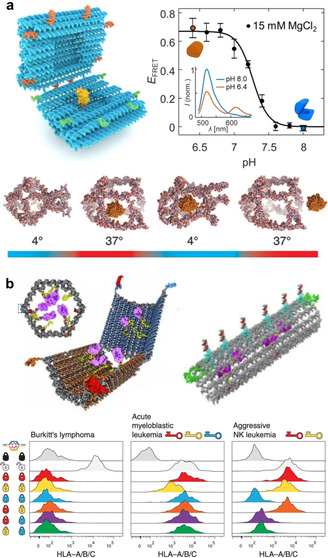
Figure 1
Figure 1
Dynamic devices for therapeutics. a) DNA nanocarriers for enzyme encapsulation and display. Top panel: A pH‐switchable DO nanocapsule that can be reversibly closed and opened. Closing and opening is characterized using Förster‐resonance energy transfer (FRET). Bottom panel: A temperature‐responsive DNA cage for enzyme trapping and release. b) DO nanorobots. Top left panel: An antibody‐loaded logic‐gated shell‐like robot. Bottom panel: Different lock and key combinations of logic‐gated robots analyzed by flow cytometry. Top right panel: A thrombin‐loaded tubular nanorobot that opens through interaction between nucleolin proteins and “fastener” strands. a) Top panel reproduced with permission from ref. 31 (https://pubs.acs.org/doi/10.1021/acsnano.9b01857). Copyright 2019 American Chemical Society. Further permissions related to the material excerpted should be directed to the American Chemical Society. Bottom panel reproduced with permission from ref. 33. Copyright 2013 American Chemical Society. b) Top left panel and bottom panel reproduced with permission from ref. 41. Copyright 2012 AAAS. Top right panel reproduced with permission from ref. 40 Copyright 2018 Springer Nature.
Figure 2
Figure 2
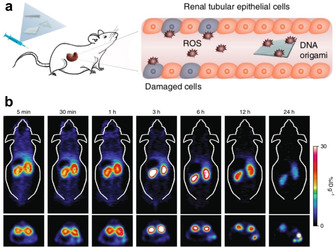
DN against acute kidney injury (AKI). a) Schematics of using non‐modified DO as therapeutics in mice: Rectangular DO alleviate AKI via scavenging of reactive oxygen species (ROS). b) Positron‐emission tomography (PET) shows rapid accumulation of 64Cu‐labeled DO in the kidneys of mice with AKI. Reproduced with permission from ref. 55. Copyright 2018 Springer Nature.
Figure 3
Figure 3
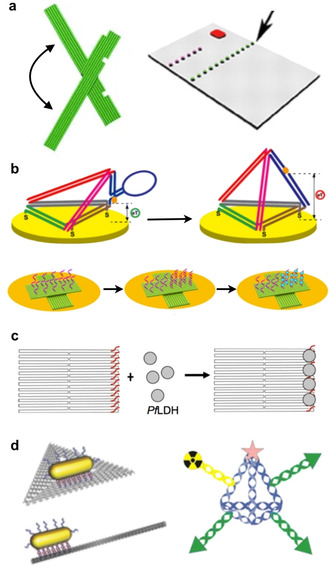
DN‐based diagnostics and imaging. a) DN for AFM‐based microRNA (miRNA) detection. Right panel: A rectangular DO template. Left panel: A dynamic plier‐like DO. b) Electrochemical nucleic‐acid detection using DN. Top panel: Switchable DT at a gold electrode. Bottom panel: DO‐based electrochemical miRNA platform. c) A DO for the aptamer‐based detection of a malaria protein biomarker. d) DN for imaging applications. Left panel: DO with gold nanorods for two‐photon luminescence. Right panel: A DT labeled with near‐infrared emitters and a radioactive Tc isotope. a) Right panel reproduced with permission from ref. 57. Copyright 2008 AAAS. Left panel reproduced with permission from ref. 59. Copyright 2011 Springer Nature. b) Top panel reproduced with permission from ref. 67. Copyright 2014 American Chemical Society. Bottom panel reproduced with permission from ref. 68 (https://pubs.acs.org/doi/10.1021/acsomega.9b01166). Copyright 2019 American Chemical Society. Further permissions related to the material excerpted should be directed to the American Chemical Society. c) Reproduced with permission from ref. 70. d) Left panel reproduced with permission from ref. 49. Copyright 2015 John Wiley and Sons. Right panel reproduced with permission from ref. 71. Copyright 2016 American Chemical Society.
Figure 4
Figure 4
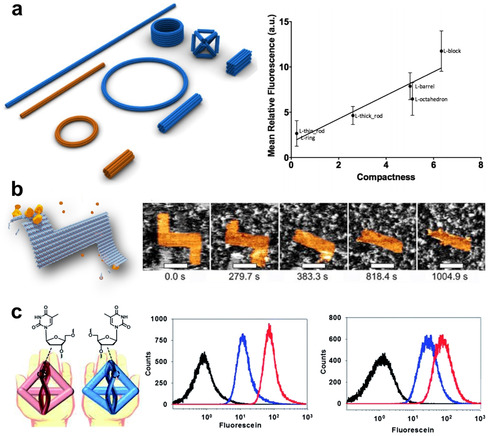
Design factors that affect DN delivery and stability. a) Left panel: DO with varied shapes and masses for studying their cellular uptake. Right panel: The results indicate enhanced delivery with increasing compactness of the DN. b) DO under DNase‐I attack analyzed in real time using high‐speed AFM. c) DT with bioorthogonal base‐pairing systems, l‐DT (red) design enhances HeLa (left) and NIH‐3T3 (right) intracellular delivery and outperforms d‐DT (blue), as shown by flow cytometry (untreated cells shown in black). a) Reproduced with permission from ref. 111. Copyright 2018 American Chemical Society. b) Reproduced with permission from ref. 107. Copyright 2019 John Wiley and Sons. c) Reproduced with permission from ref. 113.
Figure 5
Figure 5
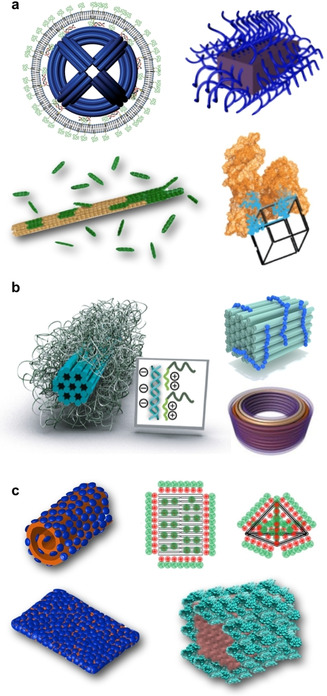
External modifications of DN. a) Coating and healing strategies for various DNA shapes using direct DNA linking. Top left panel: A sphere‐like DO with virus‐inspired lipid coating. Top right panel: A dendritic oligo‐coated DNA brick. Bottom left panel: A DNA nanotube that self‐heals in serum. Bottom right panel: A HSA‐equipped DNA cube. b) Electrostatic polymer coating of DO. Left panel: Reversible cationic polymer coating of a DNA bundle. Top right panel: A cationic polymer‐coated DNA brick. Bottom right panel: An oligolysine‐coated barrel‐like DO. c) Peptide and protein‐coated DN. Left panels: A rectangular DO complexed with virus capsid proteins yielding different morphologies. Top right panel: Rectangular and tetrahedral DN with diblock polypeptides. Bottom right panel: A bovine serum albumin (BSA)‐coated brick‐like DO. a) Top left panel reproduced with permission from ref. 85 (https://pubs.acs.org/doi/10.1021/nn5011914). Copyright 2014 American Chemical Society. Further permissions related to the material excerpted should be directed to the American Chemical Society. Top right panel reproduced with permission from ref. 117. Bottom left panel reproduced with permission from ref. 119. Copyright 2019 American Chemical Society. Bottom right panel reproduced with permission from ref. 120. Copyright 2017 American Chemical Society. b) Left panel reproduced with permission from ref. 121. Copyright 2017 John Wiley and Sons. Top right panel reproduced with permission from ref. 28. Bottom right panel reproduced with permission from ref. 86. c) Left panel reproduced with permission from ref. 122. Copyright 2014 American Chemical Society. Top right panel reproduced with permission from ref. 123. Copyright 2017 American Chemical Society. Bottom right panel reproduced with permission from ref. 106.
Figure 6
Figure 6
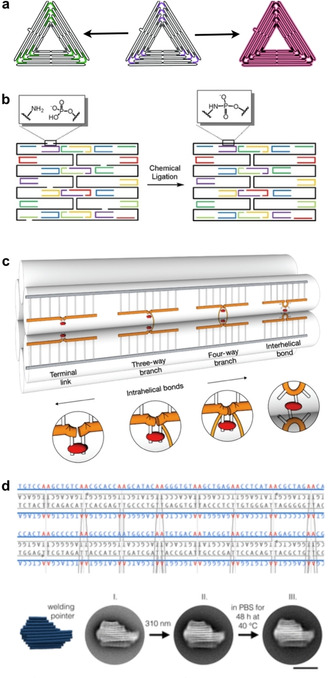
Enzymatic and chemical modifications of DN. a) Redesigned (left) and ligated (right) DO triangles for enhanced stability. b) Chemical ligation of a rectangular DO tile. c) DO staples are crosslinked by forming covalent UV‐induced cyclobutane pyrimidine dimers between thymine bases. d) Top panel: Combination of design and chemistry: a custom scaffold allows tailored UV‐crosslinking throughout a DO. Bottom panel: After the UV‐treatment the DO pointer structure retains its shape when incubated for 48 h in low ionic strength phosphate‐buffered saline (PBS) at 40 °C. a) Reproduced with permission from ref. 130. b) Reproduced with permission from ref. 133. Copyright 2014 John Wiley and Sons. c) Reproduced with permission from ref. 135. d) Reproduced with permission from ref. 136. Copyright 2019 American Chemical Society.

References

    1. None
    1. Bathe M., Rothemund P. W. K., MRS Bull. 2017, 42, 882;
    1. Jones M. R., Seeman N. C., Mirkin C. A., Science 2015, 347, 1260901. - PubMed
    1. None
    1. Ijäs H., Nummelin S., Shen B., Kostiainen M. A., Linko V., Int. J. Mol. Sci. 2018, 19, 2114; - PMC - PubMed

Publication types

LinkOut - more resources