


Reproductive and hormonal factors and risk of cognitive impairment among Singapore Chinese women
- PMID: 32112728
- PMCID: PMC7483640
- DOI: 10.1016/j.ajog.2020.02.032
Reproductive and hormonal factors and risk of cognitive impairment among Singapore Chinese women
Abstract
Background: Epidemiologic studies suggest that declining estrogen levels in menopause may play an important role in the pathogenesis of dementia and contribute to increased risk of cognitive impairment in women. Most previous studies have been conducted in Western populations to investigate the relationship of the length of reproductive periods and use of hormone-replacement therapy with risk of cognitive function and dementia, but the findings are inconclusive. Relevant evidence among Asian populations is limited.
Objectives: To evaluate the association between reproductive and hormonal factors and the risk of cognitive impairment in Chinese women with natural menopause.
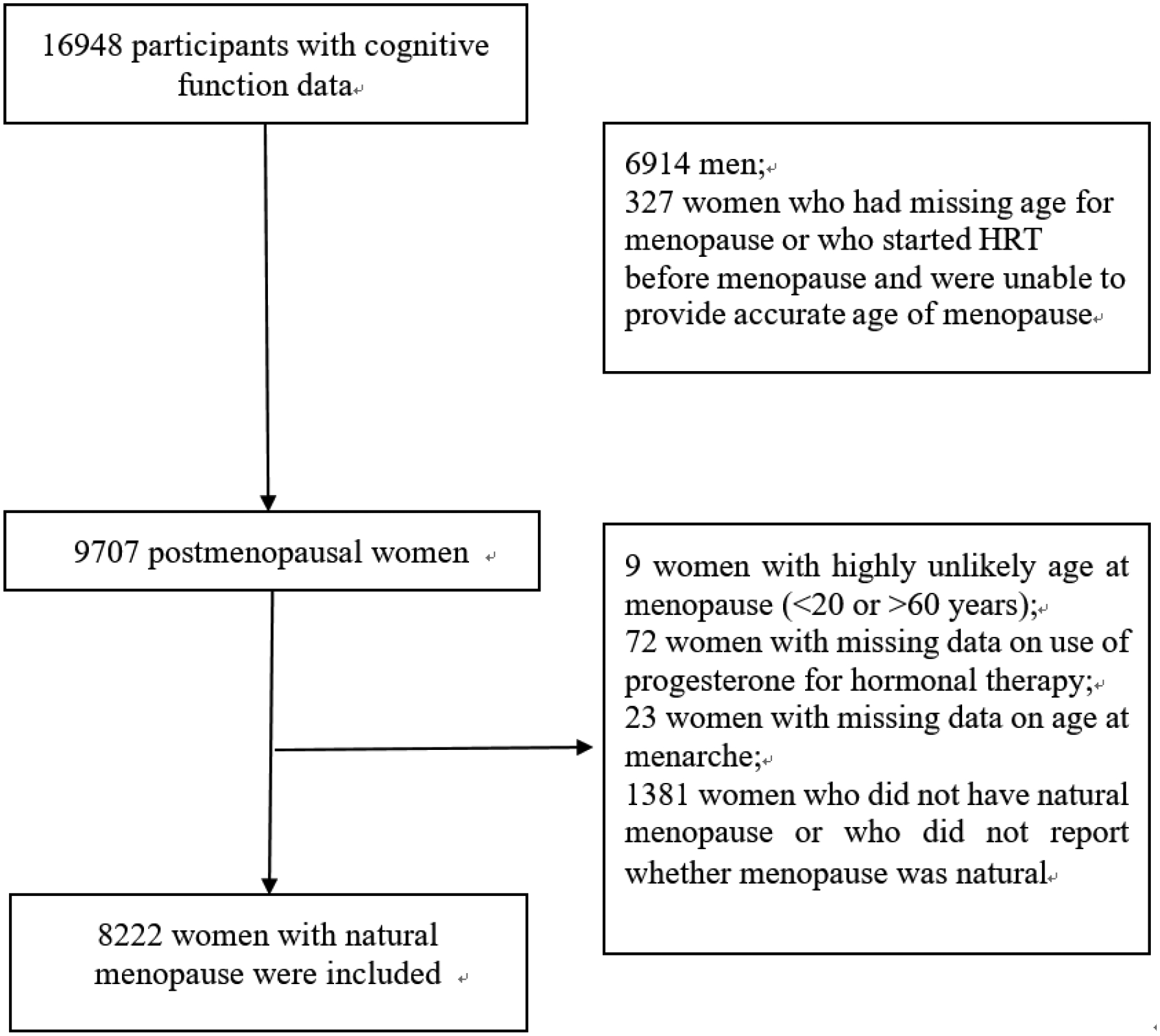
Study design: The Singapore Chinese Health Study is a population-based study that recruited participants aged 45-74 years between 1993 and 1998, and the current study included 8222 women from this cohort who had natural menopause, complete data on reproductive factors and hormonal therapies at baseline (1993-1998), follow-up 1 (1999-2004) and follow-up 2 interviews (2006-2010), and cognitive function evaluated at ages 61-96 years using the Singapore Modified Mini-Mental State Examination during the follow-up 3 visits (2014-2016). Multivariable logistic regression models were used to estimate odds ratios and 95% confidence intervals for the risk of cognitive impairment.
Results: Compared with women with menopause at 50-54 years of age, the odds ratios (95% confidence interval) were 1.67 (1.32-2.11), 1.24 (1.08-1.44), and 1.06 (0.87- 1.29) for women who experienced menopause before 45 years, at 45-49 years of age, and after 54 years, respectively. Compared with women with 35-39 reproductive years from menarche to menopause, the odds ratios (95% confidence interval) were 1.28 (1.11-1.48) for women with <35 reproductive years. Furthermore, compared with women who had 1-2 children, the odds ratios (95% confidence interval) were 1.27 (1.04-1.55) for women who had more than 5 children, and the risk increased significantly by 5% per child birth (odds ratio, 1.05; 95% confidence interval, 1.01-1.09). Compared with those who had never used oral contraceptives, women with short-term use (≤5 years) of oral contraceptives had 26% lower odds of having cognitive impairment (odds ratio, 0.74; 95% confidence interval, 0.63-0.87), whereas the association was not statistically significant for those used for more than 5 years (odds ratio, 0.87; 95% confidence interval, 0.68-1.13). Women who used hormone-replacement therapy had a 39% lower odd of getting cognitive impairment compared with nonusers (odds ratio, 0.61; 95% confidence interval, 0.46-0.80).
Conclusion: Our data suggest that shorter reproductive years and greater parity were associated with a greater risk of cognitive impairment in late life, whereas the use of oral contraceptives and hormone-replacement therapy was associated with decreased risk. As the population ages, understanding how these factors affect late-life cognitive function in women may help health professionals develop preventive measures targeting lifetime estrogen exposure from endogenous or exogenous sources.
Keywords: age at menopause; cognitive impairment; hormonal therapies; parity; reproductive factors.
Copyright © 2020 Elsevier Inc. All rights reserved.
Conflict of interest statement
References
-
- Alzheimer’s Disease International. World Alzheimer report 2018: The state of the art of dementia research: New frontiers. Available at: https://www.alz.co.uk/research/world-report-2018. Accessed June 23, 2019.
-
- Andersen K, Launer LJ, Dewey ME, et al. Gender differences in the incidence of AD and vascular dementia: The EURODEM Studies. EURODEM Incidence Research Group. Neurology 1999;53:1992–7. - PubMed
-
- Gao S, Hendrie HC, Hall KS. The relationships between age, sex, and the incidence of dementia and Alzheimer disease - A meta-analysis. Arch Gen Psychiatry 1998;55:809–15. - PubMed
-
- Heys M, Jiang C, Cheng KK, et al. Life long endogenous estrogen exposure and later adulthood cognitive function in a population of naturally postmenopausal women from Southern China: the Guangzhou Biobank Cohort Study. Psychoneuroendocrinology 2011;36:864–73. - PubMed
Publication types
MeSH terms
Substances
Grants and funding
LinkOut - more resources
Full Text Sources
Other Literature Sources
Medical
Research Materials
