


Unmet needs and behaviour during the Ebola response in Sierra Leone: a retrospective, mixed-methods analysis of community feedback from the Social Mobilization Action Consortium
- PMID: 32112750
- PMCID: PMC8180180
- DOI: 10.1016/S2542-5196(20)30008-5
Unmet needs and behaviour during the Ebola response in Sierra Leone: a retrospective, mixed-methods analysis of community feedback from the Social Mobilization Action Consortium
Abstract
Background: The west African Ebola epidemic (2014-15) necessitated behaviour change in settings with prevalent and pre-existing unmet needs as well as extensive mechanisms for local community action. We aimed to assess spatial and temporal trends in community-reported needs and associations with behaviour change, community engagement, and the overall outbreak situation in Sierra Leone.
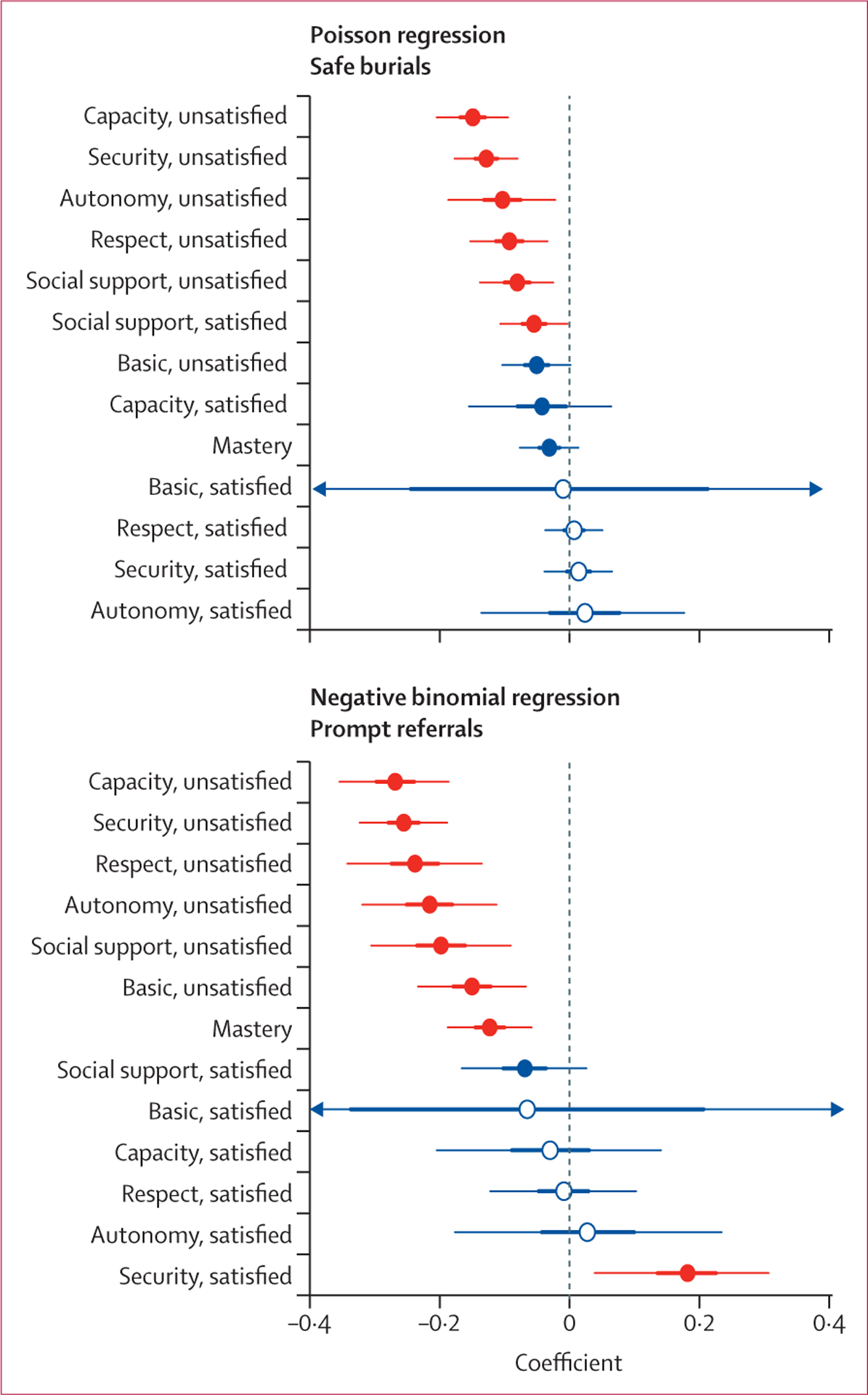
Methods: We did a retrospective, mixed-methods study. Post-hoc analyses of data from 12 096 mobiliser visits as part of the Social Mobilization Action Consortium were used to describe the evolution of satisfied and unsatisfied needs (basic, security, autonomy, respect, and social support) between Nov 12, 2014, and Dec 18, 2015, and across 14 districts. Via Bayesian hierarchical regression modelling, we investigated associations between needs categories and behaviours (numbers of individuals referred to treatment within 24 h of symptom onset or deaths responded to with safe and dignified burials) and the role of community engagement programme status (initial vs follow-up visit) in the association between satisfied versus unsatisfied needs and behaviours.
Findings: In general, significant associations were observed between unsatisfied needs categories and both prompt referrals to treatment and safe burials. Most notably, communities expressing unsatisfied capacity needs reported fewer safe burials (relative risk [RR] 0·86, 95% credible interval [CrI] 0·82-0·91) and fewer prompt referrals to treatment (RR 0·76, 0·70-0·83) than did those without unsatisfied capacity needs. The exception was expression of unsatisfied basic needs, which was associated with significantly fewer prompt referrals only (RR 0·86, 95% CrI 0·79-0·93). Compared with triggering visits by community mobilisers, follow-up visits were associated with higher numbers of prompt referrals (RR 1·40, 95% CrI 1·30-1·50) and safe burials (RR 1·08, 1·02-1·14).
Interpretation: Community-based development of locally feasible, locally owned action plans, with the support of community mobilisers, has potential to address unmet needs for more sustained behaviour change in outbreak settings.
Funding: Bill & Melinda Gates, Bill & Melinda Gates Foundation, and National Institutes of Health.
Copyright © 2020 The Author(s). Published by Elsevier Ltd. This is an Open Access article under the CC BY 4.0 license. Published by Elsevier Ltd.. All rights reserved.
Conflict of interest statement
Declaration of interests
We declare no competing interests.
Figures

Similar articles
-
Community engagement in outbreak response: lessons from the 2014-2016 Ebola outbreak in Sierra Leone.BMJ Glob Health. 2020 Aug;5(8):e002145. doi: 10.1136/bmjgh-2019-002145. BMJ Glob Health. 2020. PMID: 32830128 Free PMC article. Review.
-
Facilitators and Barriers to Community Acceptance of Safe, Dignified Medical Burials in the Context of an Ebola Epidemic, Sierra Leone, 2014.J Health Commun. 2017;22(sup1):24-30. doi: 10.1080/10810730.2016.1209601. J Health Commun. 2017. PMID: 28854130
-
Improving burial practices and cemetery management during an Ebola virus disease epidemic - Sierra Leone, 2014.MMWR Morb Mortal Wkly Rep. 2015 Jan 16;64(1):20-7. MMWR Morb Mortal Wkly Rep. 2015. PMID: 25590682 Free PMC article.
-
Cluster of Ebola Virus Disease Linked to a Single Funeral - Moyamba District, Sierra Leone, 2014.MMWR Morb Mortal Wkly Rep. 2016 Mar 4;65(8):202-5. doi: 10.15585/mmwr.mm6508a2. MMWR Morb Mortal Wkly Rep. 2016. PMID: 26938950
-
Integrated digital system for community engagement and community-based surveillance during the 2014-2016 Ebola outbreak in Sierra Leone: lessons for future health emergencies.BMJ Glob Health. 2020 Dec;5(12):e003936. doi: 10.1136/bmjgh-2020-003936. BMJ Glob Health. 2020. PMID: 33355270 Free PMC article. Review.
Cited by
-
Community engagement in outbreak response: lessons from the 2014-2016 Ebola outbreak in Sierra Leone.BMJ Glob Health. 2020 Aug;5(8):e002145. doi: 10.1136/bmjgh-2019-002145. BMJ Glob Health. 2020. PMID: 32830128 Free PMC article. Review.
-
Behaviour adoption approaches during public health emergencies: implications for the COVID-19 pandemic and beyond.BMJ Glob Health. 2021 Jan;6(1):e004450. doi: 10.1136/bmjgh-2020-004450. BMJ Glob Health. 2021. PMID: 33514594 Free PMC article. Review.
-
The effectiveness of the Sierra Leone health sector's response to COVID-19: a quantitative analysis.BMC Health Serv Res. 2025 Mar 12;25(1):367. doi: 10.1186/s12913-025-12477-3. BMC Health Serv Res. 2025. PMID: 40075349 Free PMC article.
-
Coordinated support for local action: Modeling strategies to facilitate behavior adoption in urban-poor communities of Liberia for sustained COVID-19 suppression.Epidemics. 2021 Dec;37:100529. doi: 10.1016/j.epidem.2021.100529. Epub 2021 Nov 22. Epidemics. 2021. PMID: 34871942 Free PMC article.
-
Novel strategies to support global promotion of COVID-19 vaccination.BMJ Glob Health. 2021 Oct;6(10):e006066. doi: 10.1136/bmjgh-2021-006066. BMJ Glob Health. 2021. PMID: 34649869 Free PMC article.
References
-
- Fallah M, Dahn B, Nyenswah TG, et al. Interrupting Ebola transmission in Liberia through community-based initiatives. Ann Intern Med 2016; 164: 367–69. - PubMed
-
- Calain P, Poncin M. Reaching out to Ebola victims: coercion, persuasion or an appeal for self-sacrifice? Soc Sci Med 2015; 147: 126–33. - PubMed
-
- United Nations Development Programme. The 2018 global multidimensional poverty index (MPI). http://hdr.undp.org/en/2018-MPI (accessed Jan 4, 2019).
-
- United Nations Development Programme. Human development reports 1990–2019. http://www.hdr.undp.org/en/global-reports (accessed March 18, 2019).
-
- Le Marcis F, Enria L, Abramowitz S, Saez AM, Faye SLB. Three acts of resistance during the 2014–16 West Africa Ebola epidemic: a focus on community engagement. J Humanit Aff 2019; 1: 23–31.
Publication types
MeSH terms
Grants and funding
LinkOut - more resources
Full Text Sources
Medical
Research Materials
