. 2020;10(1):149-170.
doi: 10.1016/j.jcmgh.2020.02.005. Epub 2020 Feb 26.

A Physiology-Based Model of Bile Acid Distribution and Metabolism Under Healthy and Pathologic Conditions in Human Beings

Affiliations

A Physiology-Based Model of Bile Acid Distribution and Metabolism Under Healthy and Pathologic Conditions in Human Beings

Veronika Voronova et al. Cell Mol Gastroenterol Hepatol. 2020.

Abstract

Background & aims: Disturbances of the enterohepatic circulation of bile acids (BAs) are seen in a number of clinically important conditions, including metabolic disorders, hepatic impairment, diarrhea, and gallstone disease. To facilitate the exploration of underlying pathogenic mechanisms, we developed a mathematical model built on quantitative physiological observations across different organs.

Methods: The model consists of a set of kinetic equations describing the syntheses of cholic, chenodeoxycholic, and deoxycholic acids, as well as time-related changes of their respective free and conjugated forms in the systemic circulation, the hepatoportal region, and the gastrointestinal tract. The core structure of the model was adapted from previous modeling research and updated based on recent mechanistic insights, including farnesoid X receptor-mediated autoregulation of BA synthesis and selective transport mechanisms. The model was calibrated against existing data on BA distribution and feedback regulation.

Results: According to model-based predictions, changes in intestinal motility, BA absorption, and biotransformation rates affected BA composition and distribution differently, as follows: (1) inhibition of transintestinal BA flux (eg, in patients with BA malabsorption) or acceleration of intestinal motility, followed by farnesoid X receptor down-regulation, was associated with colonic BA accumulation; (2) in contrast, modulation of the colonic absorption process was predicted to not affect the BA pool significantly; and (3) activation of ileal deconjugation (eg, in patents with small intestinal bacterial overgrowth) was associated with an increase in the BA pool, owing to higher ileal permeability of unconjugated BA species.

Conclusions: This model will be useful in further studying how BA enterohepatic circulation modulation may be exploited for therapeutic benefits.

Keywords: Bile Acids; Cholesterol 7α-Hydroxylase; Farnesoid X Receptor; Fibroblast Growth Factor-19; Physiology-Based Modeling.


Figures

None
Graphical abstract
Figure 1
Figure 1
Proposed model structure. uCA and uCDCA are synthetized in the liver and undergo conjugation with glycine or taurine together with recirculated uCA, uCDCA, and uDCA. Newly conjugated gCA, tCA, gCDCA, tCDCA, gDCA, and tDCA, together with recycled conjugated BA, are secreted into the bile ducts from where they flow directly into the duodenojejunum or are stored in the gallbladder. Food intake is followed by gallbladder contraction and additional BA release into the duodenojejunum. Conjugated BAs are transported to lower regions of the gastrointestinal tract, where they are deconjugated or dehydroxylated. A minor fraction of BAs is excreted in feces. After entering into the portal vein, BAs flow into the sinusoidal space where they can be cleared by the liver or enter the systemic circulation via the hepatic vein. From the systemic circulation, BAs can return to the portal space via the mesenteric or hepatic artery. Note that additional compensatory BA fluxes activated in cholestatic liver disease (eg, cholehepatic shunt, renal BA excretion) were not considered in the model. BSEP, bile salt export pump; CL, clearance.
Figure 2
Figure 2
Model reproduction of experimental data. (A) Total BA levels across organs; experimental data shown as mean values; error bars denote 95% CIs. (B) Individual and (C) unconjugated BA fractions in different organs (BA species are identified by color, as follows: CA, light blue; CDCA, dark blue; DCA, medium blue; unconjugated BA, brown; conjugated BA, light pink). (D) Relationship between systemic FGF-19 and C4 levels (dots indicate experimental data, line indicates model predictions). Details on experimental data are reported in Table 3. (E) Observations vs model predictions: the straight line represents a perfect agreement between experimental data and calculated values. (F) Plot of weighted residuals. N denotes the number of subjects in each experiment. BD, bile duct; COL, colon; D, experimental data; DJ, duodenojejunum; FEC, feces; GB, gallbladder; IL, ileum; LIV, liver; M, model predictions; PL, plasma; PV, portal vein; WRES, weighted residuals.
Figure 3
Figure 3
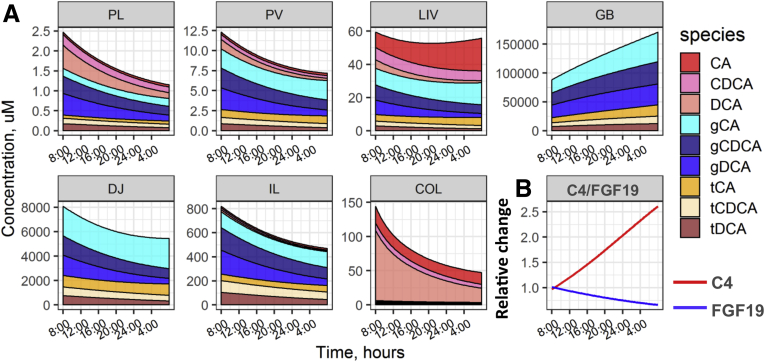
Model simulations of (A) daily dynamics of individual BAs in different compartments, (B) C4 and FGF-19 dynamics in the systemic circulation, and (C) reaction rates of BA synthesis, biotransformation, and distribution. COL, colon; DJ, duodenojejunum; GB, gallbladder; IL, ileum; LIV, liver; PL, plasma; PV, portal vein
Figure 4
Figure 4
Effects of a ±50% parameter change in daily average values on individual BA levels (A) in systemic plasma and (B) in the colonic space. (C) Systemic C4, FGF-19 normalized levels. Species are identified by color: CA, light blue; CDCA, dark blue; DCA, medium blue; FGF-19, red; C4, violet. tot, total.
Figure 5
Figure 5
Effects of pharmacologic FXR activation and efficiency of ileal BA absorption on (A) normalized C4 levels in the systemic circulation, (B) total BAs, (C) sum of CA and DCA, and (D) DCA concentration within the colon. Color reflects the severity of colonic BA accumulation: BA concentrations that may induce water secretion are marked with yellow. TBA, total BA.
Figure 6
Figure 6
(A) Daily BA dynamics in the systemic circulation, upper and lower intestine, and colon; (B) plasma C4 (solid lines) and FGF-19 (dashed lines) dynamics; (C) fractions of individual BA in bile of CST patients. BA species are identified by color, as follows: CA, light blue; CDCA, dark blue; DCA, blue. COL, colon; CST, cholecystectomy; DJ, duodenojejunum; HS, healthy subjects; IL, ileum; PL, plasma; SIBO, small intestine bacterial overgrowth; tot, total.
Figure 7
Figure 7
Model simulations of (A) daily dynamics of individual BA in different compartments, and (B) C4 and FGF-19 dynamics in the systemic circulation of subjects undergoing 24-hour fasting. COL, colon; DJ, duodenojejunum; GB, gallbladder; HS, healthy subjects; IL, ileum; LIV, liver; PL, plasma; PV, portal vein.
Figure 8
Figure 8
Comparison of ileal and colonic BA absorptions from published studies., In the original study the BA absorption rate per 25 cm of the ileum was reported; in this Figure, it was recalculated for the total organ, assuming an ileal length of 220 cm.

Comment in

References

    1. Holm R., Müllertz A., Mu H. Bile salts and their importance for drug absorption. Int J Pharm. 2013;453:44–55. - PubMed
    1. Copple B.L., Li T. Pharmacology of bile acid receptors: evolution of bile acids from simple detergents to complex signaling molecules. Pharmacol Res. 2016;104:9–21. - PMC - PubMed
    1. Sjöberg B.G., Straniero S., Angelin B., Rudling M. Cholestyramine treatment of healthy humans rapidly induces transient hypertriglyceridemia when treatment is initiated. Am J Physiol Endocrinol Metab. 2017;313:E167–E174. - PubMed
    1. Teodoro J.S., Rolo A.P., Palmeira C.M. Hepatic FXR: key regulator of whole-body energy metabolism. Trends Endocrinol Metab. 2011;22:458–466. - PubMed
    1. Walters J.R.F., Tasleem A.M., Omer O.S., Brydon W.G., Dew T., le Roux C.W. A new mechanism for bile acid diarrhea: defective feedback inhibition of bile acid biosynthesis. Clin Gastroenterol Hepatol. 2009;7:1189–1194. - PubMed

Publication types

MeSH terms

Substances