. 2020 Aug;17(8):1214-1222.
doi: 10.1080/15476286.2020.1732694. Epub 2020 Mar 1.

Novel insights into the emerging roles of tRNA-derived fragments in mammalian development

Affiliations

Novel insights into the emerging roles of tRNA-derived fragments in mammalian development

Nicola Guzzi et al. RNA Biol. 2020 Aug.

Abstract

ABTRACT tRNA-derived fragments or tRFs were long considered merely degradation intermediates of full-length tRNAs; however, emerging research is highlighting unanticipated new and highly distinct functions in epigenetic control, metabolism, immune activity and stem cell fate commitment. Importantly, recent studies suggest that RNA epitranscriptomic modifications may provide an additional regulatory layer that dynamically directs tRF activity in stem and cancer cells. In this review, we explore current work illustrating unanticipated roles of tRFs in mammalian stem cells with a focus on the impact of post-transcriptional RNA modifications for the biogenesis and function of this growing class of small noncoding RNAs.

Keywords: 5-methylcytosine; RNA epitranscriptomics; RNA modifications; development; hematopoiesis; pseudouridine; stem cells; tRNA fragments; translation control.


Figures
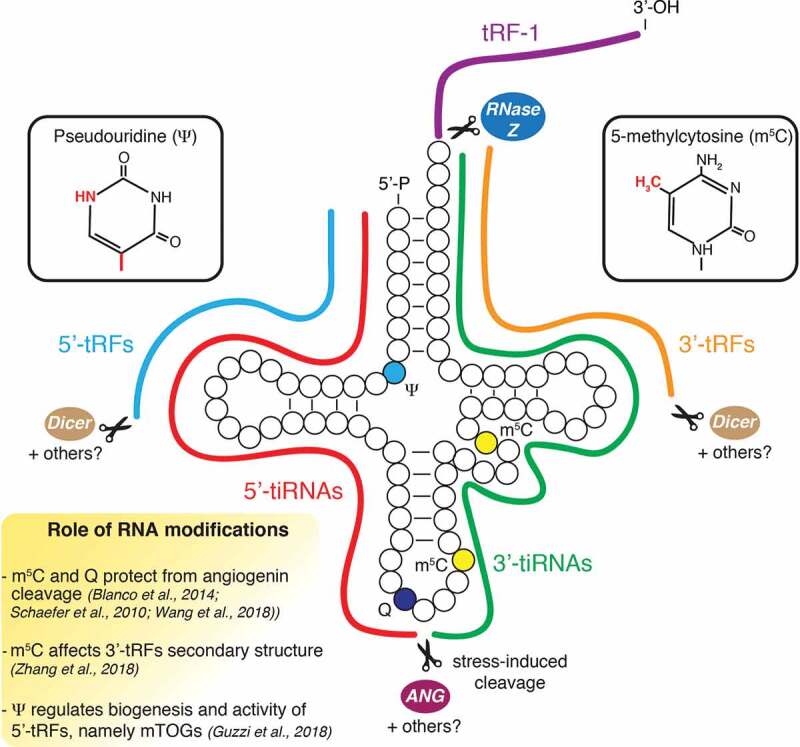
Figure 1.
Figure 1.
Regulation of tRF biogenesis in stem cells. Schematic illustrates tRF biogenesis and epitranscriptomic modifications. Dicer and possibly other ribonucleases not yet identified have been proposed to modulate the production of 5ʹ- and 3ʹ-tRFs. Angiogenin (ANG) induces cleavage of tRNAs in the anticodon loop in response to stress conditions to promote the accumulation of 5ʹ- and 3ʹ-tiRNAs. 5-methylcytosine (m5C) and queuosine (Q) modulate angiogenin activity and may impact 3ʹ-tRF secondary structure. Pseudouridine (ψ) is necessary for the biogenesis and activity of a specific class of 5ʹ-tRFs (mTOGs) in stem cells.
Figure 2.
Figure 2.
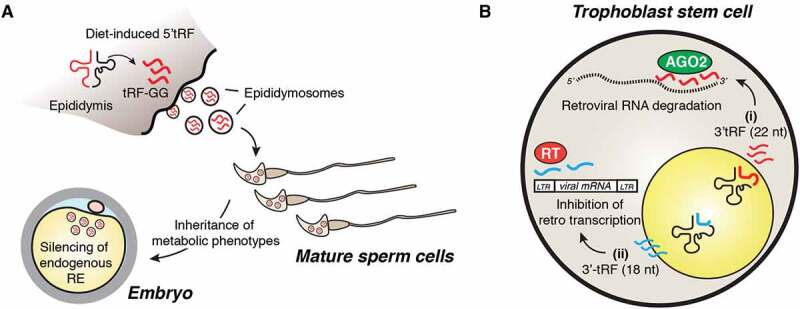
tRF function in epigenetic silencing during early embryogenesis. (A) tRFs mediate intergenerational transmission of metabolic phenotypes. 5ʹ-tRFs including tRF-GG, exhibit a two-three fold increase in somatic epididymis cells upon dietary restriction and are transferred to maturing sperm cells. This process has been proposed to repress endogenous retroelements (RE) and pass paternal inherited information during embryonic development. (B) Murine trophoblastic stem cells produce 3ʹ-tRFs that inhibit the replication of endogenous retroviruses via two distinct mechanisms: (i) putative model illustrating 22 nt 3ʹ-tRFs inducing post-transcriptional silencing of retroviral RNA possibly via association with the canonical miRNA-effector protein AGO2. (ii) 18 nt 3ʹ-tRFs interfere with reverse transcription of viral RNAs to restrict transposon mobility.
Figure 3.
Figure 3.
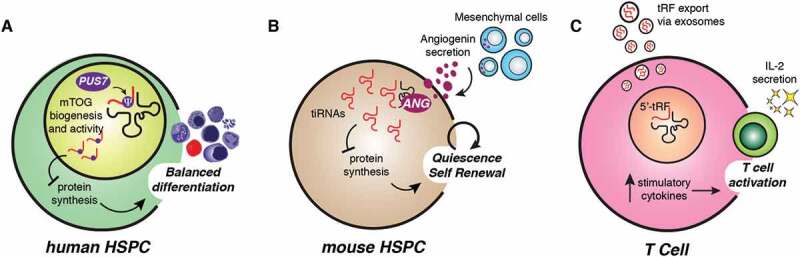
tRFs regulate self-renewal, differentiation and activation of haematopoietic cells. (A) Pseudouridine synthase 7 (PUS7) regulates biogenesis and activity of specific 5ʹ-tRFs, namely mTOGs. In human HSPCs, mTOGs ensure accurate protein synthesis levels and haematopoietic differentiation. Loss of PUS7 and mTOGs leads to aberrant stem cell growth and impaired multi-lineage commitment. (B) Angiogenin is released by MSCs in the bone marrow niche and accumulates in HSPCs to promote tiRNAs biogenesis, maintain low protein synthesis level and stem cell quiescence. (C) Activated T lymphocytes secrete inhibitory 5ʹ-tRF pools to enable production of co-stimulatory cytokines such as IL-2 and immune activation.
Figure 4.
Figure 4.
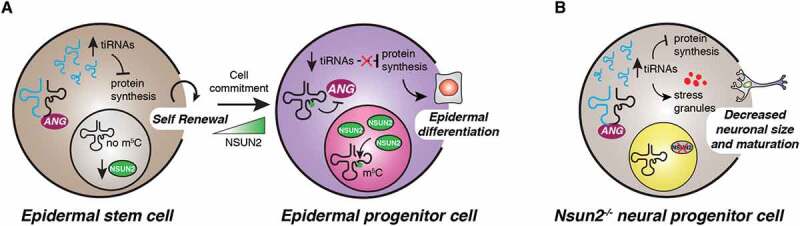
Dynamic tRNA methylation impacts tRF biogenesis and directs stem cell fate. (A) Nsun2 and Dnmt2-mediated m5C protects tRNAs from angiogenin cleavage. Low levels of NSUN2 in mouse and human epidermal stem cells lead to accumulation of tiRNAs that repress protein synthesis. Conversely, epidermal progenitors up-regulate Nsun2 to inhibit angiogenic-mediated tRNA cleavage and promote epidermal differentiation. (B) Nsun2-depletion leads to neurological disorders caused by accumulation of stress-induced tiRNAs in vivo. Nsun2-deficient neuronal cells display increased stress granules assembly, reduced size and impaired maturation. These defects are specifically rescued by angiogenin inhibition that reduces tiRNA levels in these cells.

References

    1. Fu HJ, Feng JJ, Liu Q, et al. Stress induces tRNA cleavage by angiogenin in mammalian cells. Febs Lett. 2009;583:437–442. - PubMed
    1. Haussecker D, Huang Y, Lau A, et al. Human tRNA-derived small RNAs in the global regulation of RNA silencing. Rna. 2010;16:673–695. - PMC - PubMed
    1. Thompson DM, Lu C, Green PJ, et al. tRNA cleavage is a conserved response to oxidative stress in eukaryotes. RNA. 2008;14:2095–2103. - PMC - PubMed
    1. Yamasaki S, Ivanov P, Hu GF, et al. Angiogenin cleaves tRNA and promotes stress-induced translational repression. J Cell Biol. 2009;185:35–42. - PMC - PubMed
    1. Thompson DM, Parker R.. The RNase Rny1p cleaves tRNAs and promotes cell death during oxidative stress in Saccharomyces cerevisiae. J Cell Biol. 2009;185:43–50. - PMC - PubMed

Publication types

LinkOut - more resources