. 2020 Mar 2;9(1):508-516.
doi: 10.1080/22221751.2020.1732231. eCollection 2020.

Identification of novel mobile colistin resistance gene mcr-10

Affiliations

Identification of novel mobile colistin resistance gene mcr-10

Chengcheng Wang et al. Emerg Microbes Infect. .

Abstract

Mobile colistin resistance (mcr) genes represent an emerging challenge. Here we describe a novel mcr gene, mcr-10, on an IncFIA plasmid of an Enterobacter roggenkampii clinical strain. mcr-10 has the highest nucleotide identity (79.69%) with mcr-9 and encodes MCR-10 with 82.93% amino acids identical to MCR-9. mcr-10 confers 4-fold increase in colistin MIC (from 1 to 4 mg/L) when cloned into a colistin-susceptible E. roggenkampii strain. By screening GenBank, mcr-10 was found in various Enterobacteriaceae species of countries in four continents, suggesting that this gene has widely spread. MCR-10 shows 79.04% to 83.67% amino acid identity and highly conserved predicted protein structures with chromosomally encoded MCR-like phosphoethanolamine transferases (designated MCR-B here) of various Buttiauxella species. MCR-10, MCR-9 and MCR-B proteins may, therefore, originate from a common ancestor. mcr-10 was adjacent to a site-specific recombinase-encoding gene and was bracketed by IS903 and may be mobilized by site-specific recombination or composite transposon. Our results indicate that mcr-10 is a novel plasmid-borne colistin resistance gene and warrants immediate monitoring and further studies.

Keywords: Colistin resistance; Enterobacter roggenkampii; mcr; mcr-10; plasmid.


Conflict of interest statement

No potential conflict of interest was reported by the authors.

Figures
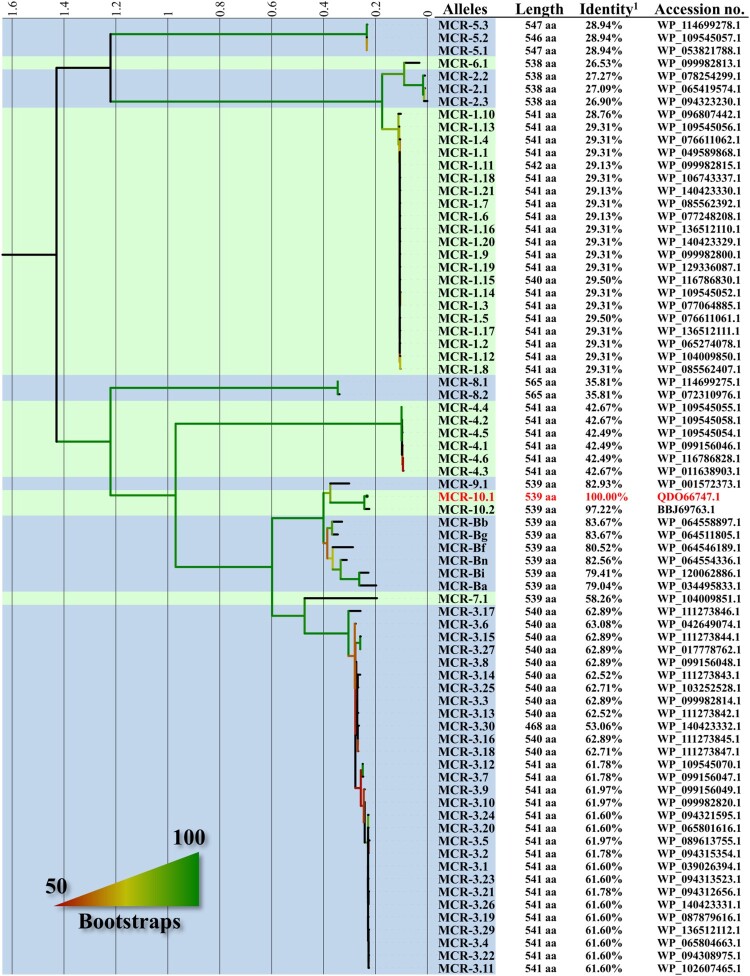
Figure 1.
Figure 1.
Comparison of MCR-10 with other known MCRs and MCR-like proteins (MCR-B) in Buttiauxella species. This maximum-likelihood tree based on amino acid sequences was inferred using RAxML v8.2.12 [25] with a 1000-bootstrap test under the PROTGTRGAMMA model. The tree is middle-point rooted and the blue and green strips separate different MCR families with MCR-10 being highlighted in red. Bootstrap results are indicated by colour gradient on the branches, starting from 50% shown as red and up to 100% shown as green. MCR-like proteins in Buttiauxella species are named here according to the species. MCR-Ba, MCR-Bb, MCR-Bf, MCR-Bg, MCR-Bi, and MCR-Bn are MCR-like proteins from Buttiauxella agrestis strain ATCC 33320T (accession no. JMPI00000000), Buttiauxella brennerae ATCC 51605T (accession no. LXER00000000), Buttiauxella ferragutiae ATCC 51602T (accession no. LXEQ00000000), Buttiauxella gaviniae ATCC 51604T (accession no. LXEP00000000), Buttiauxella izardii CCUG35510T (accession no. QZWH01000000), and Buttiauxella noackiae ATCC 51607T (accession no. LXEO00000000), respectively.
Figure 2.
Figure 2.
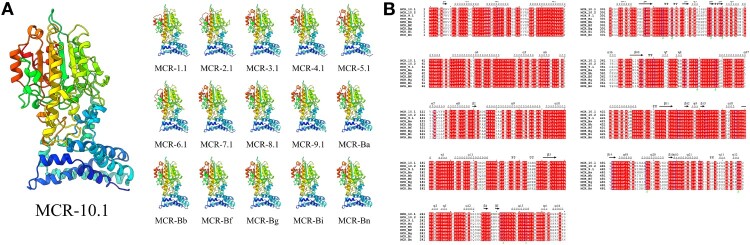
Structures of MCR-10, other reported MCR proteins (MCR-1 to -9) and MCR-B of various Buttiauxella species. (A) Structural models were constructed using Phyre2 [27] and show the transmembrane-anchored and soluble periplasmic domains of the phosphoethanolamine transferase. (B) Secondary structures of MCR-10, MCR-9 and MCR-B. The alignment of amino acid sequences and the prediction of secondary structures were performed using ESPript 3 [29]. Secondary structure elements, αhelixes, β sheets, and 310-helixes (representing by η), are indicated. β-strands are rendered as arrows, and strict β-turns are shown as TT letters.
Figure 3.
Figure 3.
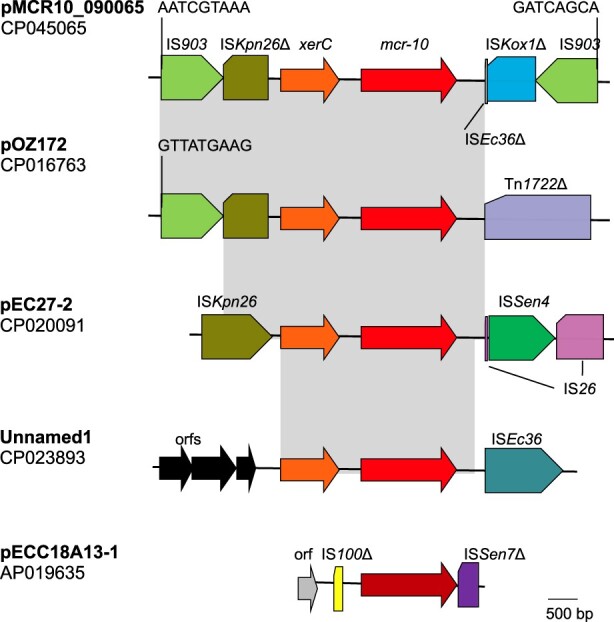
Genetic contexts of mcr-10. Gene xerC (shown in orange) encodes a XerC-type tyrosine recombinase, which may mediate mobilization of adjacent genetic components via site-specific recombination. Δ represents truncated insertion sequences or transposons. Identical regions are highlighted by grey rectangles. On pMCR10_090065, two copies of IS903 are located at upstream and downstream of xerC-mcr-10 (mcr-10 is shown in red) and the 9-bp abutting sequences are indicated. On pOZ171, there is an IS903 at upstream with the 9-bp abutting sequence being shown. However, there is no IS903 at downstream of xerC-mcr-10 but instead, transposon Tn1722 is presented. On pEC27-2, there is no IS903. A complete ISKpn26 is present at upstream of xerC-mcr-10 and an IS26, which is interrupted by the insertion of ISSen4, is at downstream. On an unnamed plasmid (accession no. CP023893), several open reading frames (orfs) without known function are present at upstream of xerC-mcr-10, while ISEc36 is present at downstream. On pECC18A13-1, the mcr-10 encodes an MCR-10 variant with 15 amino acids different from MCR-10 encoded by the other plasmids and is shown in dark red. No xerC is present, while truncated IS100 and truncated ISSen7 are located at upstream and downstream of the mcr-10, respectively.

References

    1. Li J, Nation RL, Turnidge JD, et al. Colistin: the re-emerging antibiotic for multidrug-resistant Gram-negative bacterial infections. Lancet Infect Dis. 2006;6:589–601. doi: 10.1016/S1473-3099(06)70580-1 - DOI - PubMed
    1. Liu Y-Y, Wang Y, Walsh TR, et al. Emergence of plasmid-mediated colistin resistance mechanism MCR-1 in animals and human beings in China: a microbiological and molecular biological study. Lancet Infect Dis. 2016;16:161–168. doi: 10.1016/S1473-3099(15)00424-7 - DOI - PubMed
    1. Xavier BB, Lammens C, Ruhal R, et al. Identification of a novel plasmid-mediated colistin-resistance gene, mcr-2, in Escherichia coli, Belgium. Euro Surveill. 2016 Jun;21:30280. doi: 10.2807/1560-7917.ES.2016.21.27.30280 - DOI - PubMed
    1. Yin W, Li H, Shen Y, et al. Novel plasmid-mediated colistin resistance gene mcr-3 in Escherichia coli. mBio. 2017;8:e00543-17. doi: 10.1128/mBio.00543-17 - DOI - PMC - PubMed
    1. Carattoli A, Villa L, Feudi C, et al. Novel plasmid-mediated colistin resistance mcr-4 gene in Salmonella and Escherichia coli, Italy 2013, Spain and Belgium, 2015 to 2016. Euro Surveill. 2017;22:30589. doi: 10.2807/1560-7917.ES.2017.22.31.30589 - DOI - PMC - PubMed