. 2020 Feb 7:12:1.
doi: 10.3389/fnagi.2020.00001. eCollection 2020.

Electrophile Signaling and Emerging Immuno- and Neuro-modulatory Electrophilic Pharmaceuticals

Affiliations

Electrophile Signaling and Emerging Immuno- and Neuro-modulatory Electrophilic Pharmaceuticals

Jesse R Poganik et al. Front Aging Neurosci. .

Abstract

With a lipid-rich environment and elevated oxygen consumption, the central nervous system (CNS) is subject to intricate regulation by lipid-derived electrophiles (LDEs). Investigations into oxidative damage and chronic LDE generation in neural disorders have spurred the development of tools that can detect and catalog the gamut of LDE-adducted proteins. Despite these advances, deconstructing the precise consequences of individual protein-specific LDE modifications remained largely impossible until recently. In this perspective, we first overview emerging toolsets that can decode electrophile-signaling events in a protein/context-specific manner, and how the accumulating mechanistic insights brought about by these tools have begun to offer new means to modulate pathways relevant to multiple sclerosis (MS). By surveying the latest data surrounding the blockbuster MS drug dimethyl fumarate that functions through LDE-signaling-like mechanisms, we further provide a vision for how chemical biology tools probing electrophile signaling may be leveraged toward novel interventions in CNS disease.

Keywords: 4-hydroxynonenal; central nervous system; dimethyl fumarate; lipid-derived electrophiles; multiple sclerosis.


Figures

Figure 1
Figure 1
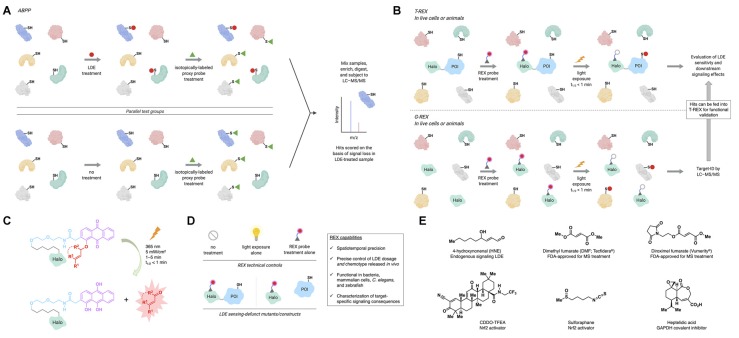
Activity-based protein profiling (ABPP) and REX technologies profile lipid-derived electrophile (LDE) sensors and/or interrogate target-specific LDE signaling. (A) In ABPP, parallel test groups (typically lysates/homogenates) are first treated with the LDE of interest, or not treated (typically, DMSO control). Subsequently, both groups are treated with a broadly reactive proxy electrophile probe, which is isotopically labeled. The samples are then mixed, enriched, digested, and subjected to liquid chromatography–tandem mass spectrometry (LC–MS/MS), where loss of proxy probe labeling allows quantitative ranking of LDE modification events. (B) Top: in targetable reactive electrophiles and oxidants (T-REX), a Halo-protein of interest (POI) fusion is expressed in live cells, worms, or zebrafish. The system is then treated with a photocaged precursor to an LDE of interest (REX probe; see panel C). After removal of excess REX probe, the system is exposed to UV light (365 nm, 5 mW/cm2, 1–5 min) to liberate, in the vicinity of the POI, the LDE (in an amount maximally stoichiometric to the in vivo concentration of Halo-POI). Provided the POI is a kinetically privileged sensor (KPS) of the LDE, it will react before the LDE diffuses away. LDE-sensing ability and downstream signaling effects can then be assayed by a number of downstream procedures (Poganik et al., 2019a). Bottom: genome-wide profiling ofreactive-electrophile and -oxidant sensors (G-REX) is similar to T-REX except that G-REX involves expression of HaloTag with no POI fusion. The liberated LDE (with maximum dosage equivalent to in vivo HaloTag concentration) is captured by endogenous KPSs, which are profiled by standard quantitative proteomics (e.g., SILAC, TMT) following enrichment and digest (Poganik et al., 2019a). Hits identified by G-REX can then be fed into the T-REX workflow to validate their LDE-sensing ability and investigate target-specific consequences of LDE modification. (C) REX probes are modular, bio-inert, bind selectively and irreversibly to HaloTag in vivo, and allow rapid release of LDEs on demand. (D) Technical controls in applying REX techniques include no treatment, light exposure alone, and REX probe treatment alone. Functional controls in applying T-REX include LDE-sensing-defunct mutant POIs (by mutation of the LDE-sensing cysteine) and split constructs where Halo and POI are expressed separately (conditions under which the POI cannot be LDE-modified upon T-REX). Inset: capabilities of REX inaccessible by other tools. (E) Structures of select endogenous signaling LDEs and electrophilic drugs and inhibitors discussed in the text.
Figure 2
Figure 2
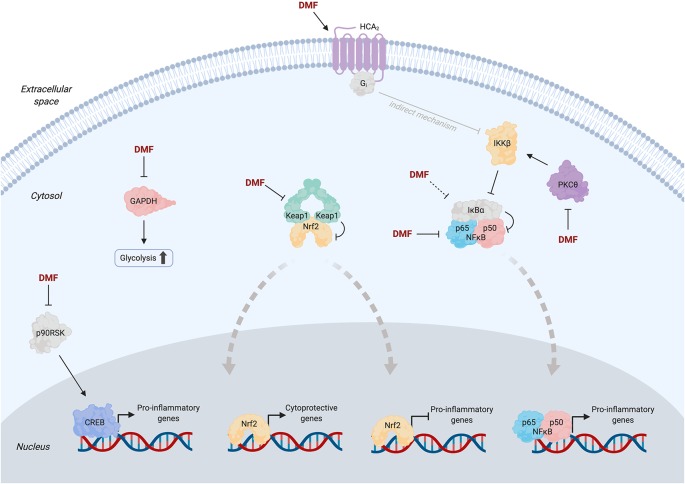
Simplified pathway diagram showing selected proposed targets of dimethyl fumarate (DMF) and potential associated mechanisms at the molecular level. Solid arrows from DMF indicate literature evidence for direct binding to the target; dashed arrows indicate purported targets for which evidence of direct binding has not yet been provided (see text for detailed discussions). Thick dashed gray arrows indicate nuclear translocation events. Apart from Keap1, oligomeric states of proteins are depicted as monomeric for simplicity. Transcriptional co-regulators of Nrf2, NFκB, and CREB are omitted for clarity. Note that the mechanism of inhibition of NFκB signaling by activated HCA2 (gray arrow) remains poorly understood but is likely indirect (Offermanns and Schwaninger, 2015).

References

    1. Abegg D., Frei R., Cerato L., Prasad Hari D., Wang C., Waser J., et al. . (2015). Proteome-wide profiling of targets of cysteine reactive small molecules by using ethynyl benziodoxolone reagents. Angew. Chem. Int. Ed. Engl. 54, 10852–10857. 10.1002/anie.201505641 - DOI - PubMed
    1. Andersen J. L., Gesser B., Funder E. D., Nielsen C. J. F., Gotfred-Rasmussen H., Rasmussen M. K., et al. . (2018). Dimethyl fumarate is an allosteric covalent inhibitor of the p90 ribosomal S6 kinases. Nat. Commun. 9:4344. 10.1038/s41467-018-06787-w - DOI - PMC - PubMed
    1. Benedetti A., Comporti M., Esterbauer H. (1980). Identification of 4-hydroxynonenal as a cytotoxic product originating from the peroxidation of liver microsomal lipids. Biochim. Biophys. Acta 620, 281–296. 10.1016/0005-2760(80)90209-x - DOI - PubMed
    1. Blatnik M., Frizzell N., Thorpe S. R., Baynes J. W. (2008). Inactivation of glyceraldehyde-3-phosphate dehydrogenase by fumarate in diabetes: formation of S-(2-succinyl)cysteine, a novel chemical modification of protein and possible biomarker of mitochondrial stress. Diabetes 57, 41–49. 10.2337/db07-0838 - DOI - PMC - PubMed
    1. Blewett M. M., Xie J., Zaro B. W., Backus K. M., Altman A., Teijaro J. R., et al. . (2016). Chemical proteomic map of dimethyl fumarate-sensitive cysteines in primary human T cells. Sci. Signal. 9:rs10. 10.1126/scisignal.aaf7694 - DOI - PMC - PubMed

LinkOut - more resources