


Personality Traits, Perceived Stress, and Tinnitus-Related Distress in Patients With Chronic Tinnitus: Support for a Vulnerability-Stress Model
- PMID: 32116880
- PMCID: PMC7025561
- DOI: 10.3389/fpsyg.2019.03093
Personality Traits, Perceived Stress, and Tinnitus-Related Distress in Patients With Chronic Tinnitus: Support for a Vulnerability-Stress Model
Abstract
Background: Despite vulnerability-stress models underlying a variety of distress-related emotional syndromes, few studies have investigated interactions between personality factors and subjectively experienced stressors in accounting for tinnitus-related distress.
Aim: The present study compared personality characteristics between patients with chronic tinnitus and the general population. Within the patient sample, it was further examined whether personality dimensions predicted tinnitus-related distress and, if so, whether differential aspects or levels of perceived stress mediated these effects.
Method: Applying a cross-sectional design, 100 patients with chronic tinnitus completed the Freiburger Persönlichkeitsinventar (FPI-R) measuring personality, the Perceived Stress Questionnaire (PSQ-20) measuring perceived stress and the German version of the Tinnitus Questionnaire (TQ) measuring tinnitus-related distress. FPI-R scores were compared with normed values obtained from a representative German reference population. Mediation analyses were computed specifying FPI-R scores as independent, PSQ20 scores as mediating and the TQ-total score as dependent variables.
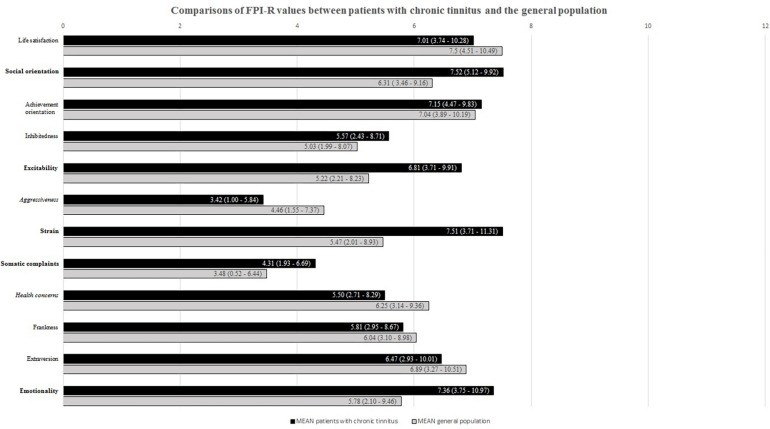
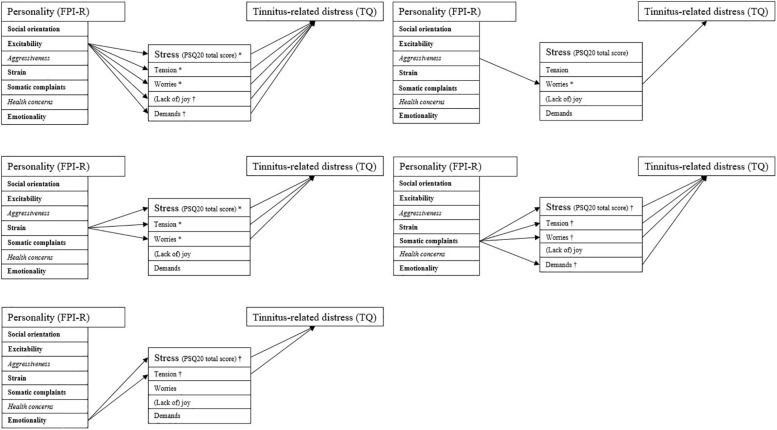
Results: Patients with chronic tinnitus significantly differed from the general population across a variety of personality indices. Tinnitus-related distress was mediated by differential interactions between personality factors and perceived stress dimensions.
Conclusion: In conceptualizing tinnitus-related distress, idiosyncratic assessments of vulnerability-stress interactions are crucial for devising effective psychological treatment strategies. Patients' somatic complaints and worries appear to be partly informed by opposing tendencies reflecting emotional excitability vs. aggressive inhibition - suggesting emotion-focused treatment strategies as a promising new direction for alleviating distress.
Keywords: FPI; Tinnitus Questionnaire (TQ); perceived stress; personality; tinnitus; vulnerability-stress.
Copyright © 2020 Biehl, Boecking, Brueggemann, Grosse and Mazurek.
Figures
References
-
- Almeida D. (2005). Resilience and vulnerability to daily stressors assessed via diary methods. Curr. Dir. Psychol. Sci. 14 64–68.
-
- Andersson G., Airikka M. L., Buhrman M., Kaldo V. (2005). Dimensions of perfectionism and tinnitus distress. Psychol. Health Med. 10 78–87.
-
- Asanger R., Wenninger G. (1999). Handwörterbuch Psychologie. Weinheim: Beltz.
-
- Biesinger E., Heiden C., Greimel V., Lendle T., Höing R., Albegger K. (1998). Strategien in der ambulanten behandlung des Tinnitus. HNO 46 157–169. - PubMed
LinkOut - more resources
Full Text Sources
