. 2020 Feb 14:11:26.
doi: 10.3389/fneur.2020.00026. eCollection 2020.

Left Atrial Enlargement and the Risk of Stroke: A Meta-Analysis of Prospective Cohort Studies

Affiliations

Left Atrial Enlargement and the Risk of Stroke: A Meta-Analysis of Prospective Cohort Studies

Yicheng Xu et al. Front Neurol. .

Abstract

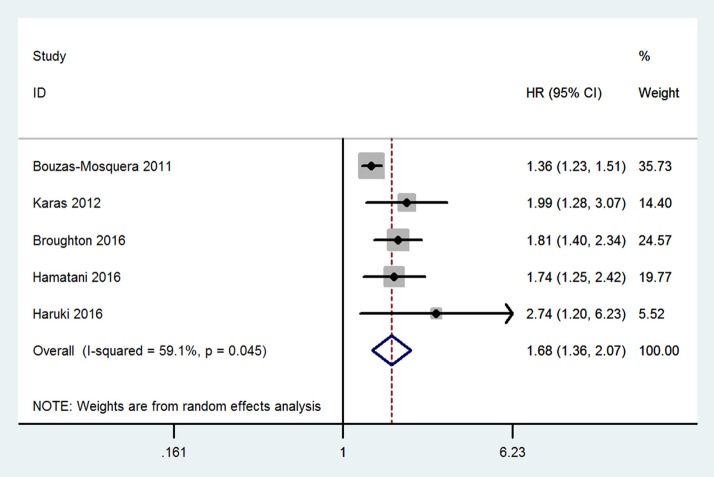
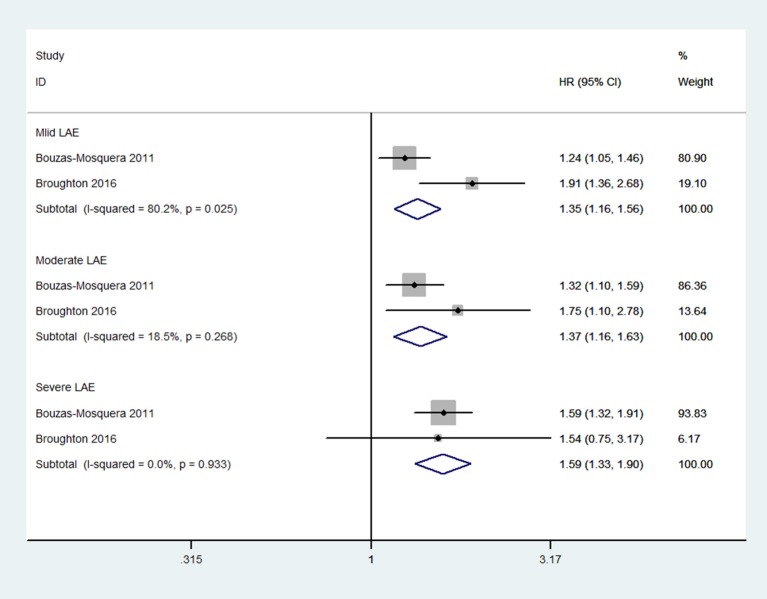
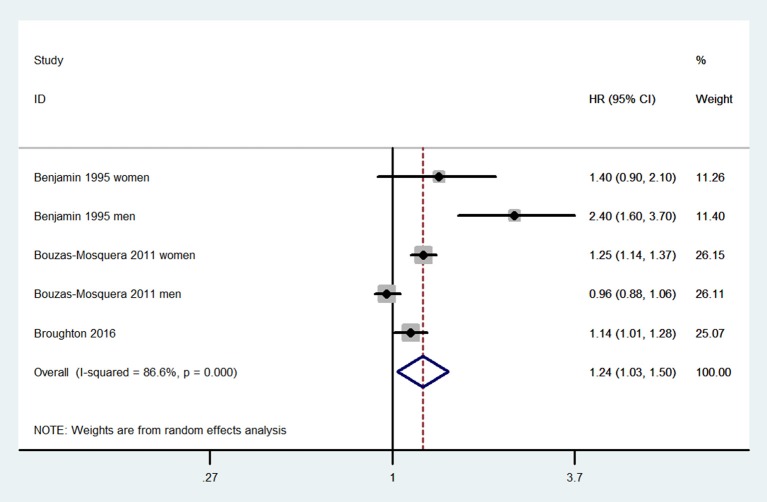
Background: The association between left atrial size and the risk of stroke has not been fully understood. We performed a meta-analysis of prospective cohort studies to determine whether left atrial enlargement (LAE) is associated with an increased risk of stroke. Methods: We searched PubMed, EMBASE, Web of Science, and the Cochrane Library through May 2019. Prospective cohort studies were included if they reported hazard ratios (HRs) and corresponding 95% confidence intervals (CIs) of stroke with respect to LAE. All meta-analyses were performed using a random-effects model. Results: Six studies involving 66,007 participants and 3,549 stroke events were included. Compared with patients without LAE, those with LAE had an increased risk of stroke (adjusted HR 1.68, 95% CI 1.36-2.07). There was also a graded association with stroke relating to LAE (adjusted HR for mild LAE 1.50, 95% CI 0.98-2.28; moderate LAE 1.40, 95% CI 1.12-1.75; and severe LAE 1.59, 95% CI 1.33-1.90). Furthermore, for each increase of 1 cm in left atrial diameter, the odds of stroke were increased by 24% (adjusted HR 1.24, 95% CI 1.03-1.50). Conclusions: Our meta-analysis demonstrated that LAE is associated with an increased and graded risk of stroke.

Keywords: left atrial size; meta-analysis; risk; stroke; systematic review.


Figures

Figure 1
Figure 1
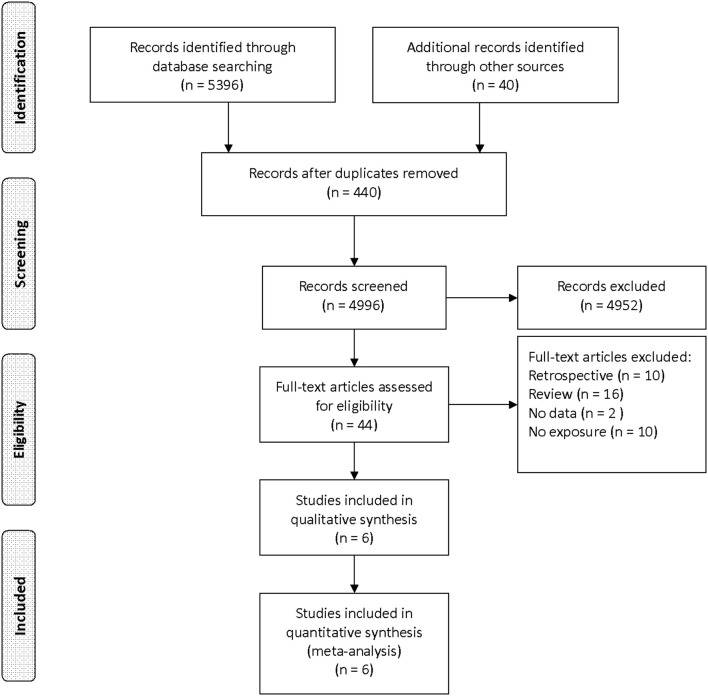
Preferred reporting items for systematic reviews and meta-analyses (PRISMA) flow diagram.
Figure 2
Figure 2
Meta-analyses of hazard ratios for the association between left atrial enlargement and stroke.
Figure 3
Figure 3
Meta-analyses of hazard ratios for the association between the severity of left atrial enlargement and stroke.
Figure 4
Figure 4
Meta-analyses of hazard ratios for the association between continuous left atrial diameter and stroke.
Figure 5
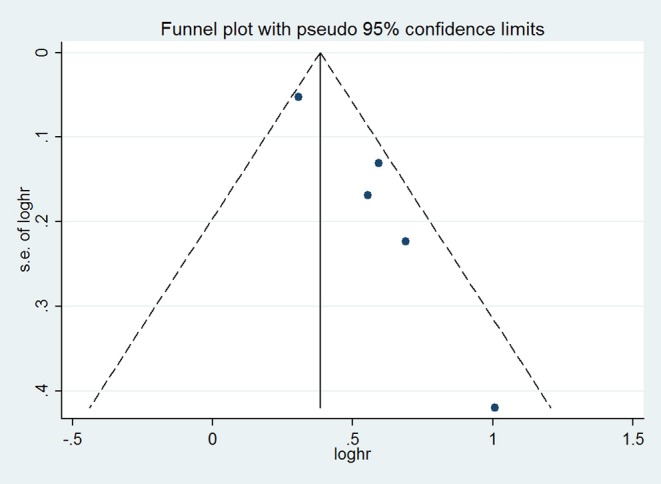
Figure 5
Funnel plot with pseudo 95% confidence limits.

References

    1. Bejot Y, Daubail B, Giroud M. Epidemiology of stroke and transient ischemic attacks: current knowledge and perspectives. Revue Neurol. (2016) 172:59–68. 10.1016/j.neurol.2015.07.013 - DOI - PubMed
    1. Feigin VL, Forouzanfar MH, Krishnamurthi R, Mensah GA, Connor M, Bennett DA, et al. Global and regional burden of stroke during 1990-2010: findings from the Global Burden of Disease Study 2010. Lancet. (2014) 383:245–54. 10.1016/S0140-6736(13)61953-4 - DOI - PMC - PubMed
    1. Aziz EF, Kukin M, Javed F, Musat D, Nader A, Pratap B, et al. Right ventricular dysfunction is a strong predictor of developing atrial fibrillation in acutely decompensated heart failure patients, ACAP-HF data analysis. J Card Fail. (2010) 16:827–34. 10.1016/j.cardfail.2010.05.004 - DOI - PubMed
    1. Biteker M, Kayatas K, Basaran O, Dogan V, Ozlek E, Ozlek B. The role of left atrial volume index in patients with a first-ever acute ischemic stroke. J Stroke Cerebrovasc Dis. (2017) 26:321–6. 10.1016/j.jstrokecerebrovasdis.2016.09.023 - DOI - PubMed
    1. Gardner JD, Skelton WPt, Khouzam RN. Is it time to incorporate the left atrial size to the current stroke risk scoring systems for atrial fibrillation? Curr Prob Cardiol. (2016) 41:251–9. 10.1016/j.cpcardiol.2016.10.004 - DOI - PubMed

Publication types