. 2020 Feb 13:11:210.
doi: 10.3389/fmicb.2020.00210. eCollection 2020.

The pH-Responsive Transcription Factor PacC Governs Pathogenicity and Ochratoxin A Biosynthesis in Aspergillus carbonarius

Affiliations

The pH-Responsive Transcription Factor PacC Governs Pathogenicity and Ochratoxin A Biosynthesis in Aspergillus carbonarius

Omer Barda et al. Front Microbiol. .

Abstract

Pathogenic fungi must respond effectively to changes in environmental pH for successful host colonization, virulence and toxin production. Aspergillus carbonarius is a mycotoxigenic pathogen with the ability to colonize many plant hosts and secrete ochratoxin A (OTA). In this study, we characterized the functions and addressed the role of PacC-mediated pH signaling in A. carbonarius pathogenicity using designed pacC gene knockout mutant. ΔAcpacC mutant displayed an acidity-mimicking phenotype, which resulted in impaired fungal growth at neutral/alkaline pH, accompanied by reduced sporulation and conidial germination compared to the wild type (WT) strain. The ΔAcpacC mutant was unable to efficiently acidify the growth media as a direct result of diminished gluconic and citric acid production. Furthermore, loss of AcpacC resulted in a complete inhibition of OTA production at pH 7.0. Additionally, ΔAcpacC mutant exhibited attenuated virulence compared to the WT toward grapes and nectarine fruits. Reintroduction of pacC gene into ΔAcpacC mutant restored the WT phenotype. Our results demonstrate important roles of PacC of A. carbonarius in OTA biosynthesis and in pathogenicity by controlling transcription of genes important for fungal secondary metabolism and infection.

Keywords: Aspergillus carbonarius; OTA biosynthesis; PacC; pH regulation; post-harvest disease.


Figures

FIGURE 1
FIGURE 1
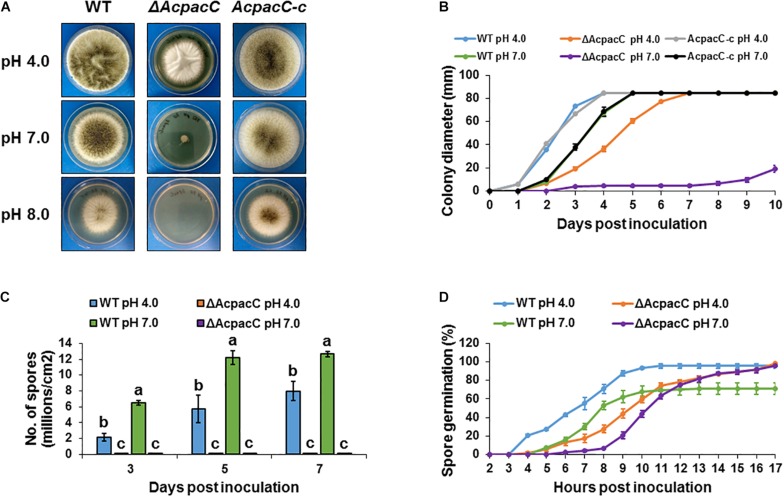
Physiological analyses of the WT and mutant strains of A. carbonarius at different pH conditions. (A) Growth phenotype and (B) radial growth of the WT, ΔAcpacC and AcpacC-c strains on solid YES media at 28°C under pH 4.0, 7.0, and 8.0. (C) Conidiation of the WT and ΔAcpacC strains on solid YES media at pH 4.0 and 7.0. (D) Germination rates in the WT and ΔAcpacC strains were assessed in static YES broth media at 28°C under pH 4.0 and 7.0. Error bars represent the standard error of the mean (SEM) across three independent replicates. Different letters above the columns indicate statistically significant differences at p < 0.05, as determined using the Tukey’s honest significant difference test.
FIGURE 2
FIGURE 2
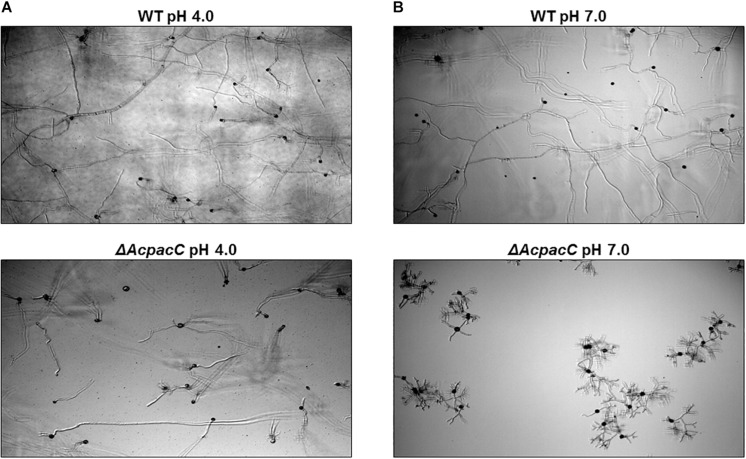
Microscopic observation of hyphal morphology of WT and ΔAcpacC strains. Images of time-course microscopy were captured 17 h following incubation of WT and ΔAcpacC conidia suspensions in YES broth media adjusted to pH 4.0 (A) and pH 7.0 (B).
FIGURE 3
FIGURE 3
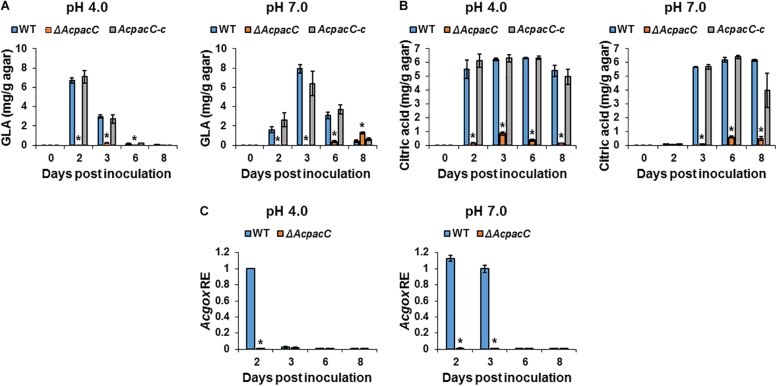
Effects of AcPacC on organic acids production in A. carbonarius. Gluconic acid (GLA) (A) and citric acid (B) accumulation by the WT, ΔAcpacC and AcpacC-c strains under different pH conditions. (C) Differential expression of the Acgox gene between WT and ΔAcpacC at pH 4.0 and 7.0. Average values of three replicates (± standard error) are reported. Experiments were repeated three times and results of a single representative experiment are shown. Asterisks denote significant differences between strains at p < 0.05.
FIGURE 4
FIGURE 4
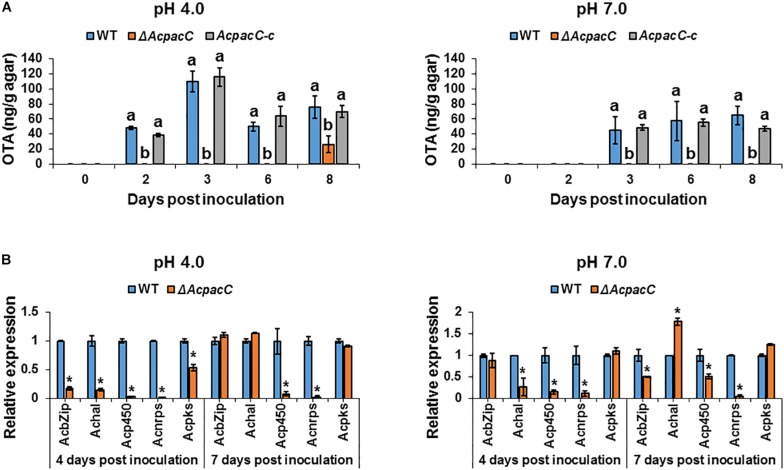
Effects of AcPacC on OTA biosynthesis in A. carbonarius at different pH conditions. (A) OTA production by the WT, ΔAcpacC and AcpacC-c strains at pH 4.0 and pH 7.0. (B) Relative expression of OTA cluster genes in WT and ΔAcpacC at days 4 and 7 post-inoculation. Relative expression was normalized using β-tubulin as an internal control. Average values of three replicates (± standard error) are presented. Experiments were repeated three times and results of a single representative experiment are shown. Different letters above the columns indicate statistically significant differences at p < 0.05, as determined using the Tukey’s honest significant difference test. Asterisks denote significant differences between strains at p < 0.05.
FIGURE 5
FIGURE 5
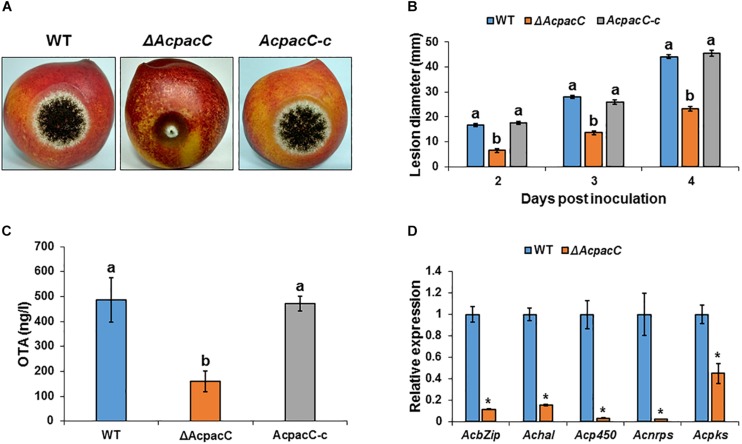
Effects of AcPacC on pathogenicity of A. carbonarius and OTA production in nectarines. (A) Disease symptoms on nectarine fruits inoculated with conidia of WT, ΔAcpacC and AcpacC-c strains at 3 days after inoculation. (B) Histogram showing the diameters of the rotten spots on infected nectarines. (C) OTA accumulation in infected nectarines, and (D) relative expression of OTA cluster genes in WT and ΔAcpacC strains. RNA was extracted from infected nectarines at day 4 post-inoculation. Relative expression was normalized using β-tubulin as an internal control. Error bars represent standard error of three independent biological replicates. Different letters above the columns indicate statistically significant differences at p < 0.05, as determined using the Tukey’s honest significant difference test. Asterisks denote significant differences between strains at p < 0.05.
FIGURE 6
FIGURE 6
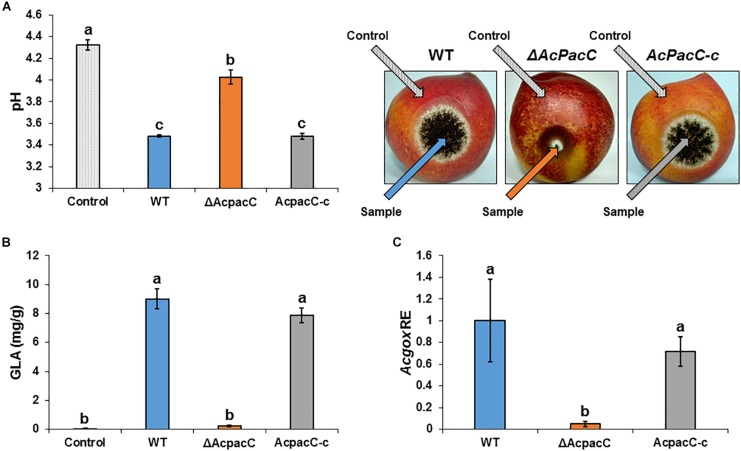
Effects of AcPacC on GLA production in colonized nectarines. pH of nectarine tissues (A), GLA accumulation (B), and Acgox relative expression (C) were measured in fruits infected with the WT, ΔAcpacC and AcpacC-c strains at day 4 post-inoculation. Error bars represent standard error of three independent biological replicates. Different letters above the columns indicate statistically significant differences at p < 0.05, as determined using the Tukey’s honest significant difference test.

References

    1. Barad S., Espeso E. A., Sherman A., Prusky D. (2016). Ammonia activates pacC and patulin accumulation in an acidic environment during apple colonization by Penicillium expansum. Mol. Plant. Pathol. 17 727–740. 10.1111/mpp.12327 - DOI - PMC - PubMed
    1. Barad S., Horowitz S. B., Kobiler I., Sherman A., Prusky D. (2014). Accumulation of the mycotoxin patulin in the presence of gluconic acid contributes to pathogenicity of Penicillium expansum. Mol. Plant Microbe Interact. 27 66–77. 10.1094/MPMI-05-13-0138-R - DOI - PubMed
    1. Barad S., Horowitz S. B., Moskovitch O., Lichter A., Sherman A., Prusky D. (2012). A Penicillium expansum glucose oxidase-encoding gene, GOX2, is essential for gluconic acid production and acidification during colonization of deciduous fruit. Mol. Plant Microbe Interact. 25 779–788. 10.1094/MPMI-01-12-0002 - DOI - PubMed
    1. Bergh K. T., Brakhage A. A. (1998). Regulation of the Aspergillus nidulans penicillin biosynthesis gene acvA (pcbAB) by amino acids: implication for involvement of transcription factor PACC. Appl. Environ. Microbiol. 64 843–849. 10.1128/aem.64.3.843-849.1998 - DOI - PMC - PubMed
    1. Brakhage A. A. (2013). Regulation of fungal secondary metabolism. Nat. Rev. Microbiol. 11 21–32. 10.1038/nrmicro2916 - DOI - PubMed

LinkOut - more resources