


Macrophage: A Potential Target on Cartilage Regeneration
- PMID: 32117263
- PMCID: PMC7026000
- DOI: 10.3389/fimmu.2020.00111
Macrophage: A Potential Target on Cartilage Regeneration
Abstract
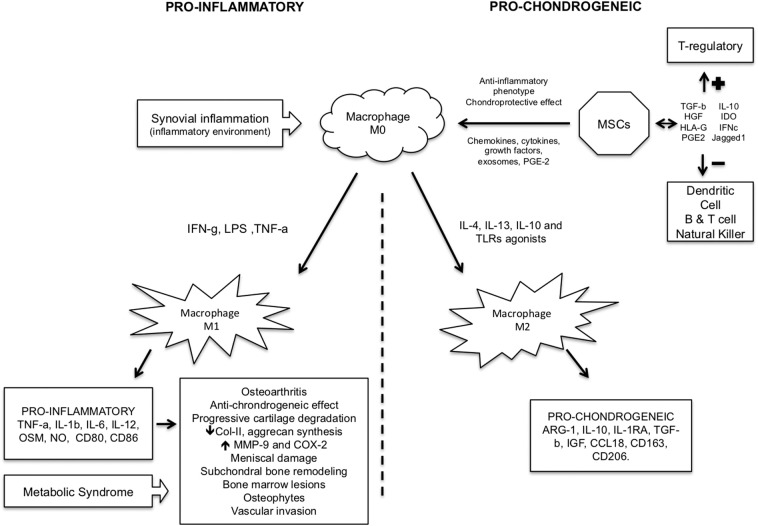
Cartilage lesions and osteoarthritis (OA) presents an ever-increasing clinical and socioeconomic burden. Synovial inflammation and articular inflammatory environment are the key factor for chondrocytes apoptosis and hypertrophy, ectopic bone formation and OA progression. To effectively treat OA, it is critical to develop a drug that skews inflammation toward a pro-chondrogenic microenvironment. In this narrative and critical review, we aim to see the potential use of immune cells modulation or cell therapy as therapeutic alternatives to OA patients. Macrophages are immune cells that are present in synovial lining, with different roles depending on their subtypes. These cells can polarize to pro-inflammatory (M1) and anti-inflammatory (M2) phenotypes, being the latter associated with wound-healing by the production of ARG-1 and pro-chondrogenic cytokines, such as IL-10, IL-1RA, and TGF-b. Emerging evidence reveals that macrophage shift can be determined by several stimuli, apart from the conventional in vitro IL-4, IL-13, and IL-10. Evidences show the potential of physical exercise to induce type 2 response, favoring M2 polarization. Moreover, macrophages in contact with oxLDL have effect on the production of anabolic mediators as TGF-b. In the same direction, type II collagen, that plays a critical role in development and maturation process of chondrocytes, can also induce M2 macrophages, increasing TGF-b. The mTOR pathway activation in macrophages was shown to be able to polarize macrophages in vitro, though further studies are required. The possibility to use mesenchymal stem cells (MSCs) in cartilage restoration have a more concrete literature, besides, MSCs also have the capability to induce M2 macrophages. In the other direction, M1 polarized macrophages inhibit the proliferation and viability of MSCs and impair their ability to immunosuppress the environment, preventing cartilage repair. Therefore, even though MSCs therapeutic researches advances, other sources of M2 polarization are attractive issues, and further studies will contribute to the possibility to manipulate this polarization and to use it as a therapeutic approach in OA patients.
Keywords: M1/M2 macrophages; articular cartilage; cartilage regeneration; cell therapy; mesenchymal stem cells; osteoarthritis; synovial inflammation.
Copyright © 2020 Fernandes, Gomoll, Lattermann, Hernandez, Bueno and Amano.
Figures
References
Publication types
MeSH terms
LinkOut - more resources
Full Text Sources
Medical
Research Materials
Miscellaneous
