. 2020 Feb 13:10:1725.
doi: 10.3389/fpls.2019.01725. eCollection 2019.

Silicon Confers Soybean Resistance to Salinity Stress Through Regulation of Reactive Oxygen and Reactive Nitrogen Species

Affiliations

Silicon Confers Soybean Resistance to Salinity Stress Through Regulation of Reactive Oxygen and Reactive Nitrogen Species

Yong Suk Chung et al. Front Plant Sci. .

Abstract

Salt stress is one of the major abiotic stressors that causes huge losses to the agricultural industry worldwide. Different strategies have been adopted over time to mitigate the negative impact of salt stress on plants and reclaim salt-affected lands. In the current study, we used silicon (Si) as a tool for salinity alleviation in soybean and investigated the influence of exogenous Si application on the regulation of reactive oxygen and reactive nitrogen species and other salt stress-related parameters of the treated plants. Our results revealed that the canopy temperature was much higher in sole NaCl-treated plants but declined in Si + NaCl-treated plants. Furthermore, the chlorophyll contents decreased with sole NaCl treatment, whereas Si + NaCl-treated plants showed improved chlorophyll contents. In addition, Si application normalized the photosynthetic responses, such as transpiration rate (E) and net photosynthesis rate (PN ) in salt-treated plants, and reduced the activity of ascorbate peroxidase and glutathione under salt stress. The expression levels of antioxidant-related genes GmCAT1, GmCAT2, and GmAPX1 started to decline at 12 h after addition of Si to NaCl-treated plants. Similarly, the S-nitrosothiol and nitric oxide (NO)-related genes were upregulated in the salt stress condition but reduced after Si supplementation. Si application downregulated genes associated with reactive oxygen species and reactive nitrogen species and reduced enzymatic and non-enzymatic antioxidants of the treated plants. Results of the current study conclude that Si mitigated the adverse effects of NaCl-induced stress by modulating the crosstalk between antioxidants and NO scavengers. It is suggested that Si may be used in agricultural systems for alleviating salt stress.

Keywords: canopy temperature; carboxylation efficiency; chlorophyll content; nitric oxide (NO) scavenger; water use efficiency.


Figures

Figure 1
Figure 1
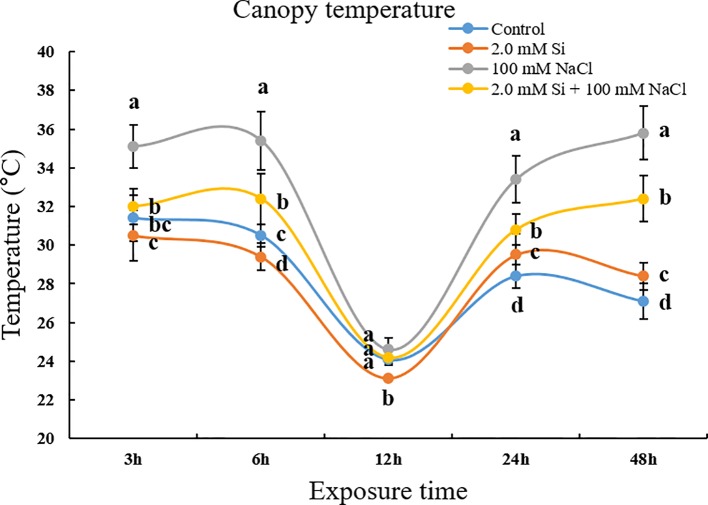
Canopy temperature after single or combined Si and NaCl treatments in soybean plants. Data were collected at 3, 6, 12, 24, and 48 h after stress exposure. Temperature data were calculated by an average temperature of the selected 20 spots on soybean leaves per treatment. In the figure, error bars denote standard deviation, and different letters near error bars indicate significant differences by Duncan's multiple range test (P < 0.05). Data were collected in triplicate and are presented as the average ± standard error (n = 10).
Figure 2
Figure 2
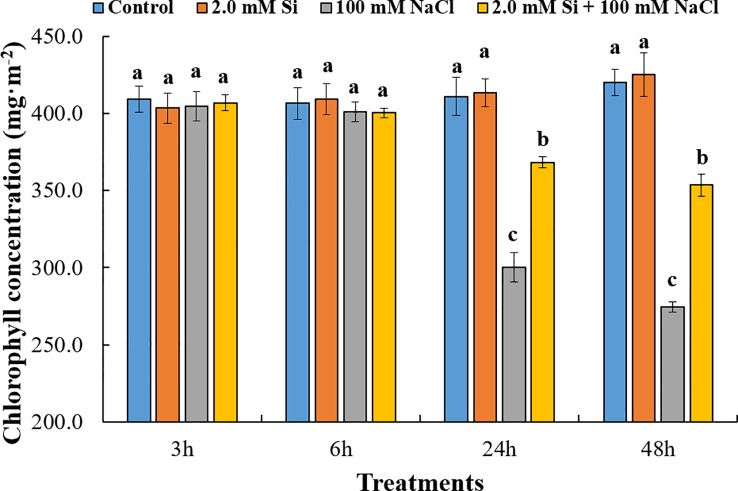
Influence of chlorophyll concentration after single or combined Si and NaCl treatments in soybean plants. Data were collected at 3, 6, 24, and 48 h after stress exposure. Different letters above error bars indicate significant differences by Duncan's multiple range test (P < 0.05). Data were collected in triplicate and are presented as the average ± standard error (n = 10).
Figure 3
Figure 3
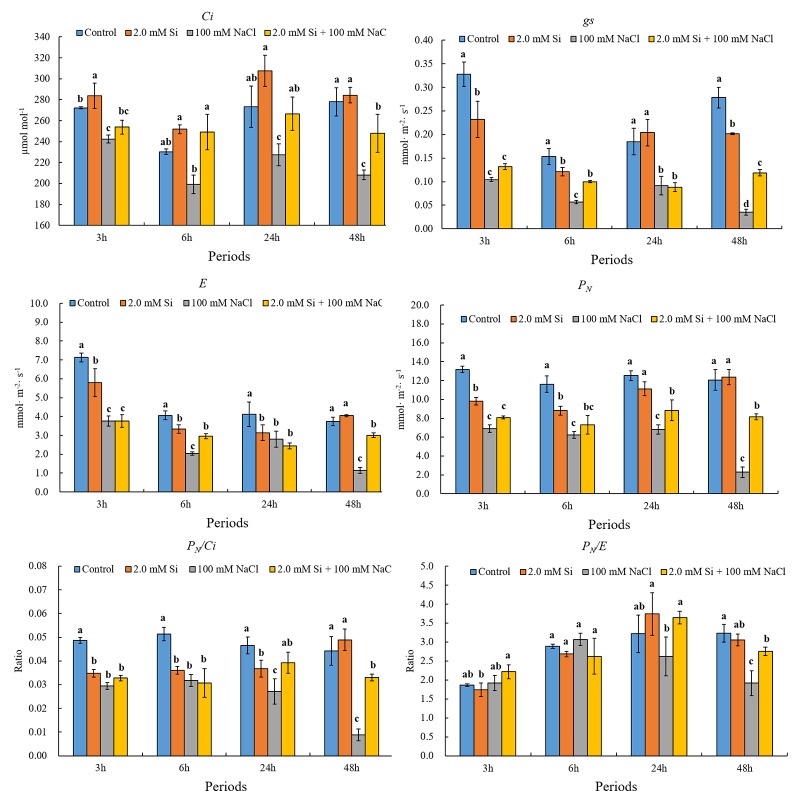
Effect of single or combined Si and NaCl treatment on net photosynthesis (PN), transpiration rate (E), stomatal conductance (gs), intercellular CO2 concentration (Ci), PN/Ci, and PN/E in soybean plants. Data were collected at 3, 6, 24, and 48 h after stress exposure. Different letters above error bars indicate significant differences by Duncan's multiple range test (P < 0.05). Data were collected in triplicate and are presented as the average ± standard error (n = 10).
Figure 4
Figure 4
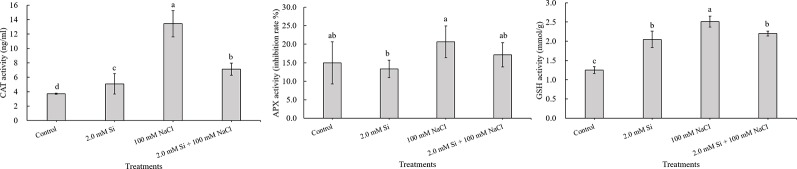
Changes in antioxidant activity after single or combined Si and NaCl. Data were collected after salt stress for 24 h. Different letters above error bars indicate significant differences by Duncan's multiple range test (P < 0.05). Data were collected in triplicate and are presented as the average ± standard error (n = 3).
Figure 5
Figure 5
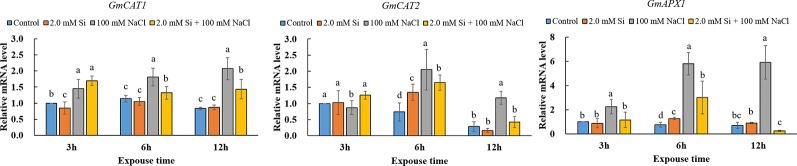
Relative messenger mRNA expression level of antioxidant-related genes (GmCAT1, GmCAT2, GmAPX1) after single or combined Si and NaCl. Data were collected at 3, 6, and 12 h after stress exposure. Different letters above error bars indicate significant differences by Duncan's multiple range test (P < 0.05). Data were collected in triplicate and are presented as the average ± standard error (n = 3).
Figure 6
Figure 6
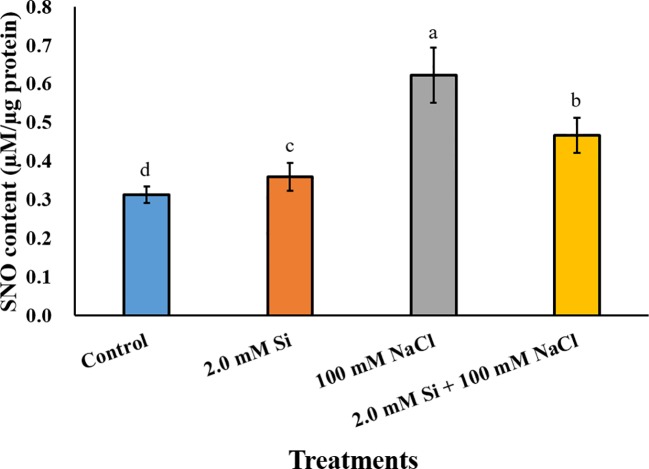
S-nitrosothiol (SNO) content after single or combined Si and NaCl. Data were collected after salt stress for 24 h. Different letters above error bars indicate significant differences by Duncan's multiple range test (P < 0.05). Data were collected in triplicate and are presented as the average ± standard error (n = 3).
Figure 7
Figure 7
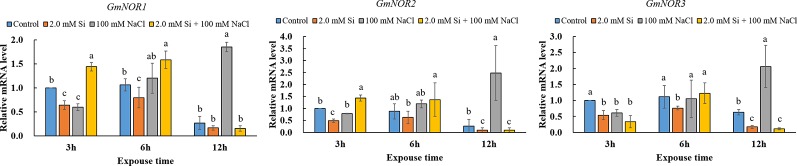
Relative mRNA expression level of SNO-related genes (GmNOR1, GmNOR2, GmNOR3) after single or combined Si and NaCl. Data were collected at 3, 6, and 12 h after stress exposure. Different letters above error bars indicate significant differences by Duncan's multiple range test (P < 0.05). Data were collected in triplicate and are presented as the average ± standard error (n = 3).

References

    1. Abdel Latef A. A., Tran L. S. P. (2016). Impacts of priming with silicon on the growth and tolerance of maize plants to alkaline stress. Front. Plant Sci. 7, 243. 10.3390/plants8090303 - DOI - PMC - PubMed
    1. Abdel Latef A. A., Srivastava A. K., Saber H., Alwaleed E. A., Tran L. S. P. (2017). Sargassum muticum and Jania rubens regulate amino acid metabolism to improve growth and alleviate salinity in chickpea. Sci. Rep. 7, 10537. 10.1007/s00344-018-9906-8 - DOI - PMC - PubMed
    1. Abdel Latef A. A., Srivastava A. K., Abdel-sadek M. S., Kordrostam M., Tran L. S. P. (2018). Titanium dioxide nanoparticles improve growth and enhance tolerance of broad bean plants under saline conditions. Land Degrad. Dev. 29, 1065–1073. 10.1002/ldr.2780 - DOI
    1. Abdel Latef A. A., Kordrostam M., Zakir A., Zaki H., Saleh O. M. (2019. a). Eustress with H2O2 facilitates plant growth by improving tolerance to salt stress in two wheat cultivars. Plants 8 (9), 303. 10.1038/s41598-017-07692-w - DOI - PMC - PubMed
    1. Abdel Latef A. A., Mostafa M. G., Rahman M. M., Abdel-Farid A. B., Tran L. S. P. (2019. b). Extracts from yeast and carrot roots enhance maize performance under seawater-induced salt stress by altering physio-biochemical characteristics of stressed plants. J. Plant Growth Regul. 38, 966–979. 10.3389/fpls.2016.00243 - DOI

LinkOut - more resources