The E2F family as potential biomarkers and therapeutic targets in colon cancer
- PMID: 32117628
- PMCID: PMC7035869
- DOI: 10.7717/peerj.8562
The E2F family as potential biomarkers and therapeutic targets in colon cancer
Abstract
Background: The E2F family is a group of genes encoding a series of transcription factors in higher eukaryotes and participating in the regulation of cell cycle and DNA synthesis in mammals. This study was designed to investigate the role of E2F family in colon cancer.
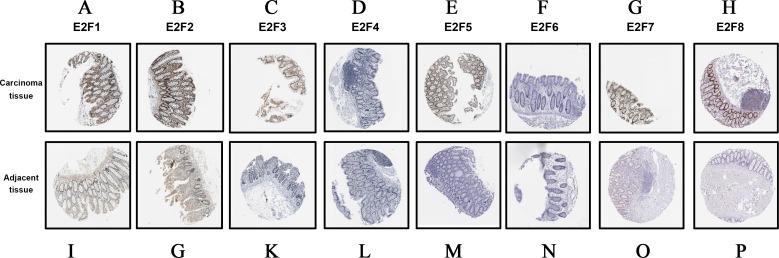
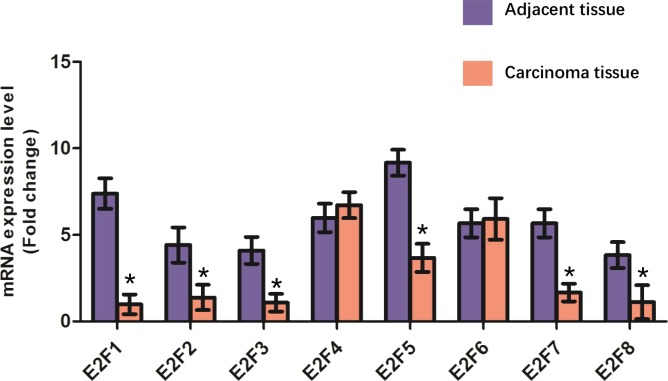
Methods: In this study, the transcriptional levels of E2F1-8 in patients with colon cancer from GEPIA was examined. Meanwhile, the immunohistochemical data of the eight genes were also obtained in the The Human Protein Atlas website. Additionally, we re-identified the mRNA expression levels of these genes via real time PCR. Furthermore, the association between the levels of E2F family and stage plot as wells overall survival of patients with colon cancer were analyzed.
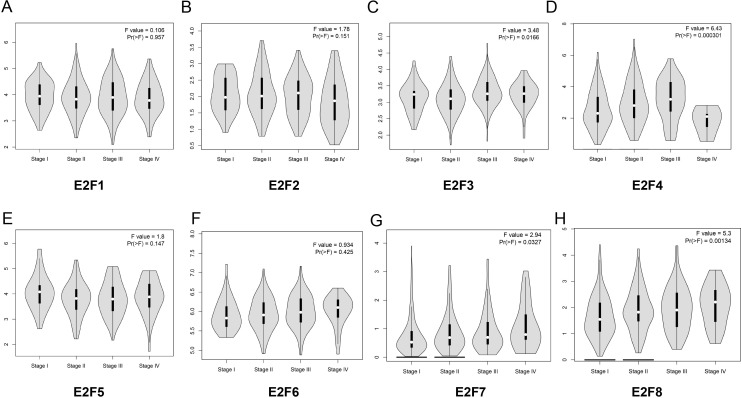
Results: We found that the mRNA and protein levels of E2F1, E2F2, E3F3, E2F5, E2F7 and E2F8 were significantly higher in colon cancer tissues than in normal colon tissues while the expression levels of E2F4 and E2F6 displayed no significant difference between colon cancer tissues and normal tissues. Additionally, E2F3, E2F4, E2F7 and E2F8 were significantly associated with the stages of colon cancer. The Kaplan-Meier Plotter showed that the high levels of E2F3 conferred a worse overall survival and disease free survival of patients with colon cancer. Also, high levels of E2F4 resulted in a worse overall survival.
Conclusion: Our study implied that E2F3, E2F4, E2F7 and E2F8 are potential targets of precision therapy for patients with colon cancer while E2F1, E2F2, E3F3, E2F5, E2F7 and E2F8 are potential biomarkers for the diagnosis of colon cancer.
Keywords: Bioinformatics; Biomarkers; Colon cancer; E2F family; Prognosis.
©2020 Yao et al.
Conflict of interest statement
The authors declare there are no competing interests.
Figures



References
-
- Ai YG, Kan Z, Jin LX, Jin LH, Lan G. Identification of a low-frequency missense variant in E2F transcription factor 7 associated with colorectal cancer risk in a chinese population. Asian Pacific Journal of Cancer Prevention. 2017;18(1):271–275. doi: 10.22034/APJCP.2017.18.1.271. - DOI - PMC - PubMed
-
- Bagaria SP, Heckman MG, Diehl NN, Parker A, Wasif N. Delay to colectomy and survival for patients diagnosed with colon cancer. Journal of Investigative Surgery. 2019;32(4):350–357. - PubMed
-
- Barbagallo C, Brex D, Caponnetto A, Cirnigliaro M, Scalia M, Magnano A, Caltabiano R, Barbagallo D, Biondi A, Cappellani A, Basile F, Di Pietro C, Purrello M, Ragusa M. LncRNA UCA1, upregulated in CRC biopsies and downregulated in serum exosomes, controls mRNA expression by RNA-RNA interactions. Molecular Therapy—Nucleic Acids. 2018;12:229–241. doi: 10.1016/j.omtn.2018.05.009. - DOI - PMC - PubMed
LinkOut - more resources
Full Text Sources