Review
. 2020 Feb 12:10:120.
doi: 10.3389/fonc.2020.00120. eCollection 2020.

Microbiome and Breast Cancer: New Role for an Ancient Population

Affiliations
Review

Microbiome and Breast Cancer: New Role for an Ancient Population

Zahra Eslami-S et al. Front Oncol. .

Abstract

There are many risk factors associated with breast cancer (BC) such as the familial history of BC, using hormone replacement therapy, obesity, personal habits, and other clinical factors; however, not all BC cases are attributed to these risk factors. Recent researches show a correlation between patient microbiome and BC suggested as a new risk factor. The present review article aimed at evaluating the role of the microbiome as a risk factor in the occurrence of BC, investigating the proposed mechanisms of interaction between the microbiome and human genes involved in BC, and assessing the impact of the altered composition of breast, gut, and milk microbiome in the physiological status of normal breast as well as cancerous or non-cancerous breast lesions. The study also evaluated the growing evidence that these altered populations may hinder chemotherapeutic treatment. The role of microbiome in the development and maintenance of inflammation, estrogen metabolism, and epigenetic alterations was properly investigated. Finally, clinical and therapeutic applications of the microbiome- e.g., probiotics, microbiome genome modulation, and engineered microbiome enzymes in the management of BC were reviewed.

Keywords: estrogen metabolism; gene-based therapy; microbiome chemotherapies; microbiome immunotherapy; microbiome radiotherapy; milk microbiome; probiotic therapy.


Figures

Figure 1
Figure 1
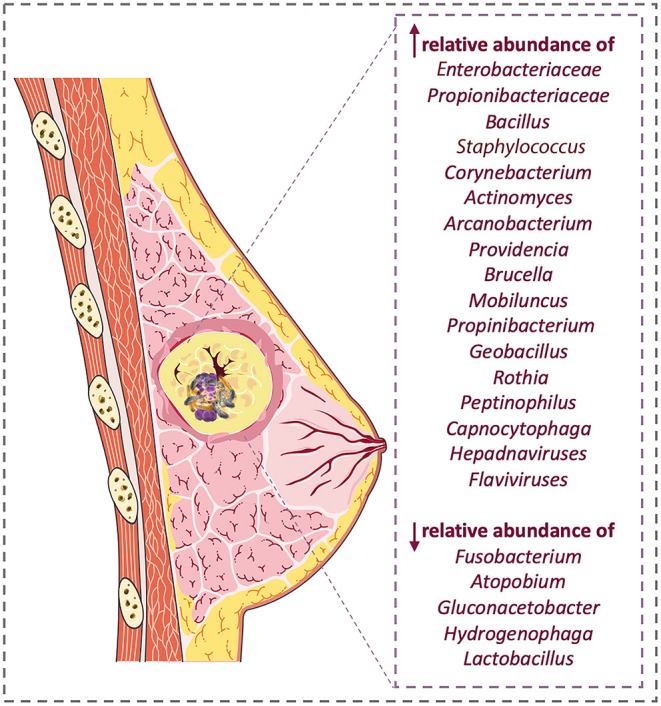
Breast cancer microbiome change; there are significant differences in microbiome population in patients compared with healthy samples.
Figure 2
Figure 2
Summary of microbiome effects and applications in breast cancer: (A) using probiotics to affect tumor progression by inhibiting cell proliferation and inducing apoptosis (B) conformational changes in β-glucoronidaze enzyme active site and different catalytic activities with genetic engineering might serve as targets to decrease the anticancer drug-induced toxicity, (C) using novel engineered recombinant probiotic to modify and target gut microbiome to reduce breast cancer risk, (D) The left-side mouse model was genetically manipulated to develop human breast tumor while right-side mouse model was fed by the Western-style diet to develop mammary tumors. Both models were treated with oral intake of probiotic lactic acid microbe, Lactobacillus reutri. The investigation showed that oral probiotic activates CD4+ and CD25+ lymphocytes and inhibits early-stage breast carcinogenesis. Moreover, oral probiotic prevented c-jun expression and NFκ-B-p65 translocation in the nucleus of breast cells and raised breast cell sensitivity to apoptosis, (E) reciprocal interaction of chemotherapy with bacterial diversity; using combination of chemotherapy and probiotics microbiome cocktails showed no effect, decreased and in some cases increased the chemotherapy agent toxicity, (F) microbiome by shifting balance of glucose utilization and fatty acid oxidation can indirectly affect immune system; hence, during radiotherapy, M1 macrophages increase the radio-sensitivity of BC cells, but M2 macrophages trigger radio-resistance via IL-4/IL-13-mediated STAT6 phosphorylation and M2 polarization.

References

    1. Fragomeni SM, Sciallis A, Jeruss JS. Molecular subtypes and local-regional control of breast cancer. Surgical Oncol Clin North America. (2018) 27:95–120. 10.1016/j.soc.2017.08.005 - DOI - PMC - PubMed
    1. Lacey JV, Kreimer AR, Buys SS, Marcus PM, Chang S-C, Leitzmann MF, et al. Breast cancer epidemiology according to recognized breast cancer risk factors in the Prostate, Lung, Colorectal and Ovarian (PLCO) Cancer Screening Trial Cohort. BMC Cancer. (2009) 9:84. 10.1186/1471-2407-9-84 - DOI - PMC - PubMed
    1. Rubinstein MR, Wang X, Liu W, Hao Y, Cai G, Han YW. Fusobacterium nucleatum promotes colorectal carcinogenesis by modulating E-cadherin/β-catenin signaling via its FadA adhesin. Cell Host Microbe. (2013) 14:195–206. 10.1016/j.chom.2013.07.012 - DOI - PMC - PubMed
    1. Nougayrède J-P, Homburg S, Taieb F, Boury M, Brzuszkiewicz E, Gottschalk G, et al. Escherichia coli induces DNA double-strand breaks in eukaryotic cells. Science. (2006) 313:848–51. 10.1126/science.1127059 - DOI - PubMed
    1. Wang TC, Goldenring JR, Dangler C, Ito S, Mueller A, Jeon WK, et al. Mice lacking secretory phospholipase A 2 show altered apoptosis and differentiation with Helicobacter felis infection. Gastroenterology. (1998) 114:675–89. 10.1016/S0016-5085(98)70581-5 - DOI - PubMed

LinkOut - more resources