. 2020 Feb 4:10:21.
doi: 10.3389/fcimb.2020.00021. eCollection 2020.

Fecal Serine Protease Profiling in Inflammatory Bowel Diseases

Affiliations

Fecal Serine Protease Profiling in Inflammatory Bowel Diseases

Amin Jablaoui et al. Front Cell Infect Microbiol. .

Abstract

Serine proteases are extensively known to play key roles in many physiological processes. However, their dysregulation is often associated to several diseases including inflammatory bowel diseases (IBD). Here, we used specific substrates to monitor fecal protease activities in a large cohort of healthy and IBD patients. Of interest, serine protease activity was 10-fold higher in IBD fecal samples compared to healthy controls. Moreover, functional analysis of these fecal proteolytic activities revealed that the most increased activities are trypsin-like, elastase-like and cathepsin G-like. We also show for the first time, an increase of proteinase 3-like activity in these samples compared to controls. Results presented here will guide further investigations to better understand the relevance of these peptidases in IBD.

Keywords: Holobiont; fecal proteases; gut microbiota; inflammatory bowel diseases; microbiome; protease profiling; serine protease inhibitors.


Figures

Figure 1
Figure 1
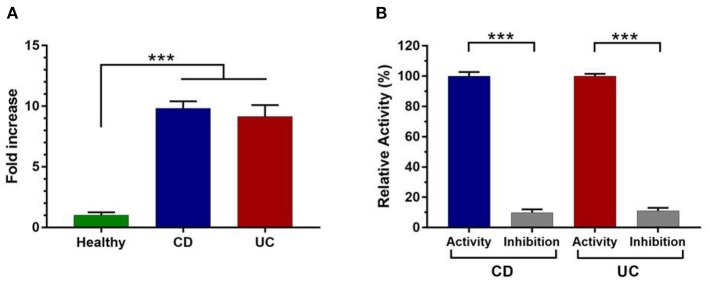
Measurement of total protease activity in fecal samples of control (n = 50) and IBD patients (n = 50). (A) Total fecal proteolytic activity in healthy subjects and IBD patients. (B) The relative proteolytic activity with or without pretreatment with PMSF in CD and UC samples. Data are mean ± SEM. Data were analyzed by Kruskal-Wallis test followed by Dunn's test. The relative activity corresponds to the maximal activity defined as 100% (CD = 363 U/mg and UC = 339 U/mg). Mann Whitney test was performed to compare the proteolytic activity without and in the presence of inhibitor (PMSF) in CD and UC patient. ***p < 0.001.
Figure 2
Figure 2
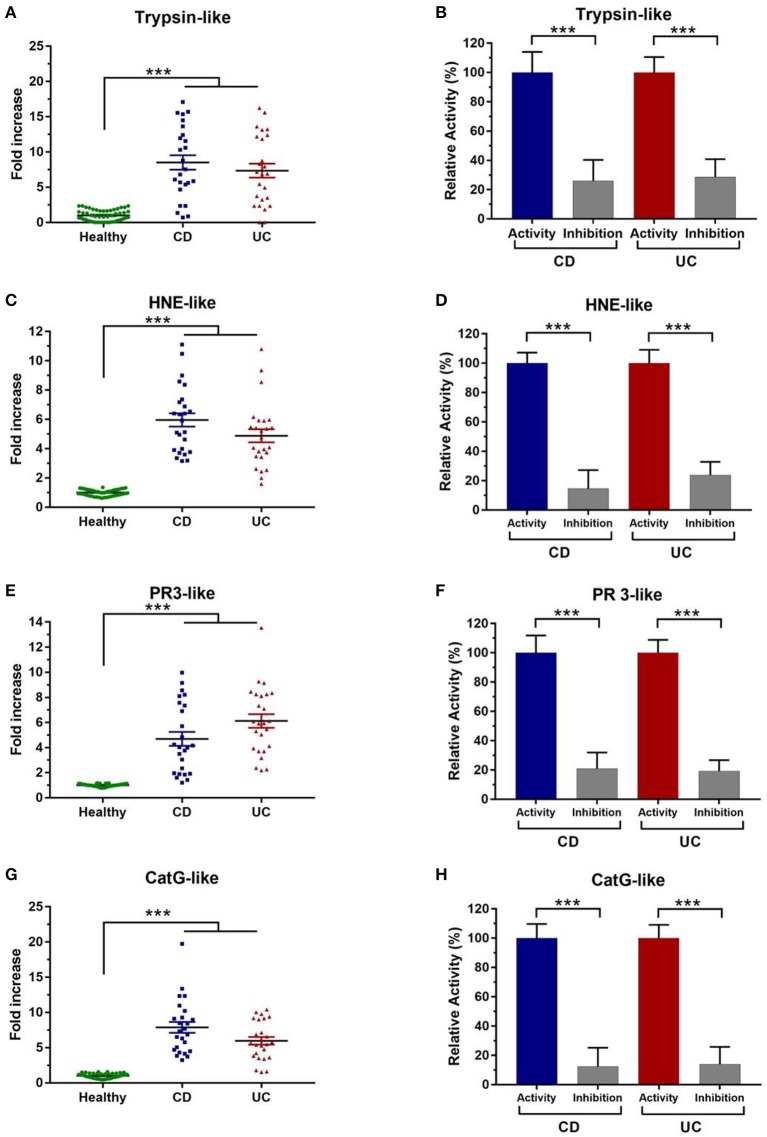
Characterization of fecal serine protease activity using specific inhibitors. (A) Fecal trypsin-like activity in healthy subjects (N = 50) and IBD patients (N = 50) (CD = 278 U/mg and UC = 234 U/mg). (B) Trypsin-like activity without and in the presence of their specific inhibitor. (C) Fecal HNE-like activity in healthy subjects and IBD patients (CD = 126 U/mg and UC = 105 U/mg). (D) HNE like-activity without and in the presence of their specific inhibitor. (E) Proteinase 3-like activity in healthy individuals and IBD patients (CD = 85 U/mg and UC = 102 U/mg). (F) Inhibition assay of PR3-like activity in the presence of their specific inhibitor. (G) Cathepsin G-like activity in healthy individuals and IBD patients (CD = 68 U/mg and UC = 54 U/mg). (H) Inhibition assay of Cat G-like activity in the presence of their specific inhibitor. The relative activity corresponds to the maximal activity defined as 100%. The error bars represent the SEM. Data were analyzed by Kruskal-Wallis test followed by Dunn's test to compare protease activity in CD and UC patient to healthy control. Mann Whitney test was performed to compare the proteolytic activity without and in the presence of each inhibitor in CD and UC patient. ***p < 0.001.

References

    1. Bencsik P., Bartekova M., Görbe A., Kiss K., Pálóczi J., Radosinska J., et al. (2017). MMP activity detection in zymograms. Methods Mol. Biol. 1626, 53–70. 10.1007/978-1-4939-7111-4_6 - DOI - PubMed
    1. Biancheri P., Di Sabatino A., Corazza G. R., MacDonald T. T. (2013). Proteases and the gut barrier. Cell Tissue Res. 351, 269–280. 10.1007/s00441-012-1390-z - DOI - PubMed
    1. Bustos D., Negri G., De Paula J. A., Di Carlo M., Yapur V., Facente A., et al. (1998). Colonic proteinases: increased activity in patients with ulcerative colitis. Medicina 58, 262–264. - PubMed
    1. Carding S., Verbeke K., Vipond D. T., Corfe B. M., Owen L. J. (2015). Dysbiosis of the gut microbiota in disease. Microb. Ecol. Health Dis. 26:26191. 10.3402/mehd.v26.26191 - DOI - PMC - PubMed
    1. Cenac N., Coelho A. M., Nguyen C., Compton S., Andrade-Gordon P., MacNaughton W. K., et al. (2002). Induction of intestinal inflammation in mouse by activation of proteinase-activated receptor-2. Am J Pathol. 161, 1903–1915. 10.1016/S0002-9440(10)64466-5 - DOI - PMC - PubMed

Publication types

LinkOut - more resources