. 2020 Feb 7:7:46.
doi: 10.3389/fvets.2020.00046. eCollection 2020.

Heat Stress Causes Immune Abnormalities via Massive Damage to Effect Proliferation and Differentiation of Lymphocytes in Broiler Chickens

Affiliations

Heat Stress Causes Immune Abnormalities via Massive Damage to Effect Proliferation and Differentiation of Lymphocytes in Broiler Chickens

Ryota Hirakawa et al. Front Vet Sci. .

Abstract

Broiler chickens are highly sensitive to high ambient temperatures due to their feathers, lack of skin sweat glands, and high productivity. Heat stress (HS) is a major concern for the poultry industry because it negatively affects growth as well as immune functions, which increase the potential risk of infectious disease outbreaks. Therefore, it is vital to elucidate HS's effect on the avian immune system, especially considering the global rise in average surface temperature. Our study identified a series of immunological disorders in heat-stressed broiler chickens. We exposed 22-day-old broiler chickens to a continuous HS condition (34.5 ± 0.5°C) for 14 days and immunized them with a prototype bovine serum albumin (BSA) antigen. The plasma and lymphoid tissues (thymus, bursa of Fabricius, and spleen) were harvested at the end of the experiments to investigate the induction of BSA-specific immune responses. Our results revealed that plasma titers of immunoglobulin (Ig)Y, IgM, and IgA antibodies specific for BSA were lower than those of thermoneutral chickens immunized with BSA. Furthermore, the spleens of the heat-stressed broiler chickens displayed severe depression of Bu1+ B cells and CD3+ T cells, including CD4+ T cells and CD8+ T cells, and lacked a fully developed germinal center (GC), which is crucial for B cell proliferation. These immunological abnormalities might be associated with severe depression of CD4-CD8- or CD4+CD8+ cells, which are precursors of either helper or killer T cells in the thymus and Bu1+ B cells in the bursa of Fabricius. Importantly, HS severely damaged the morphology of the thymic cortex and bursal follicles, where functional maturation of T and B cells occur. These results indicate that HS causes multiple immune abnormalities in broiler chickens by impairing the developmental process and functional maturation of T and B cells in both primary and secondary lymphoid tissues.

Keywords: broiler chickens; bursa of fabricius; heat stress; immunity; spleen; thymus.


Figures

Figure 1
Figure 1
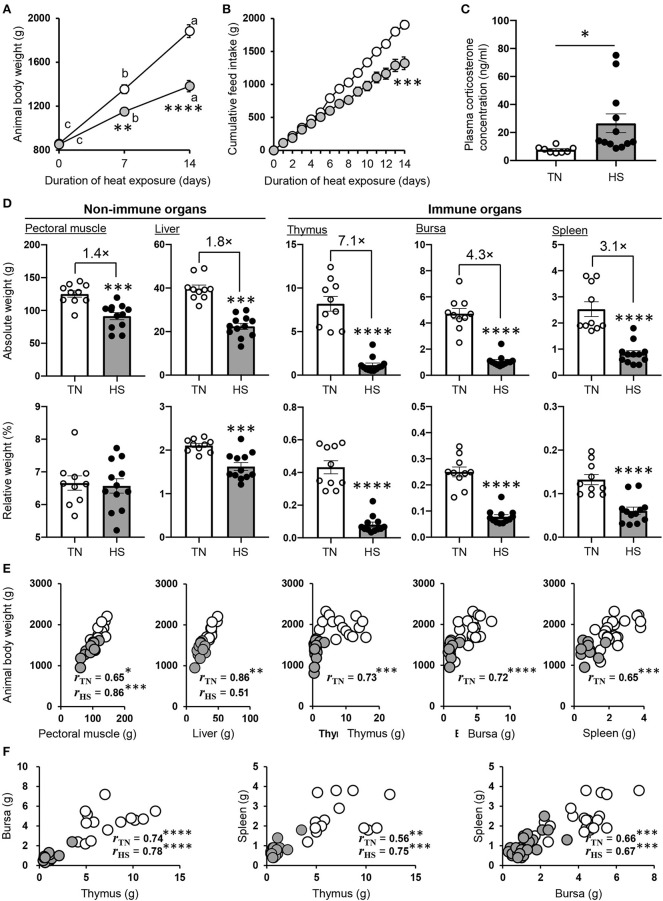
Performance parameters of broiler chickens under the HS condition. (A,B) The chickens were maintained under the TN (24 ± 0.5°C) or HS (34.5 ± 0.5°C) condition. The HS and TN conditions are indicated by gray and clear circles, respectively. Animal body weight (A) and cumulative feed intake (B) of each group were measured for 2 weeks (22–36 days old). (C) The plasma CORT concentration was analyzed in both groups at 36 days of age. (D) The pectoral muscle, liver, thymus, bursa of Fabricius, and spleen were harvested from each group at 36 days of age, and their absolute and relative weights were measured. Three experiments were conducted and a representative result was shown in (A–D). (E,F) The relationship between body weight, the weight of each tissue (E), and among the weight of lymphoid tissues (F) obtained from all three experiments conducted were evaluated by Pearson correlation analyses. The data are presented as means ± SE (n = 10–12/group for animal body weight and cumulative feed intake, n = 10–12/group for tissue weight and plasma CORT concentration). *p < 0.05, **p < 0.01, ***p < 0.001, ****p < 0.0001 compared with the TN group (unpaired two-tailed Student's t-test). (A) For points a, b, and c, p < 0.05 compared among each group for the different time points.
Figure 2
Figure 2
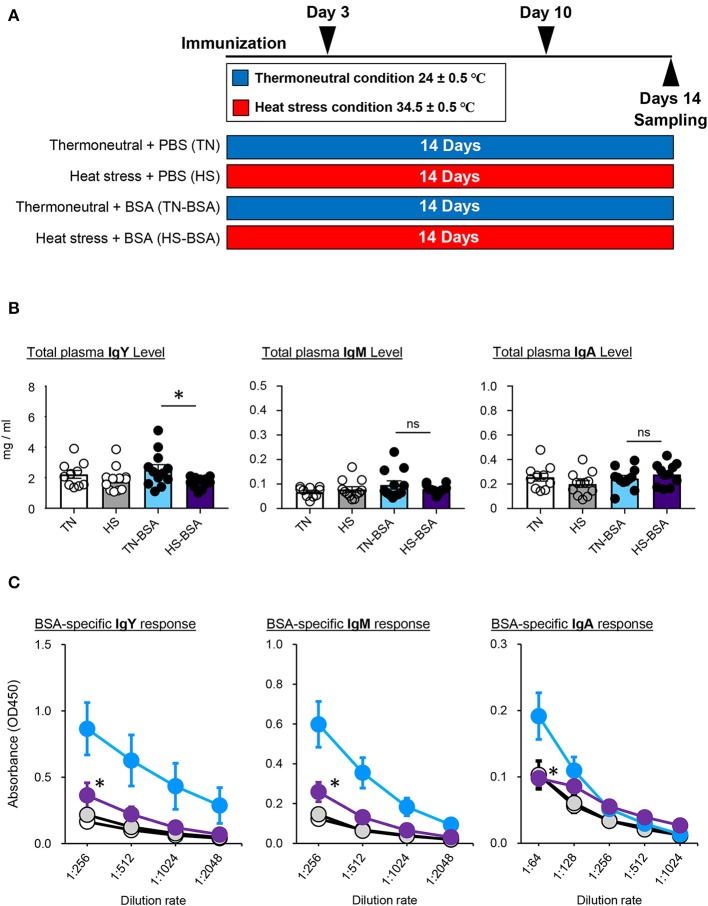
Antigen-specific immune response of broiler chickens reared in the HS condition (A). The experimental schedule is summarized. All birds were maintained in either TN or HS condition throughout the 14-days experimental period. To assess antigen-specific immune responses of heat-stressed chickens, broiler chickens under the TN (TN-BSA) and HS (HS-BSA) conditions were immunized intramuscularly with 10 μg of BSA on days 3 and 10 of the experiment. As a control, other broiler chickens, maintained under the TN and HS conditions, were immunized intramuscularly with phosphate-buffered saline on days 3 and 10 of the experiment. Blood samples were collected from the wing veins of all chickens 4 days after initial and booster immunization (B,C). Total plasma IgY, IgM, and IgA levels (B) and BSA-specific IgY, IgM, and IgA responses (C) were analyzed by ELISA. Three experiments were conducted and a representative result was shown. The data are presented as means ± SE (n = 10–12/group). *p < 0.05 compared between TN-BSA and HS-BSA (unpaired two-tailed Student's t-test). Clear, TN; gray, HS; blue; TN-BSA; purple, HS-BSA.
Figure 3
Figure 3
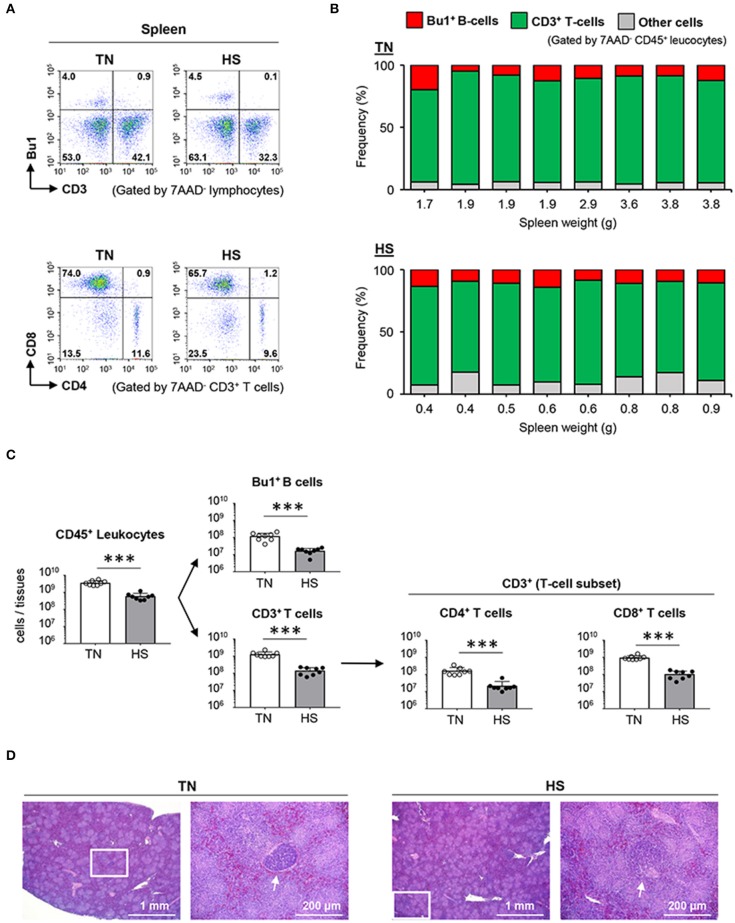
Effect of HS on lymphocytes and the spleen morphology of broiler chickens. Broiler chickens were maintained in the TN or HS condition for 14 days (A,B). Representative flow cytometry profiles of 7AADCD45+ leucocytes and 7AADCD3+ T cells in the spleen at 36 days of age. (C) Cell components of splenic CD45+ leucocytes, including CD3+ T cells, Bu1+ B cells, and other cells, and absolute number of splenic CD45+ leucocytes, Bu1+ B cells, CD3+ T cells, CD4+ helper T cells, and CD8+ killer T cells were analyzed by flow cytometry (D). Representative hematoxylin and eosin-stained histological sections of spleen at 36 days of age. Scale bar: 200 μm. Arrows: germinal center. The data are presented as means ± SE (n = 8/group). ***p < 0.001 compared with the TN group (unpaired two-tailed Student's t-test).
Figure 4
Figure 4
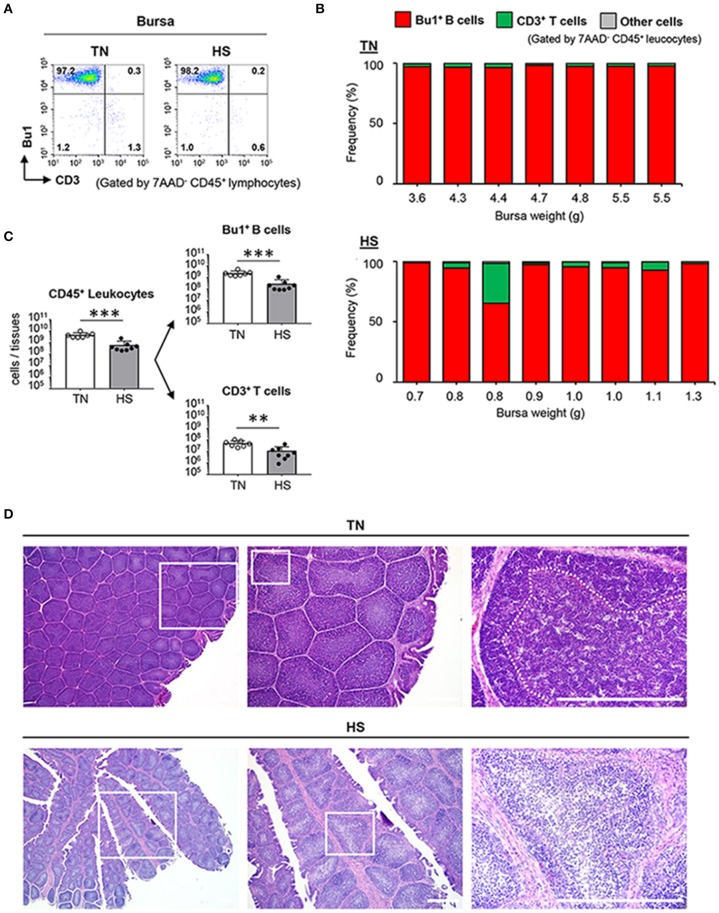
Effect of HS on the functional maturation of B cells in the bursa of Fabricius. Broiler chickens were maintained in either TN or HS condition for 14 days (A,B). Representative flow cytometry profiles of 7AADCD45+ leucocytes in bursa of Fabricius at 36 days of age (C). Cell components of bursal CD45+ leucocytes, including CD3+ T cells, Bu1+ B cells, other cells, and absolute number of bursal CD45+ leucocytes, Bu1+ B cells, and CD3+ T cells were analyzed by flow cytometry (D). Representative hematoxylin and eosin-stained histological sections of bursa of Fabricius at 36 days of age. Scale bar: 200 μm. Dotted line: Border between cortex and medulla. The data are presented as mean ± SE (n = 7–8/group). **p < 0.01, ***p < 0.001 compared with the TN group (unpaired two-tailed Student's t-test). IFE, interfollicular epithelium; FAE, follicle-associated epithelium.
Figure 5
Figure 5
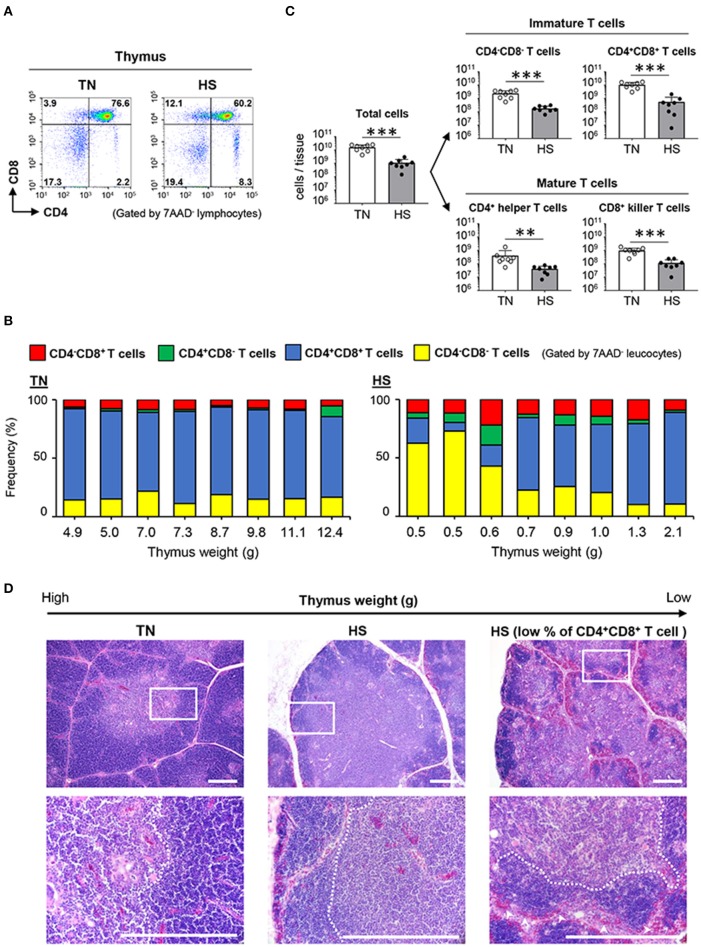
Effect of HS on the immature and mature T cells of the thymus. Broiler chickens were maintained in either TN or HS condition for 14 days (A,B). Representative flow cytometry profiles of 7AAD leucocytes in the thymus at 36 days of age. (C) Cell components of thymic lymphocytes including CD4CD8 cells, CD4+CD8+ cells, CD4+CD8 helper T cells, and CD4CD8+ killer T cells, and absolute number of thymic T cell subsets were analyzed by flow cytometry. (D) Representative hematoxylin and eosin-stained histological sections of the thymus at 36 days of age. Scale bar: 200 μm. Dotted line: Border between cortex and medulla. Arrowheads: erythrocytes. The data are presented as means ± SE (n = 8/group). **p < 0.01, ***p < 0.001 compared with the TN group (unpaired two-tailed Student's t-test).

References

    1. Azad MAK, Kikusato M, Maekawa T, Shirakawa H, Toyomizu M. Metabolic characteristics and oxidative damage to skeletal muscle in broiler chickens exposed to chronic heat stress. Comp Biochem Physiol A Mol Integr Physiol. (2010) 155:401–6. 10.1016/j.cbpa.2009.12.011 - DOI - PubMed
    1. Azad MAK, Kikusato M, Zulkifli I, Toyomizu M. Electrolysed reduced water decreases reactive oxygen species-induced oxidative damage to skeletal muscle and improves performance in broiler chickens exposed to medium-term chronic heat stress. Br Poult Sci. (2013) 54:503–9. 10.1080/00071668.2013.801067 - DOI - PubMed
    1. Quinteiro-Filho WM, Ribeiro A, Ferraz-de-Paula V, Pinheiro ML, Sakai M, Sa LR, et al. Heat stress impairs performance parameters, induces intestinal injury, and decreases macrophage activity in broiler chickens. Poult Sci. (2010) 89:1905–14. 10.3382/ps.2010-00812 - DOI - PubMed
    1. Fang XL, Zhang YT, Fang Q. [Impact of intravenous nutrition on plasma free amino acid spectrum and immune function for patients with sepsis]. Zhejiang Da Xue Xue Bao Yi Xue Ban. (2007) 36:298−302. - PubMed
    1. Lasiewski RC. Physiological responses to heat stress in the poorwill. Am J Physiol. (1969) 217:1504–9. 10.1152/ajplegacy.1969.217.5.1504 - DOI - PubMed