Review
. 2020 Feb 12;5(7):3108-3115.
doi: 10.1021/acsomega.9b03695. eCollection 2020 Feb 25.

Small-Molecule Inhibition of Bacterial Biofilm

Affiliations
Review

Small-Molecule Inhibition of Bacterial Biofilm

Anirban Ghosh et al. ACS Omega. .

Abstract

Antibiotic resistance is a massive and serious threat to human welfare and healthcare. Apart from being genetically resistant to antibiotics, the other important mechanism by which bacteria can evade antibiotics is multidrug tolerance. Here cells enter into a transiently nongrowing phase, and as a result, latent infection remains inside the host, causing disease recurrence. Biofilm-derived antibiotic tolerance and persister formation of the pathogenic bacteria inside the host remain a serious issue of treatment failure and recurrent chronic infection in the case of all major pathogens. As a result, new chemotherapeutic agents are sought that specifically inhibit biofilm formation or maturation as well as cause the dispersion of mature biofilms, thus allowing the conventional drugs to kill sensitive cells residing inside. This mini-review attempts to analyze different small-molecule-based chemical approaches that have been used to enable bacterial biofilm inhibition at different steps of maturation.


Conflict of interest statement

The authors declare no competing financial interest.

Figures
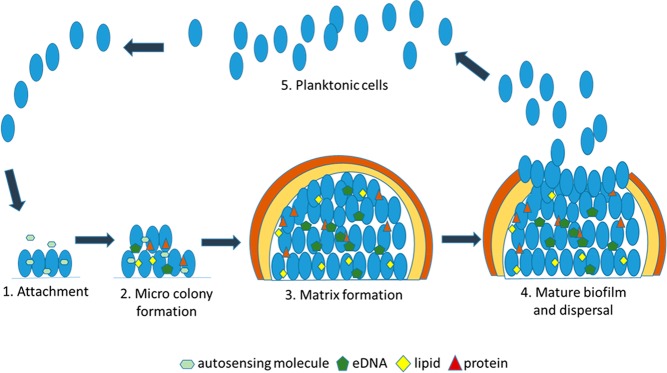
Figure 1
Figure 1
Different steps of bacterial biofilm formation.
Figure 2
Figure 2
(A) Metabolic activity of cells within biofilm is a function of depth, and (B) the biofilm enables partial penetration and killing by antibiotics.
Figure 3
Figure 3
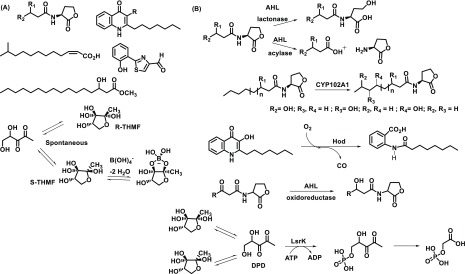
(A) Chemical structures of few Gram (-ve) bacterial quorum-sensing molecules. (B) Different reactions catalyzed by quorum-sensing molecule-degrading enzymes.
Figure 4
Figure 4
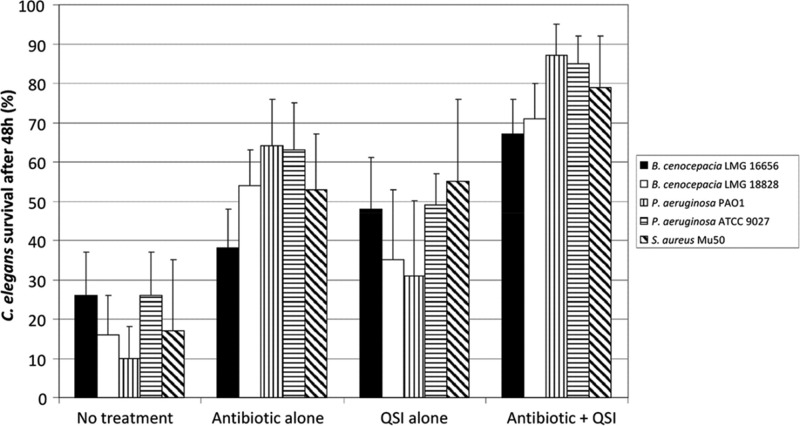
Quorum-sensing inhibitors increase the antibiotic susceptibility of P. aeruginosa, S.aureus, and B. cenocepacia biofilms (reproduced with permission from Brackman and co-workers, 2011).
Figure 5
Figure 5
Structures of (p)ppGpp inhibitors: (A) vitamin C; (B) GSK-X9; and (C and D) acetylated and benzoylated nucleoside compounds.
Figure 6
Figure 6
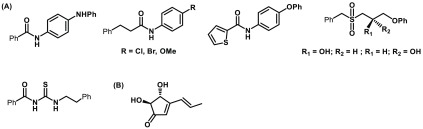
Chemical structures of (A) novel small molecule inhibiting DGC and (B) natural product terrain.
Figure 7
Figure 7
Molecular structures of (A) mannanglycolipids (1–3) and arabinomannan glycolipid (4) and (B) synthetic oligoarabinan glycolipids.
Figure 8
Figure 8
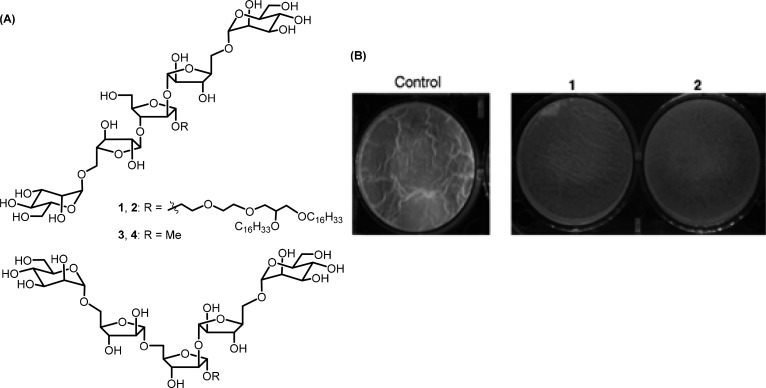
(A) Chemical structures of arabinomannan glycolipids (1, 2) and the corresponding oligosaccharides (3, 4). (B) Disruption of preformed mature biofilm with compounds 1 and 2 (reproduced with permission from Syal and co-workers, 2016).

References

    1. Flemming H. C.; Wingender J. Relevance of microbial extracellular polymeric substances (EPSs)--Part I: Structural and ecological aspects. Water Sci. Technol. 2001, 43, 1–8. 10.2166/wst.2001.0326. - DOI - PubMed
    1. Wan Y. Z.; Xiong G. Y.; Liang H.; Raman S.; He F.; Huang Y. Modification of medical metals by ion implantation of copper. Appl. Surf. Sci. 2007, 253, 9426–9429. 10.1016/j.apsusc.2007.06.031. - DOI
    1. Tang K.; Zhang X. H. Quorum quenching agents: resources for antivirulence therapy. Mar. Drugs 2014, 12, 3245–3282. 10.3390/md12063245. - DOI - PMC - PubMed
    1. Lee J. H.; Lee J. Indole as an intercellular signal in microbial communities. FEMS Microbiol. Rev. 2010, 34, 426–444. 10.1111/j.1574-6976.2009.00204.x. - DOI - PubMed
    1. Fetzner S. Quorum quenching enzymes. J. Biotechnol. 2015, 201, 2–14. 10.1016/j.jbiotec.2014.09.001. - DOI - PubMed

LinkOut - more resources