Child Access Prevention Firearm Laws and Firearm Fatalities Among Children Aged 0 to 14 Years, 1991-2016
- PMID: 32119063
- PMCID: PMC7052788
- DOI: 10.1001/jamapediatrics.2019.6227
Child Access Prevention Firearm Laws and Firearm Fatalities Among Children Aged 0 to 14 Years, 1991-2016
Abstract
Importance: Firearms caused more than 500 pediatric fatalities in 2017-a 50% increase from 2009. Laws regulating firearms are one approach to reducing pediatric firearm fatalities.
Objective: To evaluate the association between state child access prevention (CAP) firearm laws and pediatric firearm fatalities.
Design, setting, and participants: A state-level, cross-sectional study of CAP firearm laws throughout the United States, 1991-2016, was conducted using negative binomial regression to analyze differences in state fatality rates in children aged 0 to 14 years. Data analysis was performed from November 21, 2018, to October 18, 2019.
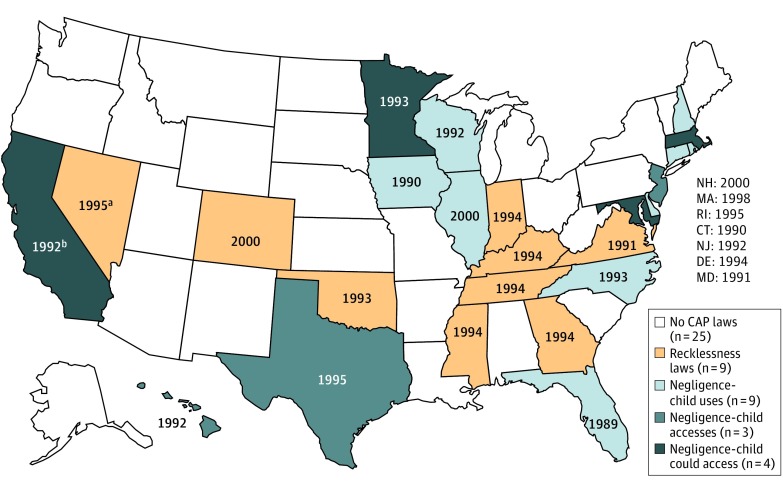
Exposures: Implementation of 2 categories of state CAP firearm laws: recklessness laws, which pertain to providing a firearm to a child, and negligence laws, which pertain to accessibility of a firearm within the home.
Main outcomes and measures: Rates of firearm fatalities across all intents and by specific intent (homicide, suicide, and unintentional) per 100 000 children aged 0 to 14 years.
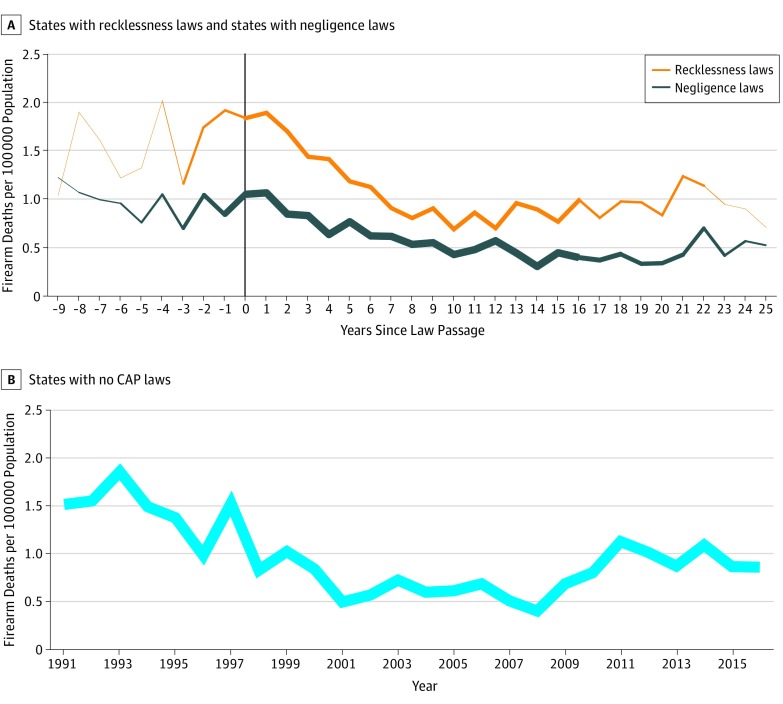
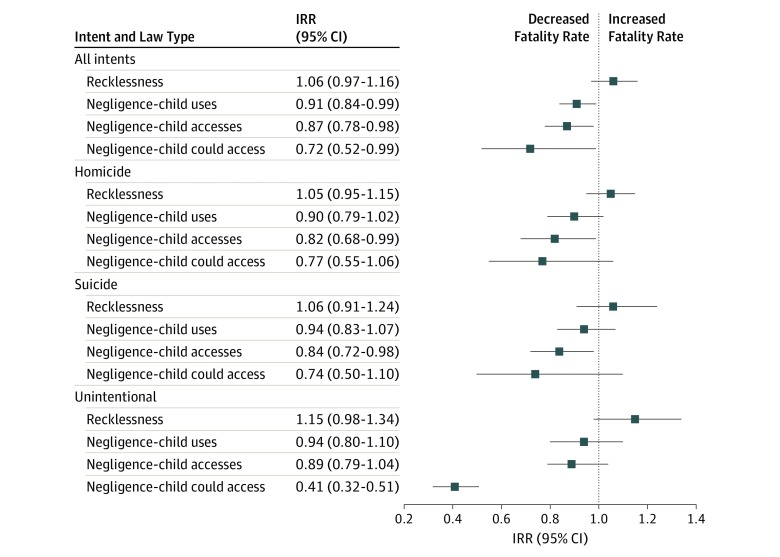
Results: Twenty-five states passed CAP laws between 1989 and 2000. Between 1991 and 2016, 13 697 firearm fatalities occurred in children aged 0 to 14 years. Recklessness laws were not associated with changes in pediatric firearm fatality rates. Negligence laws overall were associated with significant reductions in firearm fatalities in children aged 0 to 14 years, with a 13% relative reduction in all firearm fatalities (95% CI, -18% to -7%), a 15% relative reduction in firearm homicides (95% CI, -22% to -7%), a 12% relative reduction in firearm suicides (95% CI, -20% to -2%), and a 13% relative reduction in unintentional firearm fatalities (95% CI, -24% to -1%). The most stringent negligence laws were associated with unintentional firearm fatality reductions of 59% (95% CI, -68% to -49%). A total of 3929 deaths (29% of all firearm deaths) were associated with states not having passed the most stringent form of negligence CAP laws.
Conclusions and relevance: In this study, negligence laws were associated with relative reductions in firearm fatality rates in children aged 0 to 14 years. The most stringent negligence laws were associated with the largest reductions in unintentional firearm fatalities. Recklessness laws were not associated with reduced firearm fatality rates. The passage of negligence CAP laws may have the potential to reduce firearm fatalities in children.
Conflict of interest statement
Figures
Comment in
-
Evidence-Based Solutions to Pediatric Firearm Deaths-The Need for Out-of-the-Box Answers.JAMA Pediatr. 2020 May 1;174(5):411-412. doi: 10.1001/jamapediatrics.2019.6239. JAMA Pediatr. 2020. PMID: 32119061 Free PMC article. No abstract available.
References
-
- Centers for Disease Control and Prevention Injury prevention and control: data and statistics (WISQARS). https://www.cdc.gov/injury/wisqars/index.html. Accessed April 30, 2019.
-
- APA Council of Representatives Resolution on firearm violence research and prevention. https://www.apa.org/about/policy/firearms. Published February 2014. Accessed August 29, 2019.
-
- American Academy of Pediatrics State advocacy focus: safe storage of firearms. https://www.apa.org/about/policy/firearms. Accessed August 29, 2019.
Publication types
MeSH terms
LinkOut - more resources
Full Text Sources
Miscellaneous