


Applying concepts of life course theory and life course epidemiology to the study of bladder health and lower urinary tract symptoms among girls and women
- PMID: 32119156
- PMCID: PMC7659467
- DOI: 10.1002/nau.24325
Applying concepts of life course theory and life course epidemiology to the study of bladder health and lower urinary tract symptoms among girls and women
Abstract
Aims: Although lower urinary tract symptoms (LUTS) may occur at different periods during the life course of women, a little research on LUTS has adopted a life course perspective. The purpose of this conceptual paper is to demonstrate how life course theory and life course epidemiology can be applied to study bladder health and LUTS trajectories. We highlight conceptual work from the Prevention of Lower Urinary Tract Symptoms Research Consortium to enhance the understanding of life course concepts.
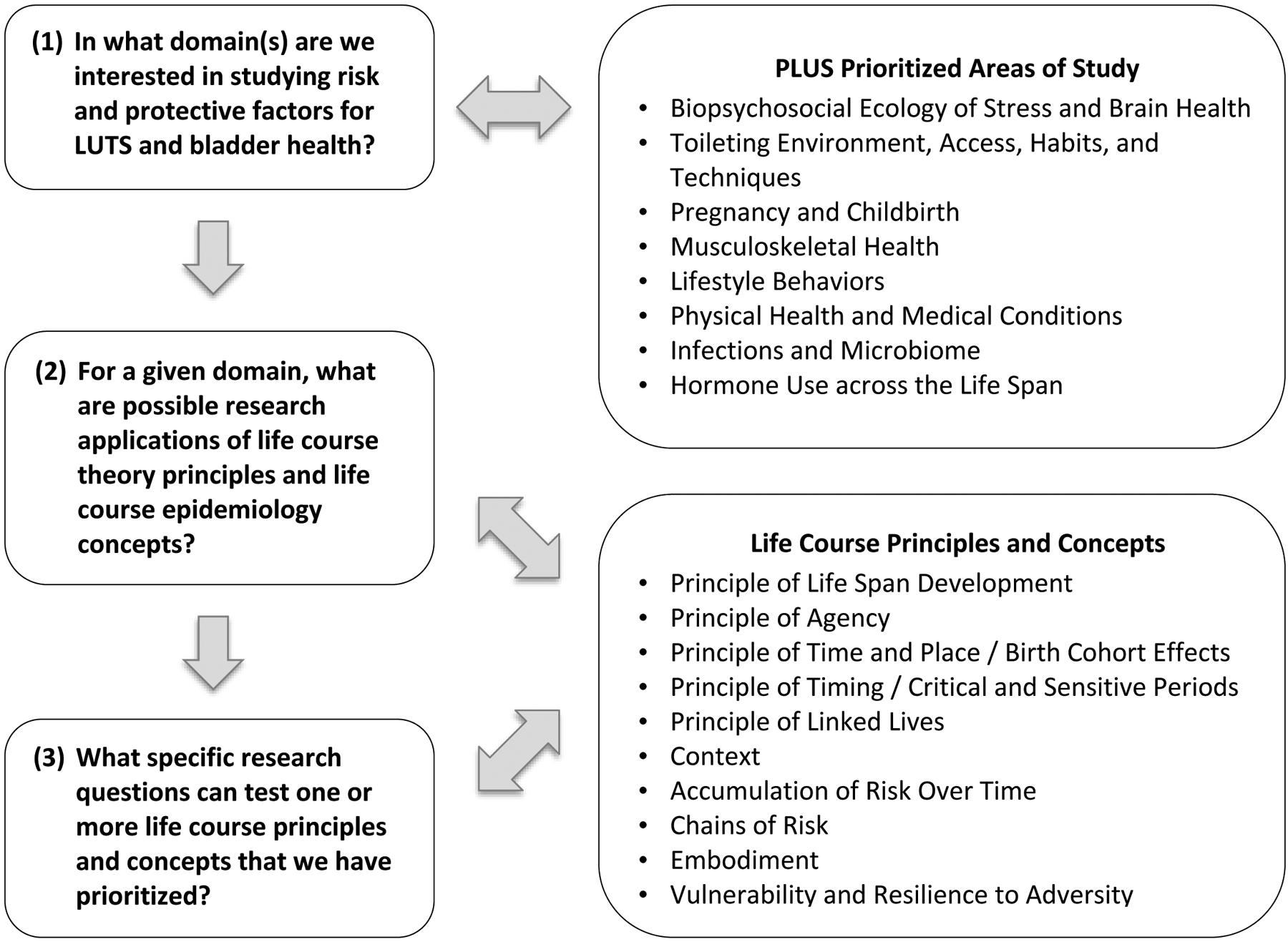
Methods: Consortium members worked in transdisciplinary teams to generate examples of how life course concepts may be applied to research on bladder health and LUTS in eight prioritized areas: (a) biopsychosocial ecology of stress and brain health; (b) toileting environment, access, habits, and techniques; (c) pregnancy and childbirth; (d) physical health and medical conditions; (e) musculoskeletal health; (f) lifestyle behaviors; (g) infections and microbiome; and (h) hormonal status across the life span.
Results: Life course concepts guided consortium members' conceptualization of how potential risk and protective factors may influence women's health. For example, intrapartum interventions across multiple pregnancies may influence trajectories of bladder health and LUTS, illustrating the principle of life span development. Consortium members also identified and summarized methodologic and practical considerations in designing life course research.
Conclusions: This paper may assist researchers from a variety of disciplines to design and implement research identifying key risk and protective factors for LUTS and bladder health across the life course of women. Results from life course research may inform health promotion programs, policies, and practices.
Keywords: bladder health; epidemiology; girls; life course; lower urinary tract symptoms; prevention; theory; transdisciplinary; women.
© 2020 Wiley Periodicals, Inc.
Conflict of interest statement
Conflict of Interest Statement
There are no reported financial conflicts directly related to this work. The Prevention of Lower Urinary Symptoms (PLUS) Research Consortium is supported by the National Institutes of Health (NIH) through cooperative agreements (U01DK106786, U01DK106853, U01DK106858, U01DK106898, U01DK106893, U01DK106827, U01DK106908, U01DK106892).
Figures
References
-
- Abrams P, Andersson KE, Birder L, et al. Fourth International Consultation on Incontinence Recommendations of the International Scientific Committee: Evaluation and treatment of urinary incontinence, pelvic organ prolapse, and fecal incontinence. Neurourol Urodyn. 2010;29(1):213–240. - PubMed
-
- Haylen BT, de Ridder D, Freeman RM, et al. An International Urogynecological Association (IUGA)/International Continence Society (ICS) joint report on the terminology for female pelvic floor dysfunction. Neurourol Urodyn. 2010;29(1):4–20. - PubMed
-
- Horowitz M, Cohen J. Review of adolescent urinary tract infection. Curr Urol Rep. July 2007;8(4):319–323. - PubMed
-
- Butler RJ, Heron J. The prevalence of infrequent bedwetting and nocturnal enuresis in childhood. A large British cohort. Scand J Urol Nephrol. 2008;42(3):257–264. - PubMed
-
- Swithinbank LV, Heron J, von Gontard A, Abrams P. The natural history of daytime urinary incontinence in children: a large British cohort. Acta Paediatr. July 2010;99(7):1031–1036. - PubMed
Publication types
MeSH terms
Grants and funding
LinkOut - more resources
Full Text Sources
Medical
