


Changes in disease burden in Poland between 1990-2017 in comparison with other Central European countries: A systematic analysis for the Global Burden of Disease Study 2017
- PMID: 32119685
- PMCID: PMC7051048
- DOI: 10.1371/journal.pone.0226766
Changes in disease burden in Poland between 1990-2017 in comparison with other Central European countries: A systematic analysis for the Global Burden of Disease Study 2017
Abstract
Background: Systematic collection of mortality/morbidity data over time is crucial for monitoring trends in population health, developing health policies, assessing the impact of health programs. In Poland, a comprehensive analysis describing trends in disease burden for major conditions has never been published. The Global Burden of Diseases, Injuries, and Risk Factors Study (GBD) provides data on the burden of over 300 diseases in 195 countries since 1990. We used the GBD database to undertake an assessment of disease burden in Poland, evaluate changes in population health between 1990-2017, and compare Poland with other Central European (CE) countries.
Methods: The results of GBD 2017 for 1990 and 2017 for Poland and CE were used to assess rates and trends in years of life lost (YLLs), years lived with disability (YLDs), disability-adjusted life years (DALYs). Data came from cause-of-death registration systems, population health surveys, disease registries, hospitalization databases, and the scientific literature. Analytical approaches have been used to adjust for missing data, errors in cause-of-death certification, and differences in data collection methodology. Main estimation strategies were ensemble modelling for mortality and Bayesian meta-regression for disability.
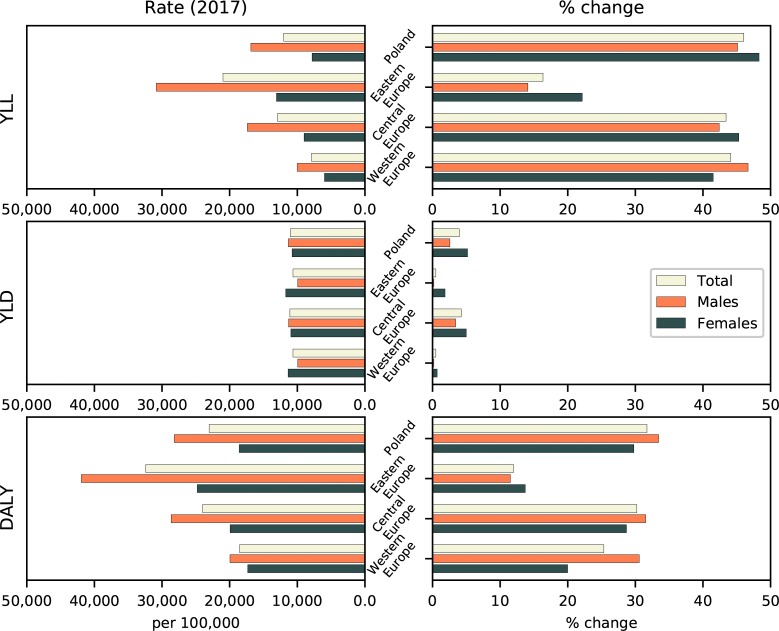
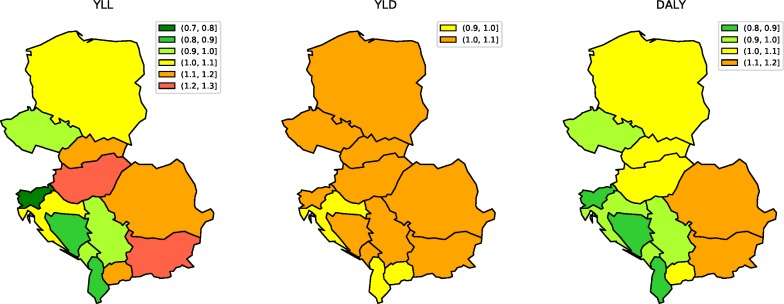
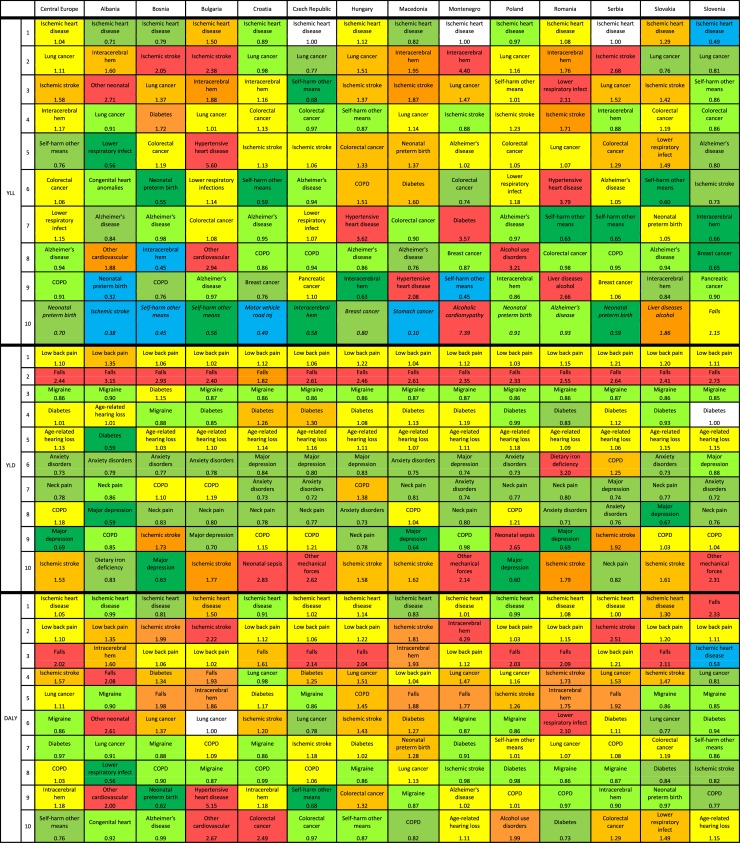
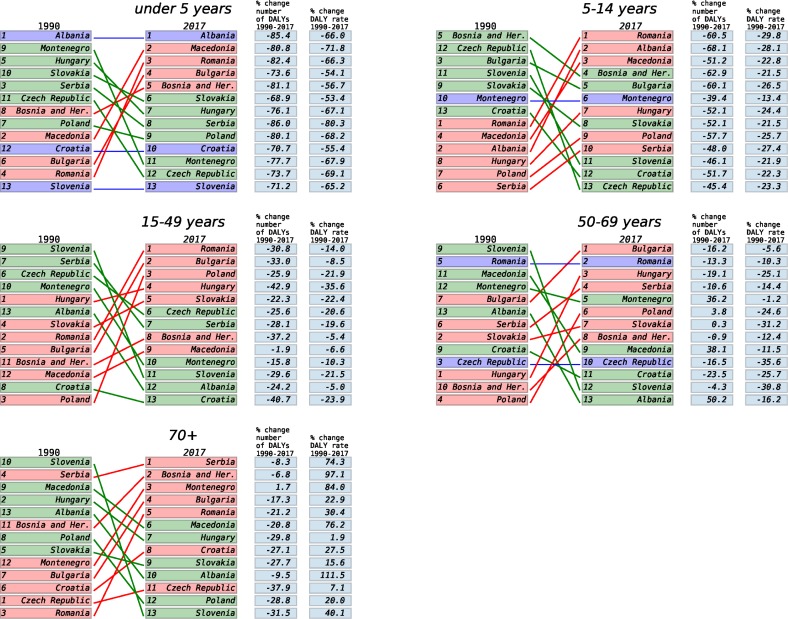
Results: Between 1990-2017, age-standardized YLL rates for all causes declined in Poland by 46.0% (95% UI: 43.7-48.2), YLD rates declined by 4.0% (4.2-4.9), DALY rates by 31.7% (29.2-34.4). For both YLLs and YLDs, greater relative declines were observed for females. There was a large decrease in communicable, maternal, neonatal, and nutritional disease DALYs (48.2%; 46.3-50.4). DALYs due to non-communicable diseases (NCDs) decreased slightly (2.0%; 0.1-4.6). In 2017, Poland performed better than CE as a whole (ranked fourth for YLLs, sixth for YLDs, and fifth for DALYs) and achieved greater reductions in YLLs and DALYs than most CE countries. In 2017 and 1990, the leading cause of YLLs and DALYs in Poland and CE was ischaemic heart disease (IHD), and the leading cause of YLDs was low back pain. In 2017, the top 20 causes of YLLs and YLDs in Poland and CE were the same, although in different order. In Poland, age-standardized DALYs from neonatal causes, other cardiovascular and circulatory diseases, and road injuries declined substantially between 1990-2017, while alcohol use disorders and chronic liver diseases increased. The highest observed-to-expected ratios were seen for alcohol use disorders for YLLs, neonatal sepsis for YLDs, and falls for DALYs (3.21, 2.65, and 2.03, respectively).
Conclusions: There was relatively little geographical variation in premature death and disability in CE in 2017, although some between-country differences existed. Health in Poland has been improving since 1990; in 2017 Poland outperformed CE as a whole for YLLs, YLDs, and DALYs. While the health gap between Poland and Western Europe has diminished, it remains substantial. The shift to NCDs and chronic disability, together with marked between-gender health inequalities, poses a challenge for the Polish health-care system. IHD is still the leading cause of disease burden in Poland, but DALYs from IHD are declining. To further reduce disease burden, an integrated response focused on NCDs and population groups with disproportionally high burden is needed.
Conflict of interest statement
The authors have declared that no competing interests exist.
Figures
References
-
- United Nations Development Programme. Human Development Report 2016. Human Development for Everyone. Puls Medycyny [Internet]. 2016. [cited 2018 Jul 3]; Available from: http://hdr.undp.org/sites/default/files/2016_human_development_report.pdf
-
- Wojtyniak B, Goryński P. (Eds.) Health status of population in Poland and its determinants. NIH-PZH, Warsaw; 2018. p-ISBN: 978-83-65870-14-8.
-
- Eurostat. Life expectancy at birth, 1980–2016. Available from: https://ec.europa.eu/eurostat/statisticsexplained/index.php?title=File:L...
-
- Eurostat. Health expenditure in the EU. Available from: https://ec.europa.eu/eurostat/web/products-eurostat-news/-/DDN-20181129-2
MeSH terms
LinkOut - more resources
Full Text Sources
Medical
Miscellaneous
