Review
. 2020 Feb 28;9(3):565.
doi: 10.3390/cells9030565.

Cross-Presenting XCR1+ Dendritic Cells as Targets for Cancer Immunotherapy

Affiliations
Review

Cross-Presenting XCR1+ Dendritic Cells as Targets for Cancer Immunotherapy

Katherine M Audsley et al. Cells. .

Abstract

The use of dendritic cells (DCs) to generate effective anti-tumor T cell immunity has garnered much attention over the last thirty-plus years. Despite this, limited clinical benefit has been demonstrated thus far. There has been a revival of interest in DC-based treatment strategies following the remarkable patient responses observed with novel checkpoint blockade therapies, due to the potential for synergistic treatment. Cross-presenting DCs are recognized for their ability to prime CD8+ T cell responses to directly induce tumor death. Consequently, they are an attractive target for next-generation DC-based strategies. In this review, we define the universal classification system for cross-presenting DCs, and the vital role of this subset in mediating anti-tumor immunity. Furthermore, we will detail methods of targeting these DCs both ex vivo and in vivo to boost their function and drive effective anti-tumor responses.

Keywords: DC-based therapy; cancer; cross-presenting dendritic cells; immunotherapy.


Conflict of interest statement

The authors declare no conflict of interest. The funders had no role in the preparation or writing of the manuscript or in the decision to publish this review.

Figures
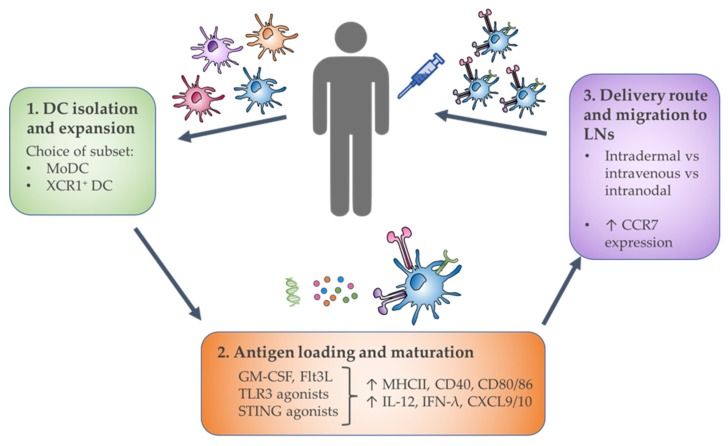
Figure 1
Figure 1
Critical considerations for DC vaccination. DCs may be isolated from patients or generated in vitro. New protocols designed to specifically generate large amounts of XCR1+ DCs, rather than MoDCs, may prove beneficial. Ex vivo culture with cytokines and/or TLR/STING agonists upregulates maturation markers on antigen-loaded DCs, and increases cytokine and chemokine secretion. Activated XCR1+ DCs are typically injected intradermally, although intranodal improves efficiency of DCs reaching the LNs. Upregulation of CCR7 expression aids in DC migration to the LNs, where they cross-present pre-loaded antigen to naïve CD8+ T cells.
Figure 2
Figure 2
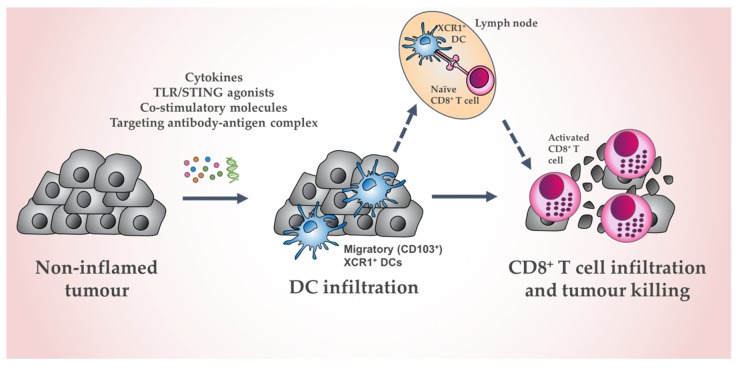
Schematic of in vivo XCR1+ DC activation to induce tumor cell death. Administration of cytokines, TLR/STING agonists, co-stimulatory molecules, and targeting antibody–antigen complexes can activate migratory (CD103+) XCR1+ DC in the tumor and lymphoid-resident XCR1+ DC. This can promote antigen acquisition, DC maturation, cross-presentation, and recruitment to the tumor site, culminating in increased CD8+ T cell-mediated tumor death.

References

    1. Wei S.C., Levine J.H., Cogdill A.P., Zhao Y., Anang N.A.S., Andrews M.C., Sharma P., Wang J., Wargo J.A., Pe’er D., et al. Distinct Cellular Mechanisms Underlie Anti-CTLA-4 and Anti-PD-1 Checkpoint Blockade. Cell. 2017;170:1120–1133.e1117. doi: 10.1016/j.cell.2017.07.024. - DOI - PMC - PubMed
    1. Darvin P., Toor S.M., Sasidharan Nair V., Elkord E. Immune checkpoint inhibitors: Recent progress and potential biomarkers. Exp. Mol. Med. 2018;50:165. doi: 10.1038/s12276-018-0191-1. - DOI - PMC - PubMed
    1. Steinman R.M., Cohn Z.A. Identification of a novel cell type in peripheral lymphoid organs of mice. I. Morphology, quantitation, tissue distribution. J. Exp. Med. 1973;137:1142–1162. doi: 10.1084/jem.137.5.1142. - DOI - PMC - PubMed
    1. Tullett K.M., Lahoud M.H., Radford K.J. Harnessing Human Cross-Presenting CLEC9A(+)XCR1(+) Dendritic Cells for Immunotherapy. Front. Immunol. 2014;5:239. doi: 10.3389/fimmu.2014.00239. - DOI - PMC - PubMed
    1. Wculek S.K., Cueto F.J., Mujal A.M., Melero I., Krummel M.F., Sancho D. Dendritic cells in cancer immunology and immunotherapy. Nat. Rev. Immunol. 2020;20:7–24. doi: 10.1038/s41577-019-0210-z. - DOI - PubMed

Publication types

Substances