


Disparity in Risk Factor Severity for Early Childhood Blood Lead among Predominantly African-American Black Children: The 1999 to 2010 US NHANES
- PMID: 32121216
- PMCID: PMC7084658
- DOI: 10.3390/ijerph17051552
Disparity in Risk Factor Severity for Early Childhood Blood Lead among Predominantly African-American Black Children: The 1999 to 2010 US NHANES
Abstract
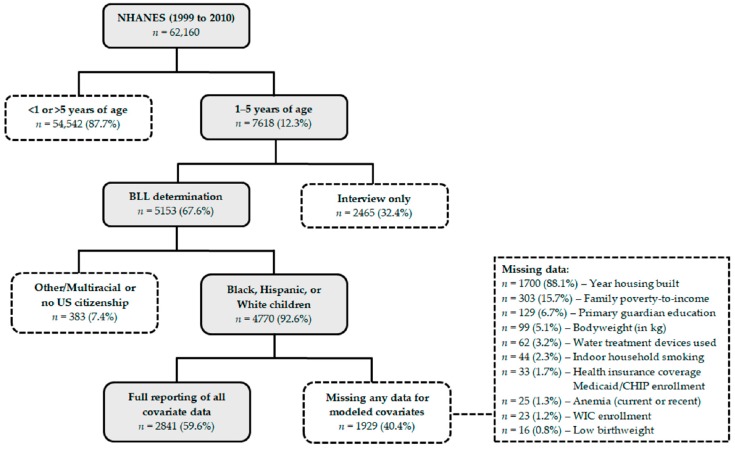
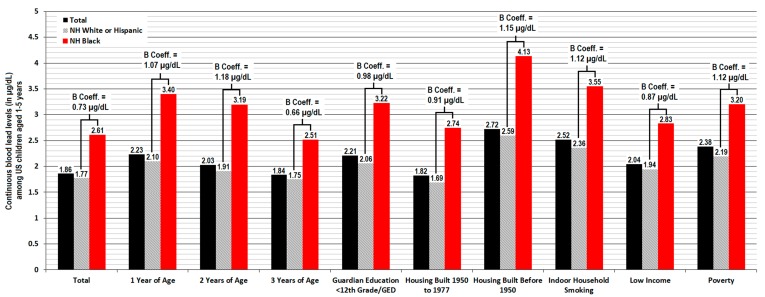
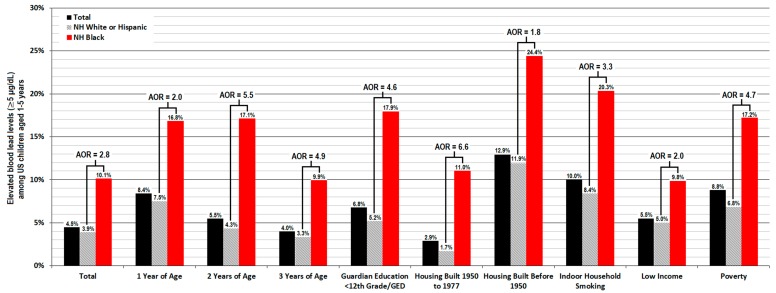
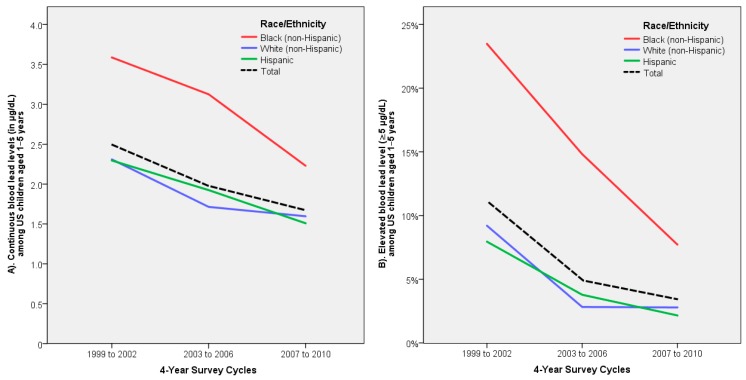
There is no safe detectable level of lead (Pb) in the blood of young children. In the United States, predominantly African-American Black children are exposed to more Pb and present with the highest mean blood lead levels (BLLs). However, racial disparity has not been fully examined within risk factors for early childhood Pb exposure. Therefore, we conducted secondary analysis of blood Pb determinations for 2841 US children at ages 1-5 years with citizenship examined by the cross-sectional 1999 to 2010 National Health and Nutrition Examination Survey (NHANES). The primary measures were racial disparities for continuous BLLs or an elevated BLL (EBLL) ≥5 µg/dL in selected risk factors between non-Hispanic Black children (n = 608) and both non-Hispanic White (n = 1208) or Hispanic (n = 1025) children. Selected risk factors included indoor household smoking, low income or poverty, older housing built before 1978 or 1950, low primary guardian education <12th grade/general education diploma (GED), or younger age between 1 and 3 years. Data were analyzed using a regression model corrected for risk factors and other confounding variables. Overall, Black children had an adjusted +0.83 µg/dL blood Pb (95% CI 0.65 to 1.00, p < 0.001) and a 2.8 times higher odds of having an EBLL ≥5 µg/dL (95% CI 1.9 to 3.9, p < 0.001). When stratified by risk factor group, Black children had an adjusted 0.73 to 1.41 µg/dL more blood Pb (p < 0.001 respectively) and a 1.8 to 5.6 times higher odds of having an EBLL ≥5 µg/dL (p ≤ 0.05 respectively) for every selected risk factor that was tested. For Black children nationwide, one in four residing in pre-1950 housing and one in six living in poverty presented with an EBLL ≥5 µg/dL. In conclusion, significant nationwide racial disparity in blood Pb outcomes persist for predominantly African-American Black children even after correcting for risk factors and other variables. This racial disparity further persists within housing, socio-economic, and age-related risk factors of blood Pb outcomes that are much more severe for Black children.
Keywords: African-American ethnicity; environmental justice; epidemiology; lead (Pb) exposure; metal toxicology; pediatrics; public health; racial disparity; safe housing; socio-economics.
Conflict of interest statement
The authors declare that they have no competing interests.
Figures
References
Publication types
MeSH terms
Substances
Grants and funding
LinkOut - more resources
Full Text Sources
Medical
