Review
. 2020 Mar 2;9(3):587.
doi: 10.3390/cells9030587.

HSP70 Multi-Functionality in Cancer

Affiliations
Review

HSP70 Multi-Functionality in Cancer

Zarema Albakova et al. Cells. .

Abstract

The 70-kDa heat shock proteins (HSP70s) are abundantly present in cancer, providing malignant cells selective advantage by suppressing multiple apoptotic pathways, regulating necrosis, bypassing cellular senescence program, interfering with tumor immunity, promoting angiogenesis and supporting metastasis. This direct involvement of HSP70 in most of the cancer hallmarks explains the phenomenon of cancer "addiction" to HSP70, tightly linking tumor survival and growth to the HSP70 expression. HSP70 operates in different states through its catalytic cycle, suggesting that it can multi-function in malignant cells in any of these states. Clinically, tumor cells intensively release HSP70 in extracellular microenvironment, resulting in diverse outcomes for patient survival. Given its clinical significance, small molecule inhibitors were developed to target different sites of the HSP70 machinery. Furthermore, several HSP70-based immunotherapy approaches were assessed in clinical trials. This review will explore different roles of HSP70 on cancer progression and emphasize the importance of understanding the flexibility of HSP70 nature for future development of anti-cancer therapies.

Keywords: HSP70; apoptosis; authophagy; cancer; exosomes; immunotherapy; metastasis; senescence.


Conflict of interest statement

The authors declare no conflict of interest.

Figures
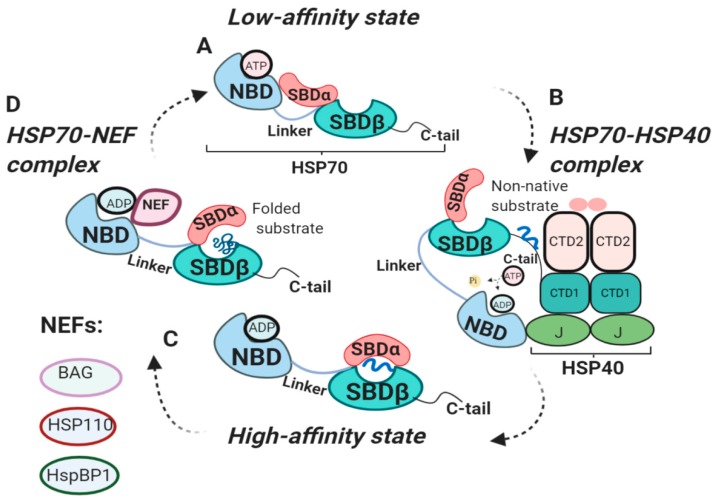
Figure 1
Figure 1
Functional cycle of HSP70 chaperones. (A) Structure of HSP70 in low-affinity (ATP) state. ATP binds to NBD, resulting in an open conformation of SBD, ready for client binding [8]. (B) HSP70-HSP40 complex. HSP40 presents non-native clients to HSP70. J-domain of HSP40 binds to HSP70-NBD stimulating its ATPase activity. Binding of HSP70 C-tail to HSP40-CTD1 displaces the client to HSP70, shifting HSP70 to ADP-bound state [16,38,39]. (C) High-affinity (ADP) state. ADP binds to NBD, SBDα forms the lid over SBDβ, locking substrate in SBD [18,28]. (D) HSP70-NEF complex. NEF displaces ADP from NBD, allowing ATP to bind NBD, shifting the HSP70 to low-affinity (ATP) state [8].NBD, nucleotide-binding domain; SBDα/β, substrate-binding domain; NEF, nucleotide exchange factor; CTD1/2, C-terminal peptide-binding domain of HSP40; J; J domain of HSP40.
Figure 5
Figure 5
HSP70 in apoptotic signaling pathways. (A) HSP70 in intrinsic apoptosis. In TNF-α induced apoptosis, HSP70 inhibits JNK and p38, thus, preventing the translocation of Bax and Bid to the mitochondria [150,156,163]. This blocks the release of cytochrome c to the cytosol and its formation of apoptosome complex with Apaf-1 and caspase-9. HSP70 may also disrupt the formation of apoptosome by binding to Apaf-1, preventing its association with procaspase-9 [164]. In addition, HSP70 stabilizes lysosomal membrane, inhibiting cathepsin release to the cytosol for the activation of intrinsic apoptotic pathway. (B) HSP70 in extrinsic apoptosis. HSP70 interacts with TRAIL-R1 and TRAIL-R2 and prevents the formation of DISC complex required for the initiation of extrinsic apoptosis. JNK, c-Jun N-terminal kinase; Cyt C, cytochrome c; Bax, Bcl-2-associated X protein; Bid, BH3 interacting-domain death agonist; p38, p38 mitogen-activated protein kinase; Apaf-1, apoptotic protease-activating factor 1; ASK, apoptosis signal-regulating kinase 1; TRAIL, TNF-related apoptosis-inducing ligand; TRAIL-R1/R2, TNF-related apoptosis-inducing ligand receptor 1/2; FADD, FAS-associated death domain (FADD).
Figure 2
Figure 2
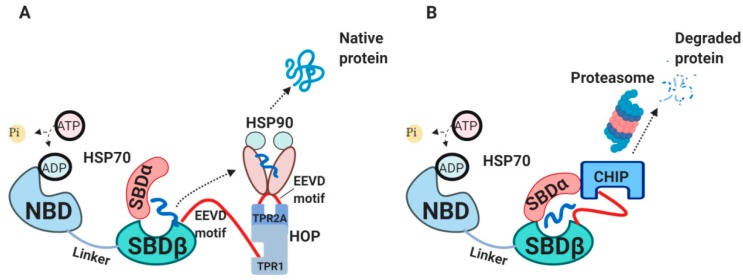
The external HSP70 network. (A) HSP70-HSP90-HOP complex. HOP acting as an adaptor molecule mediates the association between HSP70 and HSP90. HSP70 C-terminal EEVD motif binds TPR1 on HOP, whereas HSP90 C-terminal EEVD binds TPR2A [49]. This association via HOP allows handing over the substrate from HSP70 to HSP90 for further folding. (B) HSP70-CHIP complexes. CHIP binds to C-terminus of HSP70-substrate complex as well as to SBDα lid through its TPR domain, ubiquitylates HSP70-bound peptides and targets them for proteasomal degradation [55,57]. HOP, HSP70/HSP90-organizing protein; TPR, tetratrico-peptide repeats; CHIP, C-terminus of HSP70 interacting protein.
Figure 3
Figure 3
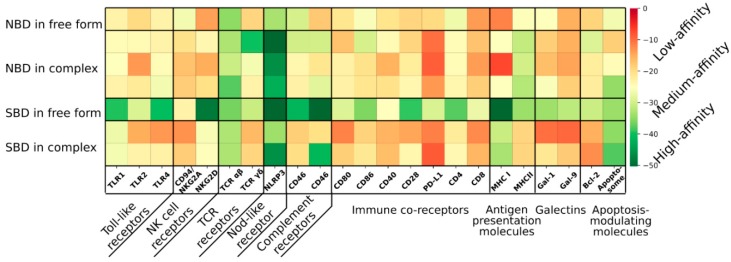
Heatmap of top docking predictions of various targets with HSP70 domains in bound and free forms. Color values correspond to binding energy assessed with the ZRANK scoring function (lower energies correspond to a higher probability of a complex formation).NBD, Nucleotide-binding domain; SBD, Substrate-binding domain.
Figure 4
Figure 4
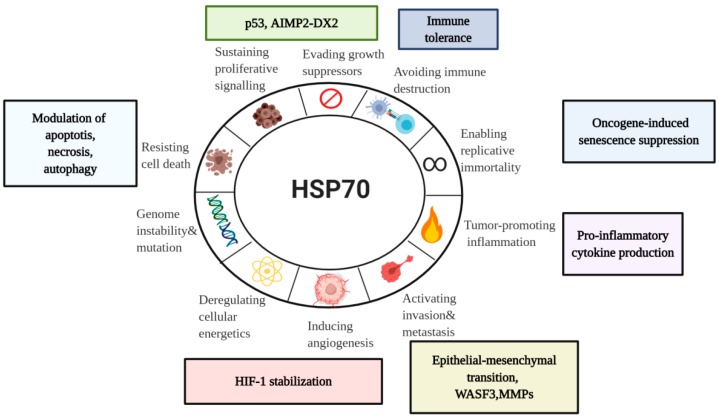
HSP70 in the Hallmarks of Cancer. Taking into account emerging role of HSP70 in cancer, it is important to assess its association with the currently established Hanahan and Weinberg model of the Hallmarks of Cancer [15]. Even though there are a lot of unanswered questions concerning HSP70 functions in tumor progression, current model can serve for the better understanding of diverse HSP70 roles in cancer for future development of anti-cancer therapeutics.WASF3, Wiskott-Aldridge syndrome family member 3; MMP, Matrix metalloproteinase; HIF-1, hypoxia-inducible factor-1; AIMP2-DX2,Aminoacyl-transfer RNA synthetase-interacting multifunctional protein 2 lacking exon 2

References

    1. Ritossa F. A new puffing pattern induced by temperature shock and DNP in drosophila. Cell. Mol. Life Sci. 1962;18:571–573. doi: 10.1007/BF02172188. - DOI
    1. Tissières A., Mitchell H.K., Tracy U.M. Protein synthesis in salivary glands of Drosophila melanogaster: Relation to chromosome puffs. J. Mol. Biol. 1974;84:389–398. doi: 10.1016/0022-2836(74)90447-1. - DOI - PubMed
    1. Moran L., Mirault M.-E., Arrigo A.P., Goldschmidt-Clermont M., Tissières A. Heat shock of Drosophila melanogaster induces the synthesis of new messenger RNAs and proteins. Philos. Trans. R. Soc. B Biol. Sci. 1978;283:391–406. - PubMed
    1. Daugaard M., Rohde M., Jäättelä M. The heat shock protein 70 family: Highly homologous proteins with overlapping and distinct functions. FEBS Lett. 2007;581:3702–3710. doi: 10.1016/j.febslet.2007.05.039. - DOI - PubMed
    1. Beere H. Stress management—Heat shock protein-70 and the regulation of apoptosis. Trends Cell Biol. 2001;11:6–10. doi: 10.1016/S0962-8924(00)01874-2. - DOI - PubMed

Publication types

Substances