Review
. 2020:107:97-137.
doi: 10.1016/bs.apar.2019.12.002. Epub 2020 Feb 5.

Recent advances in functional research in Giardia intestinalis

Affiliations
Review

Recent advances in functional research in Giardia intestinalis

Aaron R Jex et al. Adv Parasitol. 2020.

Abstract

This review considers current advances in tools to investigate the functional biology of Giardia, it's coding and non-coding genes, features and cellular and molecular biology. We consider major gaps in current knowledge of the parasite and discuss the present state-of-the-art in its in vivo and in vitro cultivation. Advances in in silico tools, including for the modelling non-coding RNAs and genomic elements, as well as detailed exploration of coding genes through inferred homology to model organisms, have provided significant, primary level insight. Improved methods to model the three-dimensional structure of proteins offer new insights into their function, and binding interactions with ligands, other proteins or precursor drugs, and offer substantial opportunities to prioritise proteins for further study and experimentation. These approaches can be supplemented by the growing and highly accessible arsenal of systems-based methods now being applied to Giardia, led by genomic, transcriptomic and proteomic methods, but rapidly incorporating advanced tools for detection of real-time transcription, evaluation of chromatin states and direct measurement of macromolecular complexes. Methods to directly interrogate and perturb gene function have made major leaps in recent years, with CRISPr-interference now available. These approaches, coupled with protein over-expression, fluorescent labelling and in vitro and in vivo imaging, are set to revolutionize the field and herald an exciting time during which the field may finally realise Giardia's long proposed potential as a model parasite and eukaryote.

Keywords: Bioinformatics; CRISPr; Functional research; Giardia; Molecular biology.


Figures

Fig. 1
Fig. 1
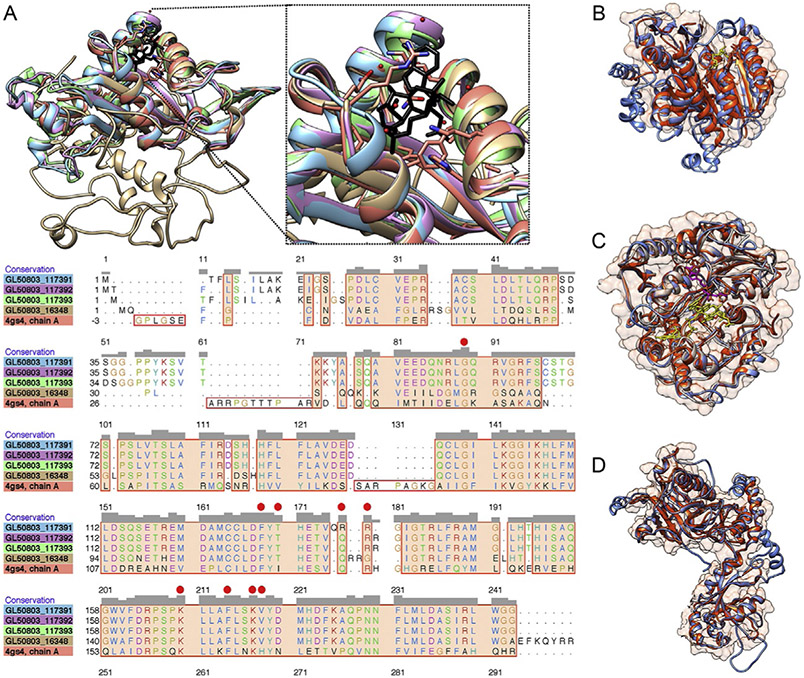
Novel functional annotations for Giardia proteins based on 3D structural homology. Examples of high-confidence models with potential and novel roles in post-transcriptional and post-translation regulation in Giardia include (A) Several homologues of human α-tubulin acetyltransferase 1 (PDB ID: 4GS4; red). Protein model includes overlay of G. intestinalis WB C6 (GL50803) coding genes GL50803_16348 (gold), GL50803_117391 (blue), GL50803_117392 (purple) and GL50803_117393 (green). Inset (dotted border) shows expanded view of the α-tubulin binding pocket containing an acetyl-CoA (black). Sequence alignment shows conserved residues among all models. Red circles in the alignment depict core catalytic residues required by human αTAT1 for acetylating α-tubulin. (B) A Giardia homologue [GL50803_22338 (blue)] of human mRNA cap guanine N7-methyltransferase [5′ m7g MTase; PDB ID: 3BGV (red)], showing S-Adenysl-l-Homocysteine in the RNA-binding pocket; (C) Two homologues [GL50803_100887 (blue) and GL50803_103058 (grey)] of yeast cap methyltransferase 1 (red), showing S-adenosyl-l-methionine (purple) and 7N-Methyl-8-Hydroguanosine-5′-Triphosphate (yellow) in RNA-binding pocket, and (D) one homologue [GL50803_17308; (blue)] of yeast Cet1 mRNA guanine-N7 capping guanylyltransferase [PDB ID: 3KYH (red)]. Data from Ansell, B.R.E., Pope, B.J., Georgeson, P., Emery-Corbin, S.J., Jex, A.R., 2019. Annotation of the Giardia proteome through structure-based homology and machine learning. Gigascience 8, giy150.
Fig. 2
Fig. 2
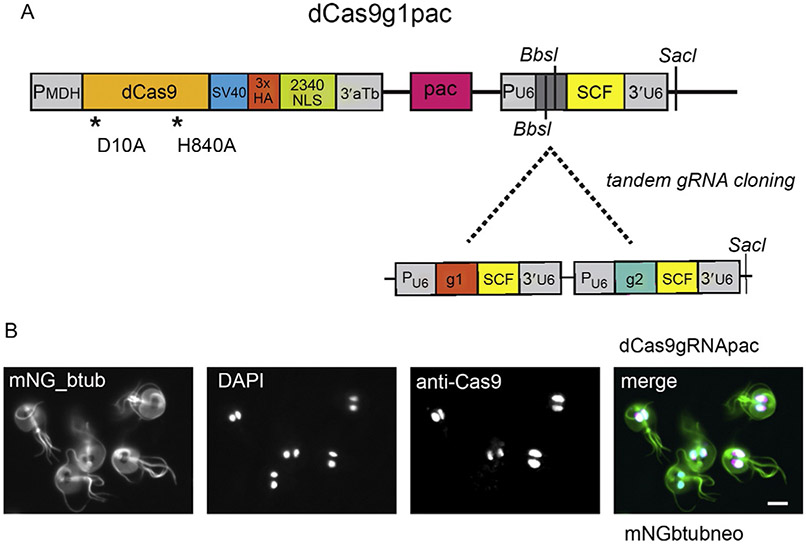
The Giardia CRISPRi plasmid includes a Giardia-specific nuclear localization signal (NLS) to localize dCas9 to both nuclei. The schematic of the Giardia CRISPRi vector dCas9g1pac indicates the catalytically inactive dCas9 with a C-terminal Giardia-specific 2340NLS and a 3XHA epitope tag (A). dCas9 expression is driven by the Giardia malate dehydrogenase promoter (PMDH), and a puromycin resistance marker (pac) allows positive selection in Giardia. The dCas9g1pac plasmid also includes inverted BbsI restriction sites for cloning of specific gRNA target sequences (g1 or g2) upstream of the gRNA scaffold sequence (SCF). The Giardia U6 spliceosomal RNA pol III promoter is used to express the gRNA cassette (g1+SCF); a non-specific gRNA is expressed unless the sequence between the BbsI sites is replaced with annealed oligomers targeting a specific genomic region. The SacI site can be used to add additional gRNA cassettes in tandem. Anti-Cas9 immunostaining of a Giardia strain carrying dCas9g1pac shows that a Giardia-specific native 34-amino acid C-terminal NLS from the Giardia protein GL50803_2340 (2340NLS) is necessary for the localization of 2340GFP to both nuclei (B). Over 50% of cells express dCas9 in both nuclei. In this strain, the microtubule cytoskeleton is visualized by expression of an integrated N-terminal mNeonGreen-tagged beta-tubulin gene selected with neomycin (mNGbtubneo). Scale bars = 5 μm.
Fig. 3
Fig. 3
Bioluminescent imaging enables quantitative evaluation of temporal and spatial infection dynamics in the gastrointestinal tracts of small animals. Transcriptional upregulation of the Giardia cyst wall protein 2 (CWP2) is a genetic indicator of the initiation of encystation. Representative in vivo (A) and ex vivo (B) bioluminescent images are shown for three mice infected with the PCWP2-FLuc strain and euthanized at 7 days post-infection (A). High bioluminescent signal is indicated for the distal small intestine (dsi) in animal 1 and for the proximal small intestine (psi) in animals 2 and 3. Photon flux or radiance (p/s/cm2/sr) for each intestinal segment is shown and has been normalized to the maximal ex vivo bioluminescence signal on the radiance scale, yielding the percent total signal per segment. These values are represented graphically on the grey scale maps below each ex vivo image (clear = 0–10% and black = 75–100%, with values between 10% and 75% indicated as shades of grey). The regions of the gastrointestinal tract (psi = proximal small intestine, dsi = distal small intestine, cec = cecum, and li = large intestine) are noted on the ex vivo images (B). The stomach (stm = stomach) is shown for orientation but lacks bioluminescence.

References

    1. Adam RD, 2000. The Giardia lamblia genome. Int. J. Parasitol 30, 475–484. - PubMed
    1. Adam RD, 2001. Biology of Giardia lamblia. Clin. Microbiol. Rev 14, 447–475. - PMC - PubMed
    1. Adam RD, Dahlstrom EW, Martens CA, Bruno DP, Barbian KD, Ricklefs SM, Hernandez MM, Narla NP, Patel RB, Porcella SF, Nash TE, 2013. Genome sequencing of Giardia lamblia genotypes A2 and B isolates (DH and GS) and comparative analysis with the genomes of genotypes A1 and E (WB and Pig). Genome Biol. Evol 5, 2498–2511. - PMC - PubMed
    1. Aggarwal A, Nash TE, 1987. Comparison of two antigenically distinct Giardia lamblia isolates in gerbils. Am. J. Trop. Med. Hyg 36, 325–332. - PubMed

    1. Altschul SF, Madden TL, Schäffer AA, Zhang J, Zhang Z, Miller W, Lipman DJ, 1997. Gapped BLAST and PSI-BLAST: a new generation of protein database search programs. Nucleic Acids Res. 25, 3389–3402. - PMC - PubMed

Publication types

MeSH terms