. 2020 Apr;182(4):1713-1722.
doi: 10.1104/pp.19.01475. Epub 2020 Mar 2.

A Synthetic Approach Allows Rapid Characterization of the Maize Nuclear Auxin Response Circuit

Affiliations

A Synthetic Approach Allows Rapid Characterization of the Maize Nuclear Auxin Response Circuit

Román Ramos Báez et al. Plant Physiol. 2020 Apr.

Abstract

Auxin plays a key role across all land plants in growth and developmental processes. Although auxin signaling function has diverged and expanded, differences in the molecular functions of signaling components have largely been characterized in Arabidopsis (Arabidopsis thaliana). Here, we used the nuclear Auxin Response Circuit recapitulated in yeast (Saccharomyces cerevisiae) system to functionally annotate maize (Zea mays) auxin signaling components, focusing on genes expressed during the development of ear and tassel inflorescences. All 16 maize auxin/indole-3-acetic acid repressor proteins were degraded in response to auxin with rates that depended on both receptor and repressor identities. When fused to the maize TOPLESS homolog RAMOSA1 ENHANCER LOCUS2, maize auxin/indole-3-acetic acids were able to repress AUXIN RESPONSE FACTOR transcriptional activity. A complete auxin response circuit comprising all maize components, including the ZmAFB2/3 b1 maize AUXIN SIGNALING F-BOX (AFB) receptor, was fully functional. The ZmAFB2/3 b1 auxin receptor was more sensitive to hormone than AtAFB2 and allowed for rapid circuit activation upon auxin addition. These results validate the conserved role of predicted auxin response genes in maize as well as provide evidence that a synthetic approach can facilitate broader comparative studies across the wide range of species with sequenced genomes.


Figures

Figure 1.
Figure 1.
Auxin repressors expressed in maize inflorescence exhibited variable auxin-induced degradation dynamics. A and B, Expression of maize Aux/IAA genes by mRNA in situ hybridizations in immature tassels. Expression patterns are shown in inflorescence meristems (A) and spikelet meristems (B). Gray arrowheads indicate vasculature, and green arrowheads indicate axillary meristems. Bars = 100 μm and 50 μm in the inset image. C, The nuclear auxin degradation module in yeast consists of ZmIAAs (purple) tagged with YFP and coexpressed with an Arabidopsis auxin receptor (green). The F-box domain of the receptor facilitates complex formation with the yeast SCF ubiquitin (Ub) ligase machinery (gray). When yeast are exposed to auxin, shown as a black circle, the hormone acts as molecular glue that brings the coreceptor complex together and leads to ubiquitination and proteasomal degradation of the YFP-tagged ZmIAA. This results in a decrease in fluorescence over time. D, The 16 ZmIAAs coexpressed with Arabidopsis TIR1 were degraded in response to auxin. Fluorescence measurements were obtained 2 h post-auxin exposure on a flow cytometer. Data from two replicates are shown; error bars represent se. AU, Absorbance units. E and G, ZmIAAs degrade at different rates that are dependent upon both repressor (E) and receptor (G) identities. Yeast strains expressing YFP-tagged ZmIAAs and either Arabidopsis TIR1 or AFB2 auxin receptor were exposed to 1 μm auxin or mock treatment (95% [v/v] ethanol) at 0 min, and fluorescence measurements were acquired on a flow cytometer. Data from two replicates are shown. F, YFP:ZmIAA degradation half-lives were calculated from cytometry data in E and G and are presented with 95% confidence intervals.
Figure 2.
Figure 2.
The TPL homolog REL2 enabled ZmIAAs to repress ARFs. A, The auxin repression module in yeast consisted of ZmIAA repressors fused to N-terminal fragments of either the Arabidopsis TPL or maize REL2 corepressors; these were coexpressed with an auxin receptor (Arabidopsis AFB2) and activator transcription factor (Arabidopsis ARF19). Auxin-induced derepression of ARF19 results in activation of the auxin response element-containing promoter (pARE) and expression of VENUS fluorescent protein. B, The N-terminal 91 amino acids of maize REL2 assist ZmIAA8 in conferring transcriptional repression on AtARF19, and this repression is relieved upon the addition of auxin. The REL2N91 fragment was directly compared with the analogous Arabidopsis TPLN100. The AtARF19_H170A mutant is unable to bind DNA, so the auxin response stays off. Strains labeled none contain a ZmIAA8 that has not been fused to a corepressor. C, ZmIAAs fused to REL2N91 exhibited different patterns of auxin-responsive gene activation, independent of their basal repression strength and degradation rate. Two ZmIAAs were unable to repress the auxin response (Supplemental Fig. S1D). All fluorescence measurements in B and C were made 5 h post-treatment. Data from two replicates are shown; error bars represent se. AU, Absorbance units; WT, wild type.
Figure 3.
Figure 3.
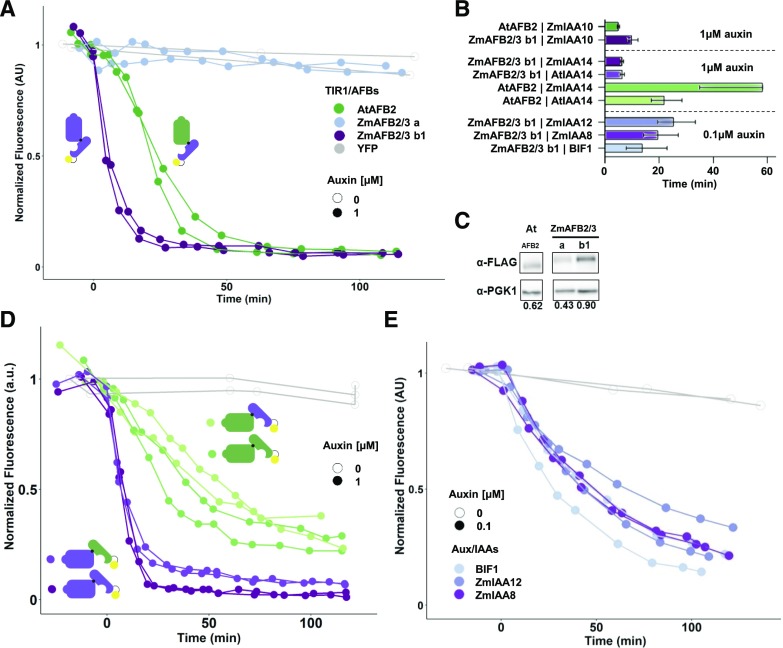
The maize auxin receptor ZmAFB2/3 b1 exhibited a higher basal activity compared with the Arabidopsis ortholog. A, ZmAFB2/3 b1 was sensitive to auxin and exhibited faster degradation than AtAFB2. ZmAFB2/3 a was not sensitive to auxin. Yeast coexpressing an Arabidopsis or maize auxin receptor and YFP-ZmIAA10 were treated with 1 μm auxin or mock (0), and fluorescence was measured on a flow cytometer. B, ZmIAA half-lives were calculated with 95% confidence intervals for data shown in A, D, and E. C, The auxin receptor expression level in yeast does not necessarily correlate with functionality. Yeast lysates were probed with anti-FLAG (for receptors) or anti-PGK1 (loading control) antibodies. Fold expression values shown below the bands were calculated by using ImageJ to quantify the intensity of each band and dividing the intensity of the receptor band by the intensity of the PGK1 band. D, ZmAFB2/3 b1 always exhibited faster IAA degradation in response to auxin, whether paired with an Arabidopsis or a maize Aux/IAA. All combinations of ZmAFB2/3 b1 or AtAFB2 paired with AtIAA14 or ZmIAA14 were tested within an auxin degradation module. E, When paired with ZmAFB2/3 b1, three maize Aux/IAAs (BIF1, ZmIAA8, and ZmIAA12) exhibited different orders of degradation speed than when paired with AtAFB2 (Fig. 1). AU, Absorbance units.
Figure 4.
Figure 4.
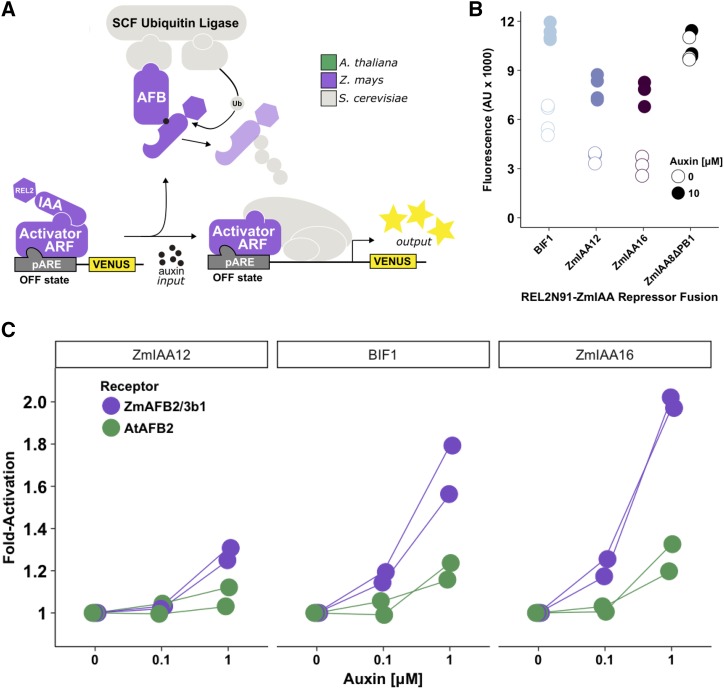
A maize auxin response circuit featuring ZmAFB2/3 b1 is functional and more sensitive to auxin than a circuit with AtAFB2. A, An auxin response circuit in yeast utilizing maize components (ZmARCSc) was assembled as shown with ZmARF27. B, The ZmARCSc is functional and responds to auxin. Data represent three to four replicates of fluorescence measurements taken 5 h following auxin hormone treatment. The ZmIAA8 strain with a deleted PB1 domain represents an always-on state. AU, Absorbance units. C, The ZmAFB2/3 b1 auxin receptor confers higher auxin sensitivity than AtAFB2 in ZmARCSc yeast strains. Strains shown in B and their AtAFB2 cognates were treated with 0, 0.1, or 1 μm auxin for 5 h before fluorescence measurements. Data are plotted as fold untreated.

Comment in

References

    1. Bargmann BOR, Vanneste S, Krouk G, Nawy T, Efroni I, Shani E, Choe G, Friml J, Bergmann DC, Estelle M, et al. (2013) A map of cell type-specific auxin responses. Mol Syst Biol 9: 688. - PMC - PubMed
    1. Bolduc N, Yilmaz A, Mejia-Guerra MK, Morohashi K, O’Connor D, Grotewold E, Hake S(2012) Unraveling the KNOTTED1 regulatory network in maize meristems. Genes Dev 26: 1685–1690 - PMC - PubMed
    1. Cabrito TR, Teixeira MC, Singh A, Prasad R, Sá-Correia I(2011) The yeast ABC transporter Pdr18 (ORF YNR070w) controls plasma membrane sterol composition, playing a role in multidrug resistance. Biochem J 440: 195–202 - PMC - PubMed
    1. Calderón Villalobos LIA, Lee S, De Oliveira C, Ivetac A, Brandt W, Armitage L, Sheard LB, Tan X, Parry G, Mao H, et al. (2012) A combinatorial TIR1/AFB-Aux/IAA co-receptor system for differential sensing of auxin. Nat Chem Biol 8: 477–485 - PMC - PubMed
    1. Causier B, Ashworth M, Guo W, Davies B(2012) The TOPLESS interactome: A framework for gene repression in Arabidopsis. Plant Physiol 158: 423–438 - PMC - PubMed

Publication types

MeSH terms

LinkOut - more resources