


Preclinical studies reveal MLN4924 is a promising new retinoblastoma therapy
- PMID: 32123578
- PMCID: PMC7026052
- DOI: 10.1038/s41420-020-0237-8
Preclinical studies reveal MLN4924 is a promising new retinoblastoma therapy
Abstract
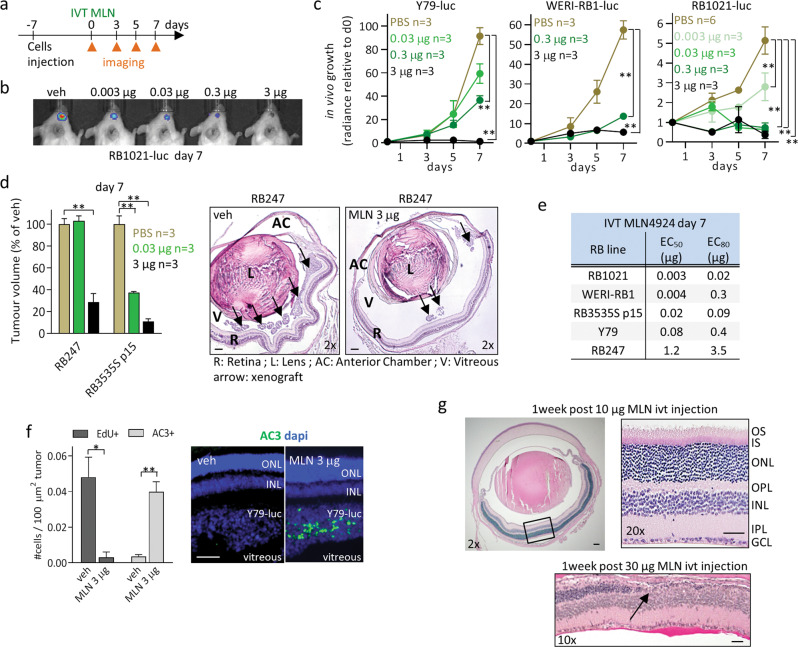
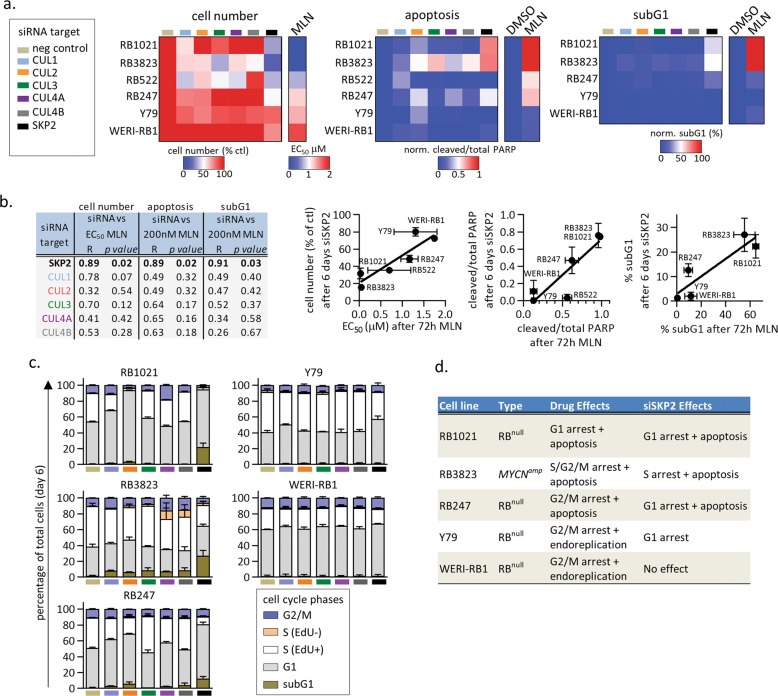
RB1 loss (RB1 null ) or MYCN amplification (MYCN amp ) in fetal human retina causes retinoblastoma. SKP2 loss kills RB1 null cells, but small molecule SKP2 inhibitors remain unexplored therapeutically. Whether SKP2 is synthetic lethal in MYCN amp retinoblastoma is unclear. SKP2 is the substrate recognition component of two Cullin-RING Ligase complexes (CRL1SKP2/SCFSKP2, and CRL4SKP2), a family of multiprotein E3 ubiquitin ligases. NEDD8 activating enzyme (NAE) is required for Cullin neddylation and thus CRL activation. Here, we show that the NAE inhibitor, Pevonedistat (MLN4924), potently inhibits RB1 null and MYCN amp tumors. Intravitreal MLN4924 suppressed multiple human xenografts with EC80s from 20 ng to 3.5 μg. Maximum tolerated dose (MTD) was 10-30 μg, highlighting a favorable therapeutic window. Inhibition of Cullin neddylation was similar in all cases, but cellular effects ranged from G1 arrest with apoptosis to G2/M arrest with endoreplication. However, even in less sensitive lines (EC50 ≈ 1 μM), prolonged exposure was lethal or induced persistent cytostasis. Mechanistically, depleting any single Cullin did not fully recapitulate drug phenotypes, but sensitivity to SKP2 loss correlated with that of drug. Thus, intravitreal MLN4924 is a promising new retinoblastoma therapy, mimicking the cancer-specific lethality of eliminating SKP2 complexes.
Keywords: Eye cancer; Targeted therapies.
© The Author(s) 2020.
Conflict of interest statement
Conflict of interestThe authors declare that they have no conflict of interest.
Figures


References
-
- Munier FL, et al. Intravitreal chemotherapy for vitreous disease in retinoblastoma revisited: from prohibition to conditional indications. Br. J. Ophthalmol. 2012;96:1078–1083. - PubMed
-
- Francis JH, et al. The classification of vitreous seeds in retinoblastoma and response to intravitreal melphalan. Ophthalmology. 2015;122:1173–1179. - PubMed
-
- Shields CL, et al. Intravitreal melphalan for persistent or recurrent retinoblastoma vitreous seeds: preliminary results. JAMA Ophthalmol. 2014;132:319–325. - PubMed
-
- Corson TW, Gallie BL. One hit, two hits, three hits, more? Genomic changes in the development of retinoblastoma. Genes Chromosomes Cancer. 2007;46:617–634. - PubMed
LinkOut - more resources
Full Text Sources
Research Materials
Miscellaneous
