. 2020 Apr 7;54(7):4583-4591.
doi: 10.1021/acs.est.9b06287. Epub 2020 Mar 27.

Deep Learning Neural Network Approach for Predicting the Sorption of Ionizable and Polar Organic Pollutants to a Wide Range of Carbonaceous Materials

Affiliations

Deep Learning Neural Network Approach for Predicting the Sorption of Ionizable and Polar Organic Pollutants to a Wide Range of Carbonaceous Materials

Gabriel Sigmund et al. Environ Sci Technol. .

Abstract

Most contaminants of emerging concern are polar and/or ionizable organic compounds, whose removal from engineered and environmental systems is difficult. Carbonaceous sorbents include activated carbon, biochar, fullerenes, and carbon nanotubes, with applications such as drinking water filtration, wastewater treatment, and contaminant remediation. Tools for predicting sorption of many emerging contaminants to these sorbents are lacking because existing models were developed for neutral compounds. A method to select the appropriate sorbent for a given contaminant based on the ability to predict sorption is required by researchers and practitioners alike. Here, we present a widely applicable deep learning neural network approach that excellently predicted the conventionally used Freundlich isotherm fitting parameters log KF and n (R2 > 0.98 for log KF, and R2 > 0.91 for n). The neural network models are based on parameters generally available for carbonaceous sorbents and/or parameters freely available from online databases. A freely accessible graphical user interface is provided.


Conflict of interest statement

The authors declare no competing financial interest.

Figures
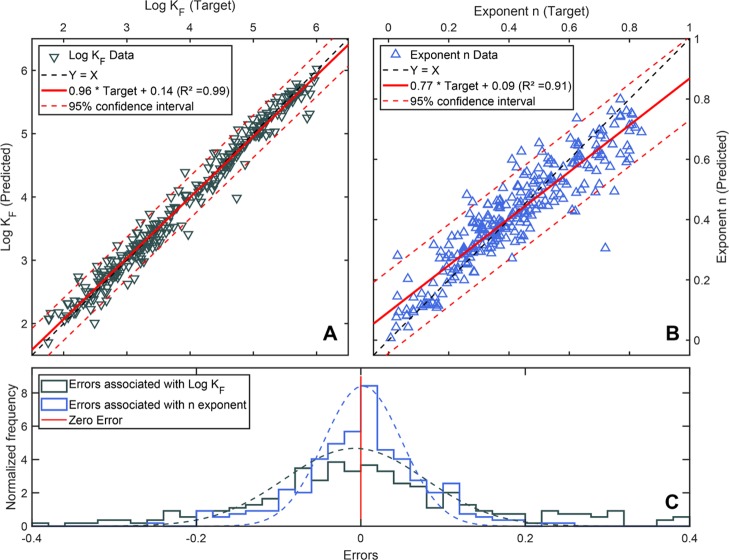
Figure 1
Figure 1
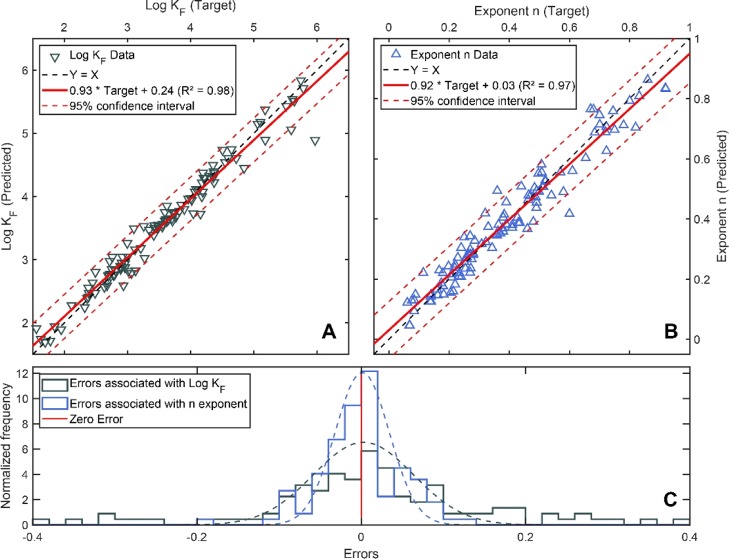
Measured Freundlich parameters log KF and t·n (“target”) from the training set of polar and negatively charged compounds plotted against log KF and n, as predicted by the neural network model. (A) Shows the model for log KF (grey ▽) and the 95% confidence interval for the prediction (dashed red lines). (B) Shows the model for the exponent n (blue △) and the 95% confidence interval for the prediction (dashed red lines). (C) Shows the normalized error frequency associated with the predictions of KF and n (sample size = 313).
Figure 2
Figure 2
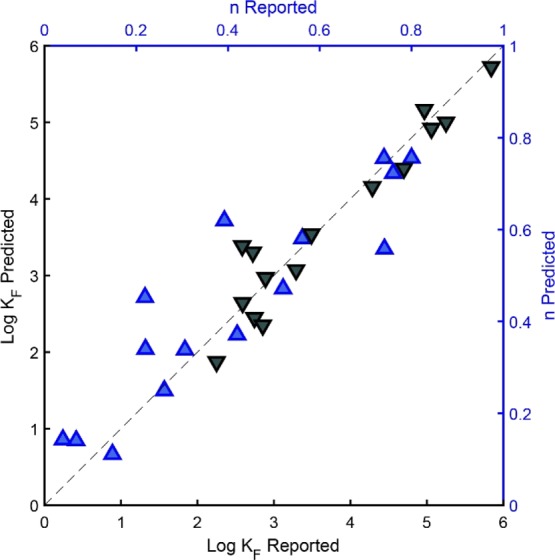
Measured Freundlich fit parameters log KF (grey ▼) and n (blue ▲) from the independent data set for negatively charged and polar compounds plotted against parameters predicted by the neural network model (sample size = 15).
Figure 3
Figure 3
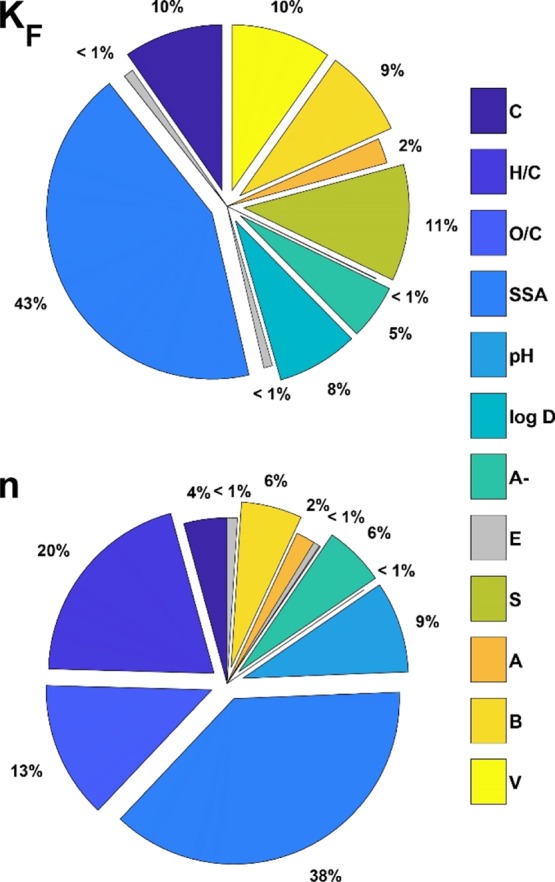
GSA first-order indices (Si) for the prediction of the Freundlich parameters for negatively charged and polar compounds. Abbreviations: carbon content (C, %), molar ratios H/C and O/C, SSA (m2/g), and abundance of ionized negatively charged species (A, %), E (excess molar refraction), S (dipolarity/polarizability), A (H-bond acidity), B (H-bond basicity), and V (molar volume).
Figure 4
Figure 4
Measured Freundlich fit parameters log KF and n (“target”) from the training set of cations and zwitterions plotted against log KF and n predicted by the neural network model. (A) Shows the model for log KF (▽) and the 95% confidence interval for the prediction (dashed red lines). (B) Shows the model for the exponent n (blue △) and the 95% confidence interval (dashed red lines). (C) Shows the normalized errors associated with the predictions of KF and n (sample size = 133).
Figure 5
Figure 5
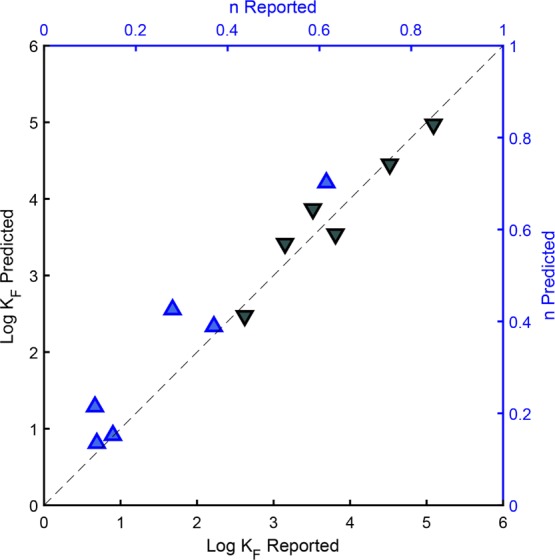
Measured Freundlich fit parameters log KF (grey ▼) and n (blue ▲) from the independent data set for cations and zwitterions plotted against the parameters predicted by the neural network model (sample size = 6).
Figure 6
Figure 6
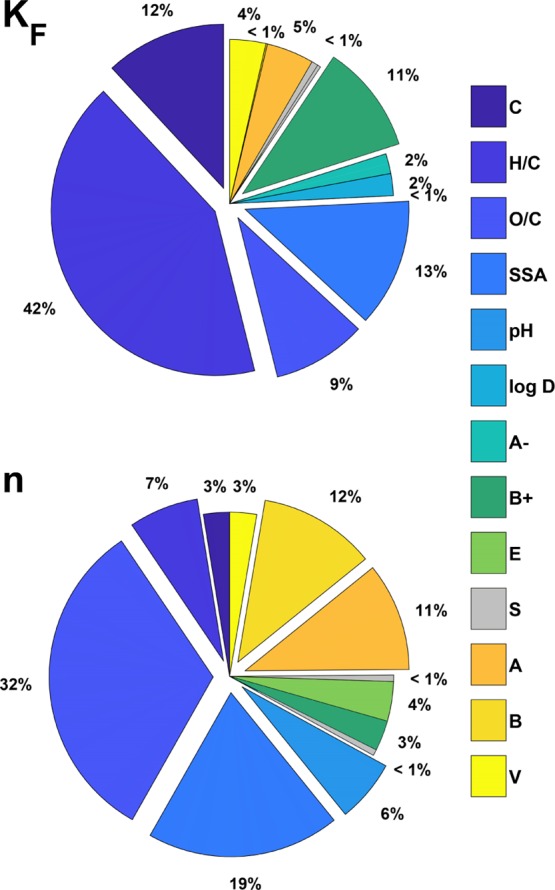
GSA first-order indices (Si) for the prediction of the Freundlich parameters for cations and zwitterions. Abbreviations: carbon content (C, %), molar ratios H/C and O/C, SSA (m2/g), amount of ionized negatively charged species (A, %), amount of ionized positively charged species (B+, %), E (excess molar refraction), S (dipolarity/polarizability), A (H-bond acidity), B (H-bond basicity), and V (molar volume).

References

    1. Goss K.-U.; Schwarzenbach R. P. Linear Free Energy Relationships Used To Evaluate Equilibrium Partitioning of Organic Compounds. Environ. Sci. Technol. 2001, 35, 1–9. 10.1021/es000996d. - DOI - PubMed
    1. Franco A.; Ferranti A.; Davidsen C.; Trapp S. An Unexpected Challenge: Ionizable Compounds in the REACH Chemical Space. Int. J. Life Cycle Assess. 2010, 15, 321–325. 10.1007/s11367-010-0165-6. - DOI
    1. Hüffer T.; Endo S.; Metzelder F.; Schroth S.; Schmidt T. C. Prediction of Sorption of Aromatic and Aliphatic Organic Compounds by Carbon Nanotubes Using Poly-Parameter Linear Free-Energy Relationships. Water Res. 2014, 59, 295–303. 10.1016/j.watres.2014.04.029. - DOI - PubMed
    1. Shih Y.-S.; Gschwend P. M. Evaluating Activated Carbon-Water Sorption Coefficients of Organic Compounds Using a Linear Solvation Energy Relationship Approach and Sorbate Chemical Activities. Environ. Sci. Technol. 2009, 43, 851–857. 10.1021/es801663c. - DOI - PubMed
    1. Lu Z.; MacFarlane J. K.; Gschwend P. M. Adsorption of Organic Compounds to Diesel Soot: Frontal Analysis and Polyparameter Linear Free-Energy Relationship. Environ. Sci. Technol. 2016, 50, 285–293. 10.1021/acs.est.5b03605. - DOI - PubMed

Publication types