. 2020 Mar 4;17(1):77.
doi: 10.1186/s12974-020-01760-1.

Supplement of microbiota-accessible carbohydrates prevents neuroinflammation and cognitive decline by improving the gut microbiota-brain axis in diet-induced obese mice

Affiliations

Supplement of microbiota-accessible carbohydrates prevents neuroinflammation and cognitive decline by improving the gut microbiota-brain axis in diet-induced obese mice

Hongli Shi et al. J Neuroinflammation. .

Abstract

Background: Western pattern diets induce neuroinflammation and impair cognitive behavior in humans and animals. Neuroinflammation and cognitive impairment have been associated with microbiota dysbiosis, through the gut-brain axis. Furthermore, microbiota-accessible carbohydrates (MACs) found in dietary fiber are important in shaping the microbial ecosystem and have the potential to improve the gut-brain-axis. However, the effects of MACs on neuroinflammation and cognition in an obese condition have not yet been investigated. The present study aimed to evaluate the effect of MACs on the microbiota-gut-brain axis and cognitive function in obese mice induced by a high-fat and fiber deficient (HF-FD) diet.

Methods: C57Bl/6 J male mice were fed with either a control HF-FD or a HF-MAC diet for 15 weeks. Moreover, an additional group was fed with the HF-MAC diet in combination with an antibiotic cocktail (HF-MAC + AB). Following the 15-week treatment, cognitive behavior was investigated; blood, cecum content, colon, and brain samples were collected to determine metabolic parameters, endotoxin, gut microbiota, colon, and brain pathology.

Results: We report MACs supplementation prevented HF-FD-induced cognitive impairment in nesting building and temporal order memory tests. MACs prevented gut microbiota dysbiosis, including increasing richness, α-diversity and composition shift, especially in Bacteroidetes and its lower taxa. Furthermore, MACs increased colonic mucus thickness, tight junction protein expression, reduced endotoxemia, and decreased colonic and systemic inflammation. In the hippocampus, MACs suppressed HF-FD-induced neuroglia activation and inflammation, improved insulin IRS-pAKT-pGSK3β-pTau synapse signaling, in addition to the synaptic ultrastructure and associated proteins. Furthermore, MACs' effects on improving colon-cognitive parameters were eliminated by wide spectrum antibiotic microbiota ablation.

Conclusions: These results suggest that MACs improve cognitive impairments via the gut microbiota-brain axis induced by the consumption of an HF-FD. Supplemental MACs to combat obesity-related gut and brain dysfunction offer a promising approach to prevent neurodegenerative diseases associated with Westernized dietary patterns and obesity.

Keywords: Cognition; Gut microbiota; Gut-brain axis; Microbiota-accessible carbohydrate; Obesity.


Conflict of interest statement

The authors declare that they have no competing interests.

Figures

Fig. 1
Fig. 1
Diet rich in microbiota-accessible carbohydrate prevented gut microbiota dysbiosis in diet-induced obese mice. a Levels of fecal bacterial DNA were quantitated by qPCR (n = 6). Cecal contents of microbiota composition were analyzed by 16S RNA sequencing (n = 5–7) (bj). b Principal coordinates analysis plot of bray distances. ce The α-diversity of the fecal microbiome among three groups depicted according to Chao index (c), ACE index (d), and Shannon index (e). f Composition of abundant bacterial phyla. g Ratio of Firmicutes (FM) to Bacteroidetes (BO). h Linear discriminant analysis (LDA) effect size showing the most differentially significant abundant taxa enriched in microbiota from the control (Con) vs. HF-FD vs. HF-MAC. i Cladogram generated from linear discriminant analysis (LDA). Values are mean ± SEM. *p < 0.05 vs. Con. #p < 0.05 vs. high-fat and fiber-deficient (HF-FD). p, phylum
Fig. 2
Fig. 2
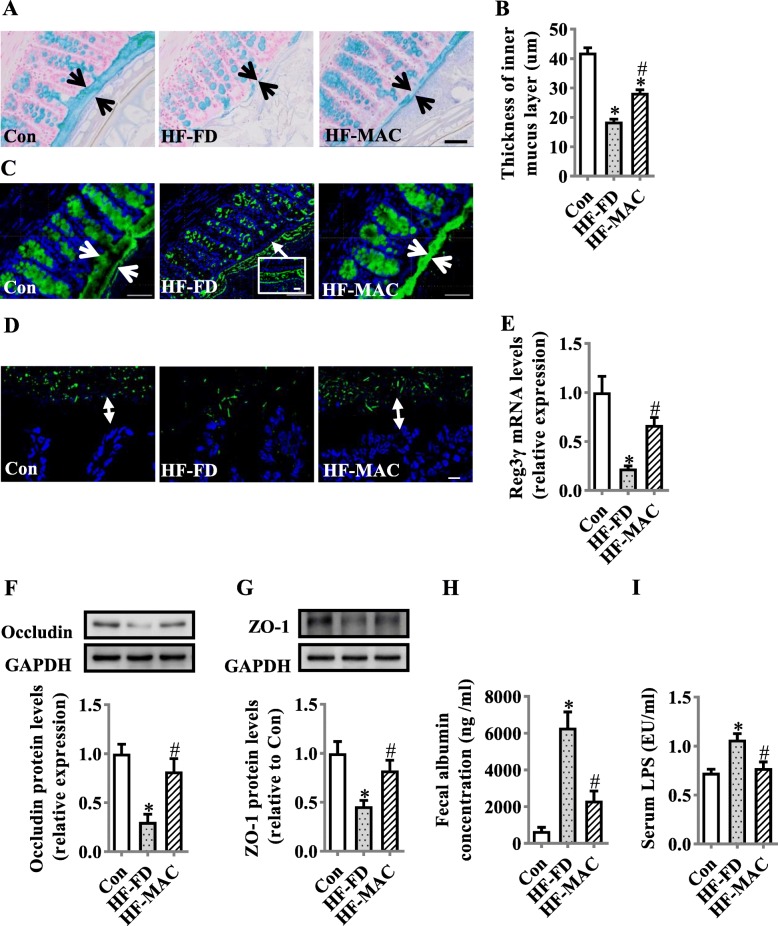
Diet rich in microbiota-accessible carbohydrate prevented degradation of colonic mucus barrier, reduced tight junction expression, and endotoxemia in diet-induced obese mice. a Alcian blue-stained colonic sections showing the mucus layer (arrows). Opposing black arrows with shafts delineate the mucus layer that was measured. Scale bar 50 μm. b The quantification of colonic mucus layer was statistically analyzed (per section/2 sections per animal, n = 5). c Immunofluorescence images of colonic sections stained with a-MUC2 (green) and DAPI (blue). Opposing white arrows with shafts delineate the mucus layer. Inset (HF-FD group) shows a higher magnification of bacteria-sized, DAPI-stained particles in closer proximity to host epithelium and even crossing this barrier. Scale bar 50 μm, inset 10 μm. d FISH analysis of sections of the colon using the general bacterial probe EUB338-Alexa Fluor 488 (green) and nuclear staining DAPI (blue). Arrows indicate the distance between bacteria and epithelium. Scale bar 10 μm. e Quantitation of colonic Reg3γ by RT-PCR (n = 6). e Protein expression levels of occludin (f) and ZO-1 (g) in the colon (n = 5). h Fecal albumin concentrations (n = 8). i Serum endotoxin level (n = 10). Values are mean ± SEM. *p < 0.05 vs. Control (Con). #p < 0.05 vs. high-fat and fiber-deficient (HF-FD)
Fig. 3
Fig. 3
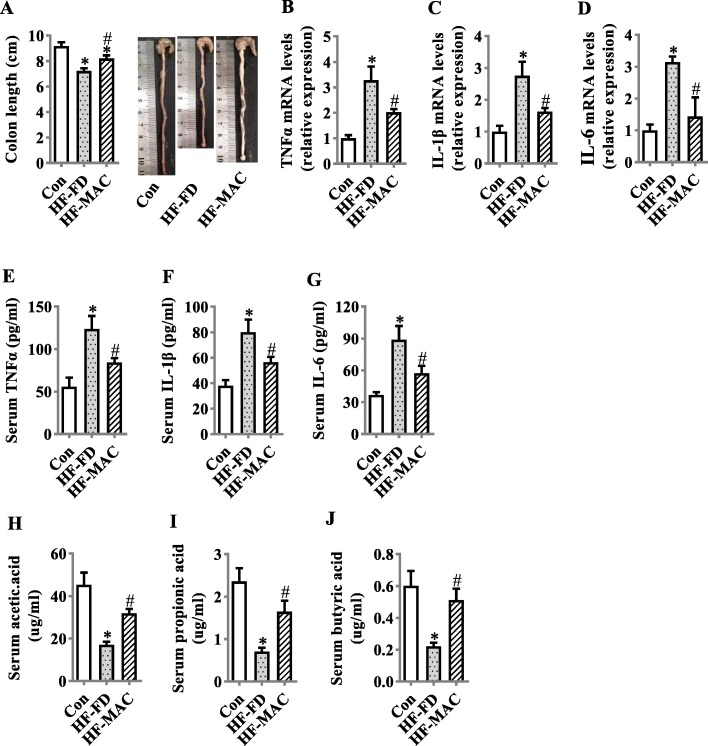
Diet rich in microbiota-accessible carbohydrate reduced colonic and systemic inflammation. a The quantification of colon length was statistically analyzed (n = 9) and representative images of colons. bd mRNA expression levels of TNFα, IL-1β, and IL-6 in the colon (n = 5). eg TNF-α, IL-1β, and IL-6 levels in the serum (n = 10). h–j The serum levels of acetic acid, propionic acid, and butyric acid (n = 6). Values are mean ± SEM. *p < 0.05 vs. Control (Con). #p < 0.05 vs. high-fat and fiber-deficient (HF-FD)
Fig. 4
Fig. 4
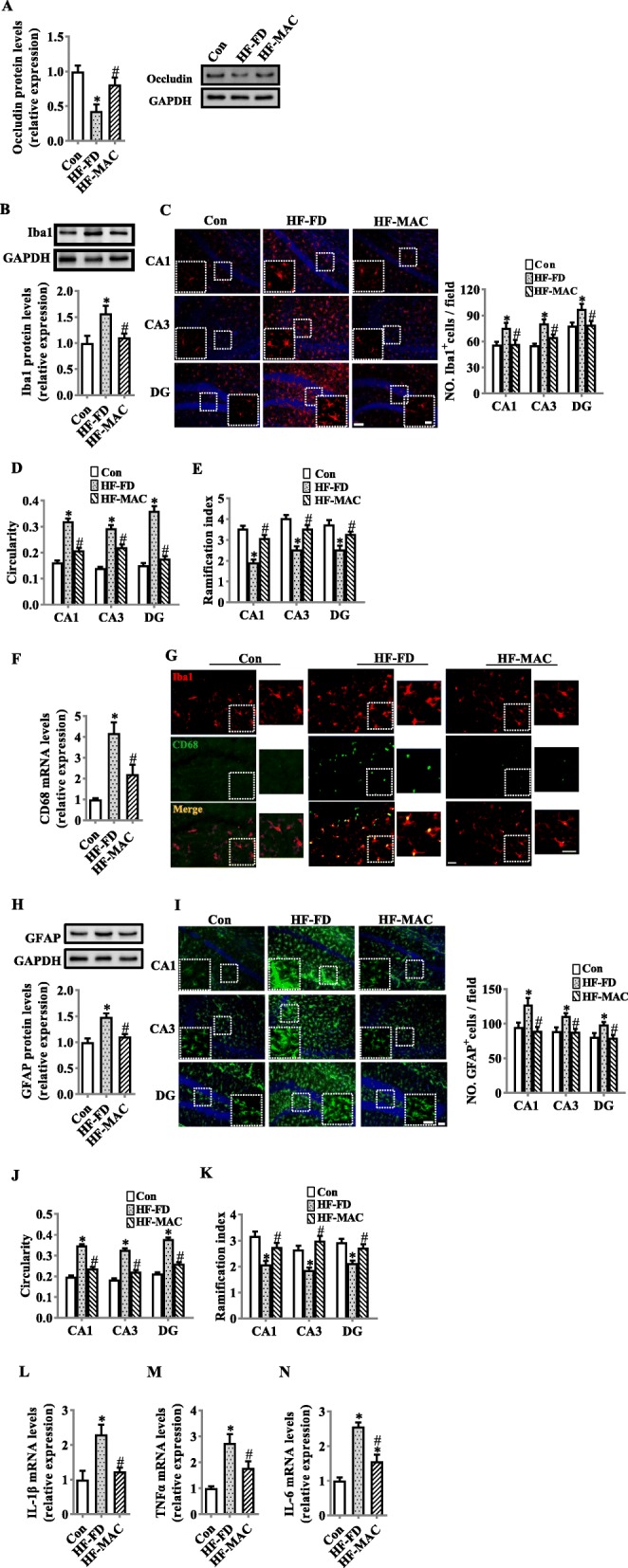
Diet rich in microbiota-accessible carbohydrate prevented the degradation of hippocampus tight junction and suppressed the gliosis and inflammation in the hippocampus of diet-induced obese mice. a Protein level of occludin in the hippocampus (n = 6). b Protein level of Iba1 in the hippocampus (n = 6). c The immunofluorescent staining of Iba1 and quantification of Iba1+cells numbers in CA1, CA3, and DG of the hippocampus (n = 2 images per mouse, n = 6, scale bar 50 μm) and the image capture from the box marked with a dotted line (scale bar 10 μm). d and e The circularity and ramification index of Iba1+ cells (n = 2 images per mouse, n = 3). f mRNA expression of CD68. g The representative immunofluorescent staining of CD68 in the hippocampus, scale bar 25 μm. h Protein level of GFAP in the hippocampus (n = 6). i The immunofluorescent staining of GFAP and quantification of GFAP +cells numbers in CA1, CA3, and DG of the hippocampus (n = 2 images per mouse, n = 6). j and k The circularity and ramification index of GFAP+ cells (n = 2 images per mouse, n = 3). l–n mRNA expression of pro-inflammatory cytokines, IL-1β, TNFα, and IL-6 in the hippocampus (n = 5). Scale bar 50 μm, the image capture from the box marked with a dotted line 10 μm. Values are mean ± SEM. *p < 0.05 vs. Control (Con). #p < 0.05 vs. high-fat and fiber-deficient (HF-FD)
Fig. 5
Fig. 5
Diet rich in microbiota-accessible carbohydrate inhibited PTP1B and improved synaptic signaling molecules in the hippocampus of diet-induced obese mice. a Protein level of PTP1B in the hippocampus (n = 6). b–d Protein levels of p-IRS-1/IRS-1, p-Akt/ Akt, and p-GSK3β/ GSK3β (n = 6). e Protein level of p-Tau/Tau in the hippocampus (n = 4). f Phosphorylation cascade of insulin IRS-pAKT-pGSK3β-pTau synapse signaling. Values are mean ± SEM. *p < 0.05 vs. Control (Con). #p < 0.05 vs. high-fat and fiber-deficient (HF-FD)
Fig. 6
Fig. 6
Diet rich in microbiota-accessible carbohydrate improved the synaptic ultrastructure and synaptic proteins in the hippocampus of diet-induced obese mice. a The ultrastructure of synapses on the electron micrograph in the hippocampus CA1 region of mice fed with different diets (scale bar 500 nm). The images captured from the box marked with a dotted line were in a lower level (scale bar 250 nm). b and c Image analysis of thickness of PSD and the width of the synaptic cleft (n = 3). PSD, postsynaptic density; SC, synaptic cleft; SV, synaptic vesicle. d–f The protein levels of PSD-95, SYN, and SYS. Values are mean ± SEM. *p < 0.05 vs. Control (Con). #p < 0.05 vs. high-fat and fiber-deficient (HF-FD)
Fig. 7
Fig. 7
Diet rich in microbiota-accessible carbohydrate prevented cognitive impairment in diet-induced obese mice. Nest building and temporal order memory were performed to evaluate the cognition of the mice. a and b The ability to build a nest (nesting behavior), reflecting activities of daily living in rodents, is altered in mice fed HF-FD for 15 weeks, as indicated by lower nest score (see methods) (a) and increased amount of untorn nesting material (b) (n = 15). c Representative nest of control, HF-FD, and HF-MAC groups. d–f Temporal order memory test. d The discrimination ratio. e The total object exploration time. f Show representative track plots of control, HF-FD ,and HF-MAC groups recorded by SMART Video tracking system in the testing phase. Blue dot and yellow crucifix denote an object that was moved to an old familiar location and an object that moved to a recent familiar location in the testing phase respectively. Note that the control diet mouse spent more time exploring the old familiar object, whereas the HF-FD diet mouse did not show preference to the old familiar object. Correlation between levels of gut Bacteroidetes and the nest score (g), untorn nesting material (h), or the discrimination ratio (i), values are mean ± SEM. *P < 0.05 vs. con. #P < 0.05 vs. HF-FD
Fig. 8
Fig. 8
Microbiota ablation with antibiotics eliminated MAC supplementation in improving colon length, endotoxemia, and cognition of diet-induced obese mice. a Levels of feces bacterial DNA were quantitated by qPCR after chronic antibiotic treatment (n = 6). b The quantification of colon length was statistically analyzed (n = 9). c Serum LPS level (n = 10). d Nest score (n = 12–15). e Untorn nesting material. f The discrimination ratio. g Total object exploration time in temporal order memory test. Values are mean ± SEM. *p < 0.05 vs. high-fat and fiber-deficient (HF-FD). #p < 0.05 vs. HF-MAC

References

    1. Subhramanyam CS, et al. Microglia-mediated neuroinflammation in neurodegenerative diseases. Semin Cell Dev Biol. 2019;94:112–120. doi: 10.1016/j.semcdb.2019.05.004. - DOI - PubMed
    1. Francis H, Stevenson R. The longer-term impacts of Western diet on human cognition and the brain. Appetite. 2013;63:119–128. doi: 10.1016/j.appet.2012.12.018. - DOI - PubMed
    1. Liu Y, et al. Luteolin protects against high fat diet-induced cognitive deficits in obesity mice. Behav Brain Res. 2014;267:178–188. doi: 10.1016/j.bbr.2014.02.040. - DOI - PubMed
    1. Livingston G, et al. Dementia prevention, intervention, and care. Lancet. 2017;390(10113):2673–2734. doi: 10.1016/S0140-6736(17)31363-6. - DOI - PubMed
    1. Zhang P, et al. Alterations to the microbiota-colon-brain axis in high-fat-diet-induced obese mice compared to diet-resistant mice. J Nutr Biochem. 2019;65:54–65. doi: 10.1016/j.jnutbio.2018.08.016. - DOI - PubMed