Review
. 2020 Apr;39(18):3611-3619.
doi: 10.1038/s41388-020-1239-y. Epub 2020 Mar 3.

Alterations of T-cell-mediated immunity in acute myeloid leukemia

Affiliations
Review

Alterations of T-cell-mediated immunity in acute myeloid leukemia

Zhuoyan Li et al. Oncogene. 2020 Apr.

Abstract

Acute myeloid leukemia (AML) is a systemic, heterogeneous hematologic malignancy with poor overall survival. While some malignancies have seen improvements in clinical outcomes with immunotherapy, success of these agents in AML remains elusive. Despite limited progress, stem cell transplantation and donor lymphocyte infusions show that modulation of the immune system can improve overall survival of AML patients. Understanding the causes of immune evasion and disease progression will identify potential immune-mediated targets in AML. This review explores immunosuppressive mechanisms that alter T-cell-mediated immunity in AML.


Conflict of interest statement

Competing Interests

Dr. Ferrell receives funding support from Incyte, Forma Therapeutics, and Astex Pharmaceuticals and is a consultant for Agios Pharmaceuticals. Dr. Li and Dr. Philip have no competing interests to declare.

Figures
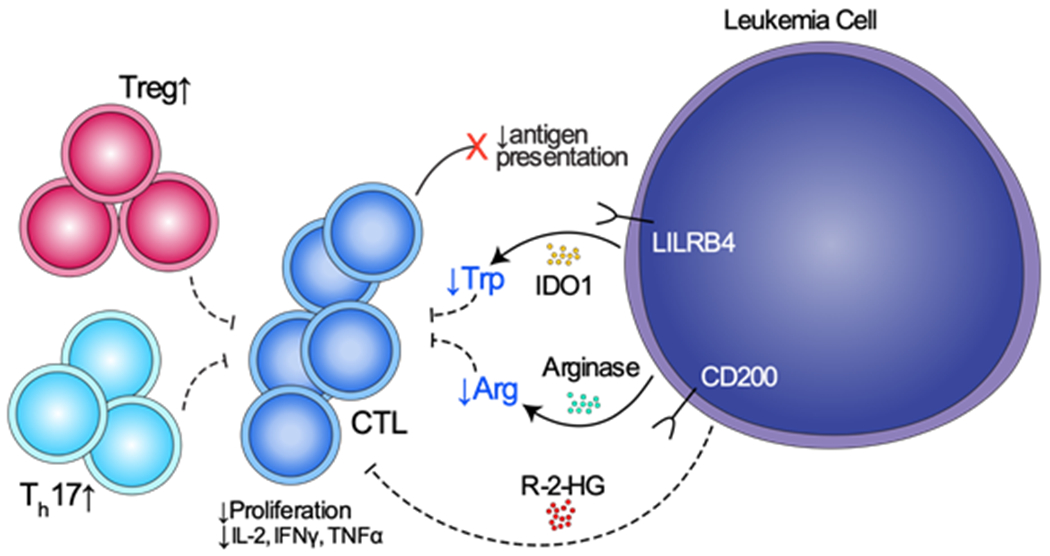
Figure 1.
Figure 1.
Proposed mechanisms of T cell suppression and promotion of T cell dysfunction by AML. LILRB4 is an inhibitory receptor found in monocytic AML that directly suppresses T cell proliferation. CD200 is a surface receptor found on leukemic blasts that is associated with increase in Tregs and reduce cytotoxic T cell function. IDO1 and arginase II are enzymes that reduce the presence of amino acids tryptophan and arginine, respectively, inhibiting T cell proliferation. 2-HG is an oncometabolite produced by IDH mutated AML that inhibits T cell proliferation and function.

References

    1. Howlader N NA, Krapcho M, Miller D, Brest A, Yu M, Ruhl J, Tatalovich Z, Mariotto A, Lewis DR, Chen HS, Feuer EJ, Cronin KA. SEER Cancer Statistics Review, 1975-2016. In. Bethesda, MD.
    1. Papaemmanuil E, Gerstung M, Bullinger L, Gaidzik VI, Paschka P, Roberts ND et al. Genomic Classification and Prognosis in Acute Myeloid Leukemia. The New England journal of medicine 2016; 374(23): 2209–2221. e-pub ahead of print 2016/06/09; doi: 10.1056/NEJMoa1516192 - DOI - PMC - PubMed
    1. Pollyea DA. New drugs for acute myeloid leukemia inspired by genomics and when to use them. Hematology. American Society of Hematology. Education Program 2018; 2018(1): 45–50. e-pub ahead of print 2018/12/07; doi: 10.1182/asheducation-2018.1.45 - DOI - PMC - PubMed
    1. Cerrano M, Itzykson R. New Treatment Options for Acute Myeloid Leukemia in 2019. Current oncology reports 2019; 21(2): 16 e-pub ahead of print 2019/02/05; doi: 10.1007/s11912-019-0764-8 - DOI - PubMed
    1. Lamble AJ, Lind EF. Targeting the Immune Microenvironment in Acute Myeloid Leukemia: A Focus on T Cell Immunity. Frontiers in oncology 2018; 8: 213 e-pub ahead of print 2018/06/29; doi: 10.3389/fonc.2018.00213 - DOI - PMC - PubMed

Publication types

MeSH terms

Substances
