


Climate connectivity of the bobcat in the Great Lakes region
- PMID: 32128144
- PMCID: PMC7042766
- DOI: 10.1002/ece3.6049
Climate connectivity of the bobcat in the Great Lakes region
Abstract
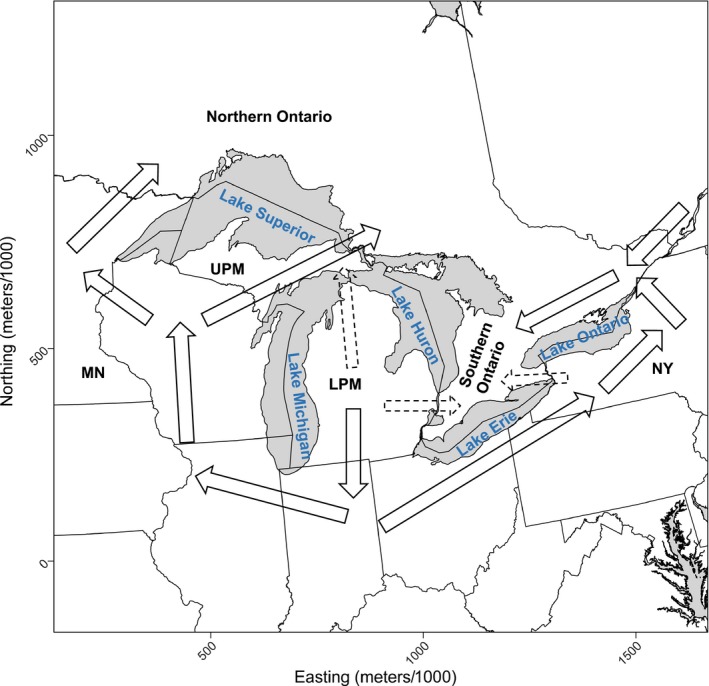
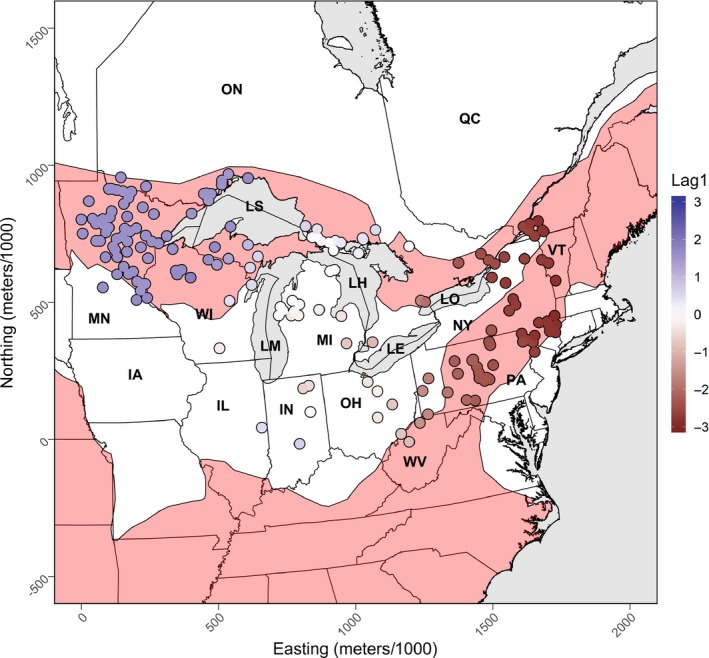
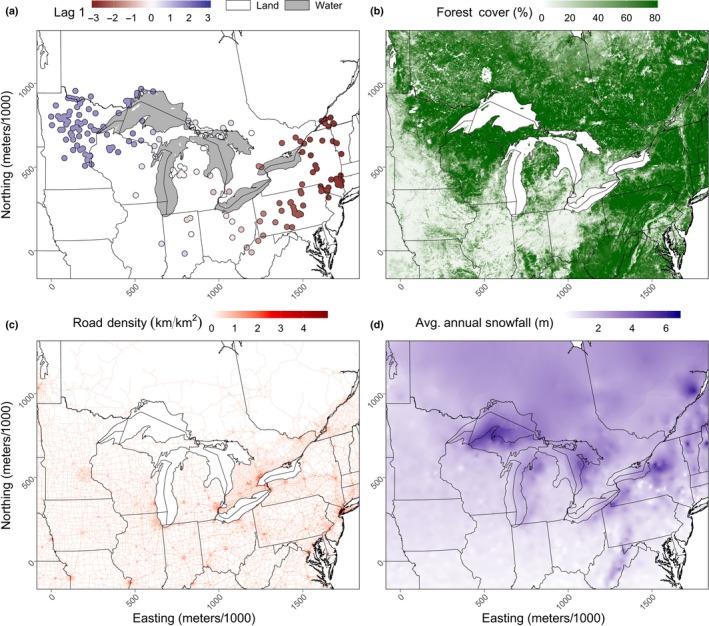
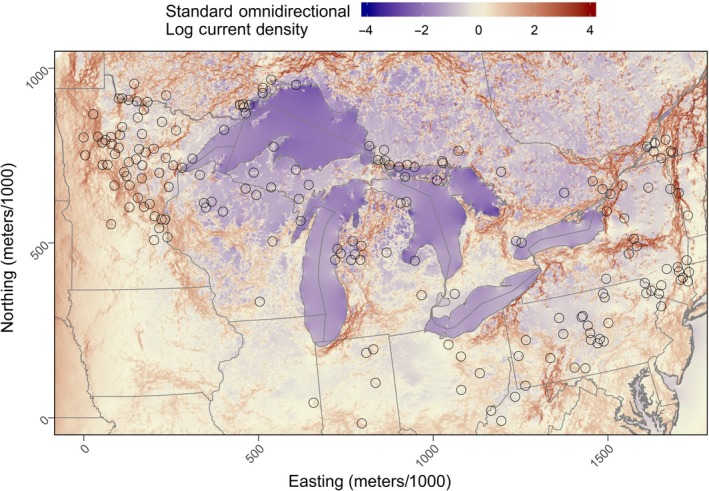
The Great Lakes and the St. Lawrence River are imposing barriers for wildlife, and the additive effect of urban and agricultural development that dominates the lower Great Lakes region likely further reduces functional connectivity for many terrestrial species. As the climate warms, species will need to track climate across these barriers. It is important therefore to investigate land cover and bioclimatic hypotheses that may explain the northward expansion of species through the Great Lakes. We investigated the functional connectivity of a vagile generalist, the bobcat, as a representative generalist forest species common to the region. We genotyped tissue samples collected across the region at 14 microsatellite loci and compared different landscape hypotheses that might explain the observed gene flow or functional connectivity. We found that the Great Lakes and the additive influence of forest stands with either low or high canopy cover and deep lake-effect snow have disrupted gene flow, whereas intermediate forest cover has facilitated gene flow. Functional connectivity in southern Ontario is relatively low and was limited in part by the low amount of forest cover. Pathways across the Great Lakes were through the Niagara region and through the Lower Peninsula of Michigan over the Straits of Mackinac and the St. Marys River. These pathways are important routes for bobcat range expansion north of the Great Lakes and are also likely pathways that many other mobile habitat generalists must navigate to track the changing climate. The extent to which species can navigate these routes will be important for determining the future biodiversity of areas north of the Great Lakes.
Keywords: Bobcat; Great Lakes region; Lynx rufus; functional connectivity; gene flow; landscape genetics; range expansion.
© 2020 The Authors. Ecology and Evolution published by John Wiley & Sons Ltd.
Conflict of interest statement
None Declared.
Figures


References
-
- Anantharaman, R. , Hall, K. , Shah, V. , & Edelman, A. (2019). Circuitscape in Julia: High Performance Connectivity Modelling to Support Conservation Decisions. Retrieved from http://arxiv.org/abs/1906.03542
-
- Anderson, E. , & Lovallo, M. J. (2003). Bobcat and Lynx In George A. F., Bruce C. T., Joseph A. C. (Eds.), Mammals of North America: Biology, Management, and Conservation (pp. 758–786). Baltimore, Maryland: Johns Hopkins University Press.
-
- Bagchi, R. , Hole, D. G. , Butchart, S. H. M. , Collingham, Y. C. , Fishpool, L. D. , Plumptre, A. J. , … Willis, S. G. (2018). Forecasting potential routes for movement of endemic birds among important sites for biodiversity in the Albertine Rift under projected climate change. Ecography, 41(2), 401–413. 10.1111/ecog.02712 - DOI
-
- Baijnath‐Rodino, J. A. , & Duguay, C. R. (2018). Historical spatiotemporal trends in snowfall extremes over the canadian domain of the Great Lakes Basin. Advances in Meteorology, 2018, 1–20. 10.1155/2018/5404123 - DOI
-
- Balkenhol, N. , & Fortin, M. J. (2015). Basics of study design: sampling landscape heterogeneity and genetic variation for landscape genetic studies In Balkenhol N., Cushman S., Storfer A., Waits L. (Eds.), Landscape Genetics: Concepts, Methods, Applications (pp. 58–76). Chichester, UK: John Wiley & Sons, Ltd; 10.1002/9781118525258.ch04 - DOI
Associated data
LinkOut - more resources
Full Text Sources
Research Materials
