


Association of fitness and body fatness with left ventricular mass: The Heart Health Study
- PMID: 32128239
- PMCID: PMC7042021
- DOI: 10.1002/osp4.380
Association of fitness and body fatness with left ventricular mass: The Heart Health Study
Abstract
Objective: Left ventricular mass (LVM) is a clinical prognostic indicator of cardiovascular disease. Left ventricular mass is associated with body size (body mass index [BMI], weight, and body surface area [BSA]). This study examined if the association between body size (weight, BMI, and BSA) and LVM is influenced by body composition and cardiorespiratory fitness in adults who are overweight or obese.
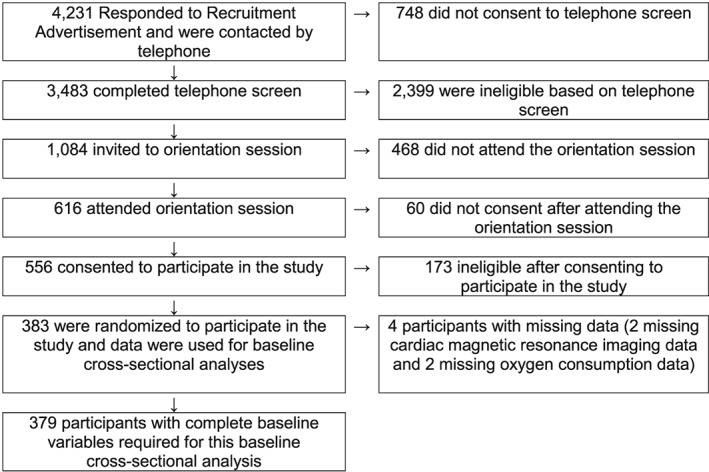
Methods: This study included cross-sectional baseline data from a randomized clinical trial. Participants included 379 adults (age, 45.6 ± 7.9 y) who were overweight or obese (BMI, 32.4 ± 3.8 kg·m-2). Measures included weight, height, BMI, BSA, body composition, cardiorespiratory fitness, and LVM by cardiac magnetic resonance imaging (CMR).
Results: Left ventricular mass was positively associated with weight, BMI, BSA, and fitness (P < .0001) and inversely associated with percent body fat (P < .0001). Stepwise multiple regression models showed that body fatness was inversely associated and cardiorespiratory fitness was positively associated with LVM even after considering weight, BMI, or BSA in the analyses.
Conclusions: These cross-sectional findings support that in adults who are overweight or obese but otherwise relatively healthy, LVM is associated with both body composition and cardiorespiratory fitness. This may indicate the need to reduce body fatness and improve fitness for patients with obesity to enhance cardiovascular structure and function.
Keywords: Cardiac magnetic resonance imaging (CMR); exercise; fitness; obesity.
© 2019 The Authors Obesity Science & Practice published by World Obesity and The Obesity Society and John Wiley & Sons Ltd.
Conflict of interest statement
No conflict of interest was declared.Dr. Rogers was the principal investigator on a grant awarded to the University of Pittsburgh by Weight Watchers International. Dr. Schelbert accepted contrast material from Bracco Diagnostics for research purposes and has served on advisory boards for Merck and Bayer. Dr. Jakicic received an honorarium for serving on the Scientific Advisory Board for Weight Watchers International and was a coinvestigator on a grant awarded to the University of Pittsburgh by Weight Watchers International.
Figures
References
-
- Hales CM, Carroll MD, Fryar CD, Ogden CL. Prevalence of Obesity Among Adults and Youth: United States, 2015‐2016. Hyattsville, MD: National Center for Health Statistics; 2017. - PubMed
-
- Jensen MD, Ryan DH, Apovian CM, et al. 2013 AHA/ACC/TOS guideline for the management of overweight and obesity in adults: a report of the American College of Cardiology/American Heart Association Task Force on Practice Guidelines and The Obesity Society. J Am Coll Cardiol. 2014;63:2985‐3023. - PubMed
-
- National Institutes of Health National Heart Lung and Blood Institute . Clinical guidelines on the identification, evaluation, and treatment of overweight and obesity in adults—the evidence report. Obes Res. 1998;6:67S‐82S. - PubMed
-
- Levy D, Garrison RJ, Savage DD, Kannel WB, Castelli WP. Left ventricular mass and incidence of coronary heart disease in an elderly cohort. The Framingham Heart Study. Ann Intern Med. 1989;110:101‐107. - PubMed
-
- Levy D, Garrison RJ, Savage DD, Kannel WB, Castelli WP. Prognostic implications of echocardiographically determined left ventricular mass in the Framingham Heart Study. N Engl J Med. 1990;322:1561‐1566. - PubMed
Grants and funding
LinkOut - more resources
Full Text Sources