


Editorial
doi: 10.1080/17425247.2020.1738380.
Epub 2020 Mar 11.
Advancing human in vitro pulmonary disease models in preclinical research: opportunities for lung-on-chips
Affiliations
- PMID: 32129105
- PMCID: PMC7611801
- DOI: 10.1080/17425247.2020.1738380
Item in Clipboard
Editorial
Advancing human in vitro pulmonary disease models in preclinical research: opportunities for lung-on-chips
Expert Opin Drug Deliv.
2020 May.
No abstract available
Keywords: Preclinical research; lung diseases; microfluidics; organ-on-chips; respiratory therapy.
Conflict of interest statement
CM Lehr is co-founder, scientific advisor and shareholder of PharmBioTec GmbH, Saarbrücken, Germany.
Figures
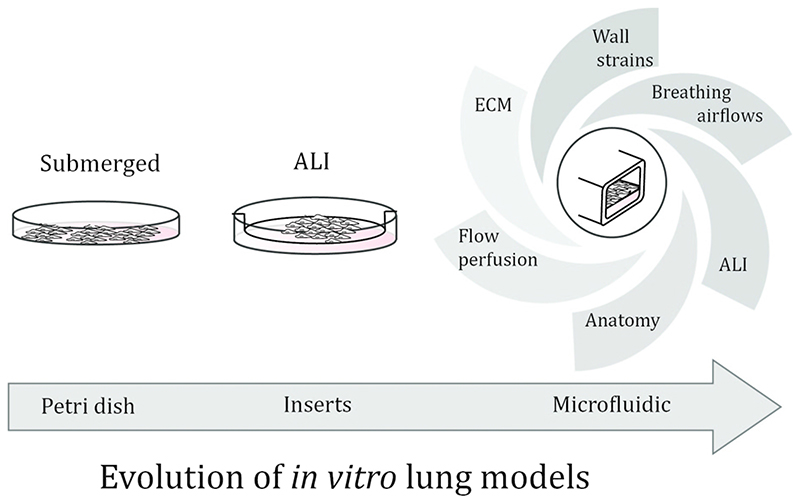
Schematic of preclinical in vitro research tools in respiratory medicine. Traditional assays include the use of petri dishes where cell cultures are grown under submerged conditions. The introduction of filter inserts permits cell cultures (e.g. epithelium, co-cultures, etc.) at the air-liquid interface (ALI), as well as growing endothelial cells on the basal side of the membrane. With the introduction of lung-on-chip platforms, ALI-based cultures can now include an array of physiological cues more closely in line with the innate pulmonary milieu.
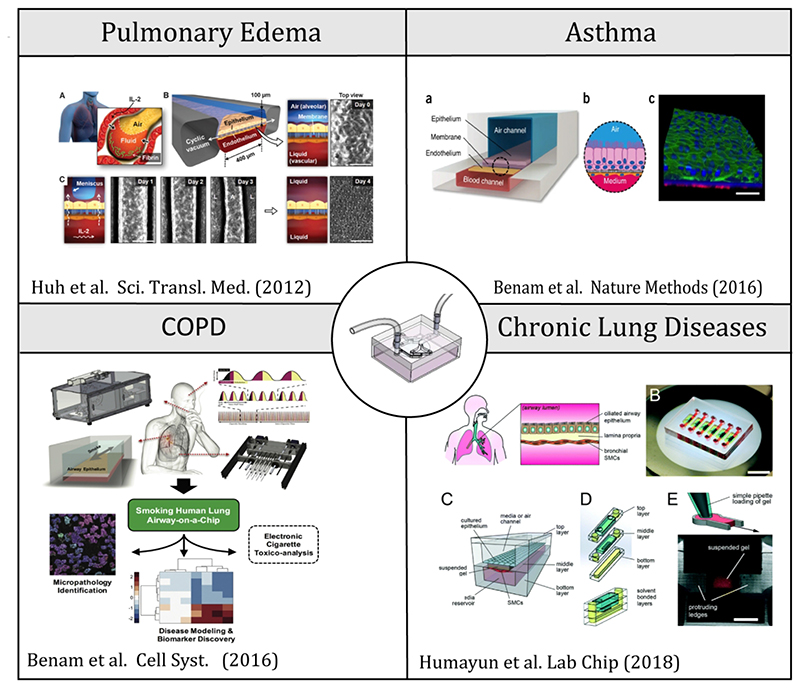
Recent examples of lung-on-chips modeling respiratory diseases include an asthma model [27], pulmonary edema [40] and a COPD model [41], as well as most an airway-on-chip study on epithelial and smooth muscle cell interactions in the pathogenesis of chronic lung diseases [42]. By and large, most microfluidic in vitro designs still consist of simple, straight channels featuring an alveolar capillary barrier (ACB) model made of co-cultures of epithelial and endothelial cells grown above and below a porous membrane, respectively.
References
-
- Prakash YS, Halayko AJ, Gosens R, Panettieri RA, Camoretti-Mercado B, Penn RB, Aiyar R, Ammit A, Berkman N, Bond R, et al. An official American thoracic society research statement: Current challenges facing research and therapeutic advances in airway remodeling. Am J Respir Crit Care Med. 2017;195:e4–e19. doi: 10.1164/rccm.201611-2248ST. - DOI - PubMed
Publication types
Grants and funding
LinkOut - more resources
Full Text Sources
