


Online Self-Management Support for Family Caregivers Dealing With Behavior Changes in Relatives With Dementia (Part 2): Randomized Controlled Trial
- PMID: 32130142
- PMCID: PMC7064946
- DOI: 10.2196/13001
Online Self-Management Support for Family Caregivers Dealing With Behavior Changes in Relatives With Dementia (Part 2): Randomized Controlled Trial
Abstract
Background: Online contacts with a health professional have the potential to support family caregivers of people with dementia.
Objective: The goal of the research was to study the effects of an online self-management support intervention in helping family caregivers deal with behavior changes of a relative with dementia. The intervention-involving among others personal email contacts with a dementia nurse-was compared with online interventions without these email contacts.
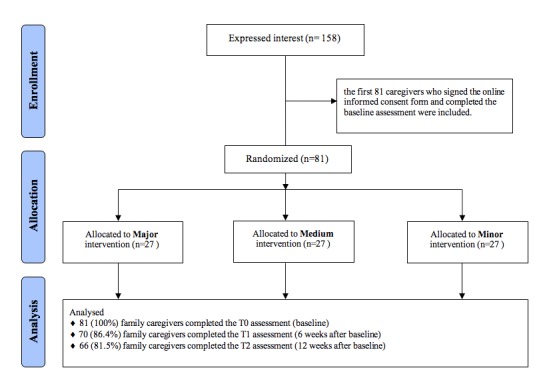
Methods: A randomized controlled trial was conducted with 81 family caregivers of people with dementia who live at home. Participants were randomly assigned to a (1) major self-management support intervention consisting of personal email contacts with a specialist dementia nurse, online videos, and e-bulletins; (2) medium intervention consisting only of online videos and e-bulletins; or (3) minor intervention consisting of only the e-bulletins. The primary outcome was family caregivers' self-efficacy in dealing with behavior changes of the relative with dementia. Secondary outcomes were family caregivers' reports of behavior problems in the people with dementia and the quality of the relationship between the family caregiver and the person with dementia. Measurements were performed at the baseline and at 6 (T1) and 12 weeks (T2) after the baseline. A mixed-model analysis was conducted to compare the outcomes of the 3 intervention arms.
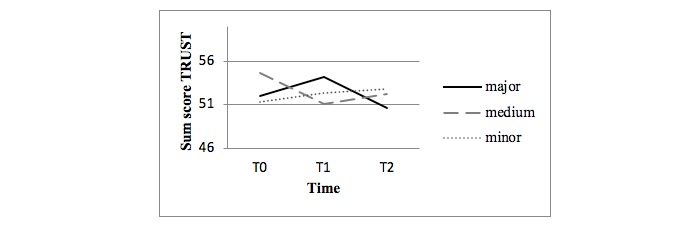
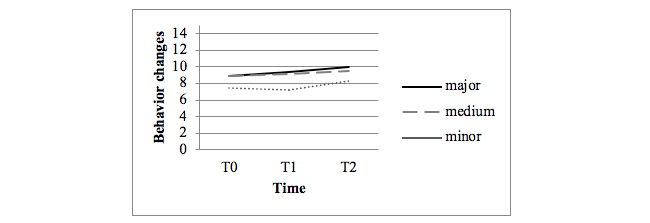
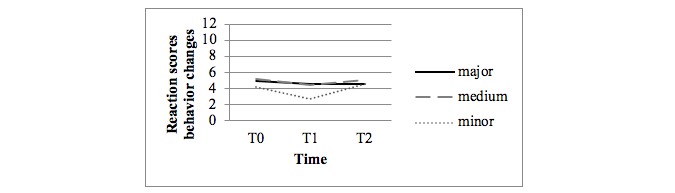
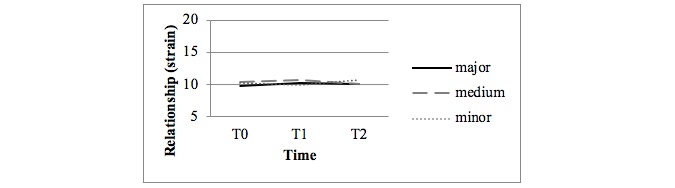
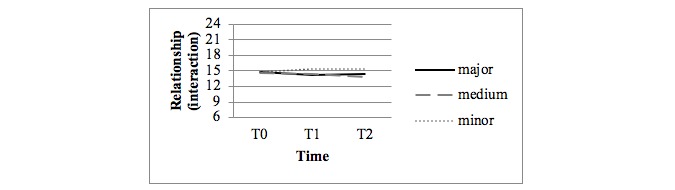
Results: Family caregivers participating in the major intervention involving email contacts showed no statistically significant differences in self-efficacy after the intervention compared with the minor intervention involving only e-bulletins (difference -0.02, P=.99). In the adjusted analysis, the medium intervention (involving videos and e-bulletins) showed a negative trend over time (difference -4.21, P=.09) and at T1 (difference -4.71, P=.07) compared with the minor intervention involving only e-bulletins. No statistical differences were found between the intervention arms in terms of the reported behavior problems and the quality of the relationship between the family caregiver and the person with dementia.
Conclusions: The expectation that an online self-management support intervention involving email contacts would lead to positive effects and be more effective than online interventions without personal email contacts was not borne out. One explanation might be related to the fact that not all family caregivers who were assigned to that intervention actually made use of the opportunity for personal email contact. The online videos were also not always viewed. To obtain more definite conclusions, future research involving extra efforts to reach higher use rates is required.
Trial registration: Netherlands Trial Registry NTR6237; http://www.trialregister.nl/trialreg/admin/rctview.asp?TC=6237 (Archived by WebCite at http://www.webcitation.org/6v0S4fxTC).
International registered report identifier (irrid): RR2-10.2196/resprot.8365.
Keywords: dementia; family caregivers; intervention; self-management; support.
©Judith G Huis in het Veld, Bernadette M Willemse, Iris FM van Asch, Rob BM Groot Zwaaftink, Paul-Jeroen Verkade, Jos WR Twisk, Renate Verkaik, Marco M Blom, Berno van Meijel, Anneke L Francke. Originally published in the Journal of Medical Internet Research (http://www.jmir.org), 25.02.2020.
Conflict of interest statement
Conflicts of Interest: None declared.
Figures
References
-
- Wimo A, Prince M. Alzheimer's Disease International. 2010. [2019-11-20]. World alzheimer report 2010: the global economic impact of dementia https://www.alz.co.uk/research/files/WorldAlzheimerReport2010.pdf.
-
- Cheng S. Dementia caregiver burden: a research update and critical analysis. Curr Psychiatry Rep. 2017 Aug 10;19(9):64. doi: 10.1007/s11920-017-0818-2. http://europepmc.org/abstract/MED/28795386 - DOI - PMC - PubMed
-
- Feast A, Orrell M, Charlesworth G, Melunsky N, Poland F, Moniz-Cook E. Behavioural and psychological symptoms in dementia and the challenges for family carers: systematic review. Br J Psychiatry. 2016 May;208(5):429–434. doi: 10.1192/bjp.bp.114.153684. http://europepmc.org/abstract/MED/26989095 - DOI - PMC - PubMed
-
- Zwaanswijk M, Peeters JM, van Beek AP, Meerveld JH, Francke AL. Informal caregivers of people with dementia: problems, needs and support in the initial stage and in subsequent stages of dementia: a questionnaire survey. Open Nurs J. 2013;7:6–13. doi: 10.2174/1874434601307010006. http://europepmc.org/abstract/MED/23346266 - DOI - PMC - PubMed
Publication types
MeSH terms
Associated data
LinkOut - more resources
Full Text Sources
Medical
Miscellaneous
