. 2020 Feb 20;8(2):e16492.
doi: 10.2196/16492.

Analyzing Medical Research Results Based on Synthetic Data and Their Relation to Real Data Results: Systematic Comparison From Five Observational Studies

Affiliations

Analyzing Medical Research Results Based on Synthetic Data and Their Relation to Real Data Results: Systematic Comparison From Five Observational Studies

Anat Reiner Benaim et al. JMIR Med Inform. .

Abstract

Background: Privacy restrictions limit access to protected patient-derived health information for research purposes. Consequently, data anonymization is required to allow researchers data access for initial analysis before granting institutional review board approval. A system installed and activated at our institution enables synthetic data generation that mimics data from real electronic medical records, wherein only fictitious patients are listed.

Objective: This paper aimed to validate the results obtained when analyzing synthetic structured data for medical research. A comprehensive validation process concerning meaningful clinical questions and various types of data was conducted to assess the accuracy and precision of statistical estimates derived from synthetic patient data.

Methods: A cross-hospital project was conducted to validate results obtained from synthetic data produced for five contemporary studies on various topics. For each study, results derived from synthetic data were compared with those based on real data. In addition, repeatedly generated synthetic datasets were used to estimate the bias and stability of results obtained from synthetic data.

Results: This study demonstrated that results derived from synthetic data were predictive of results from real data. When the number of patients was large relative to the number of variables used, highly accurate and strongly consistent results were observed between synthetic and real data. For studies based on smaller populations that accounted for confounders and modifiers by multivariate models, predictions were of moderate accuracy, yet clear trends were correctly observed.

Conclusions: The use of synthetic structured data provides a close estimate to real data results and is thus a powerful tool in shaping research hypotheses and accessing estimated analyses, without risking patient privacy. Synthetic data enable broad access to data (eg, for out-of-organization researchers), and rapid, safe, and repeatable analysis of data in hospitals or other health organizations where patient privacy is a primary value.

Keywords: MDClone; big data analysis; electronic medical records; synthetic data; validation study.


Conflict of interest statement

Conflicts of Interest: None declared.

Figures
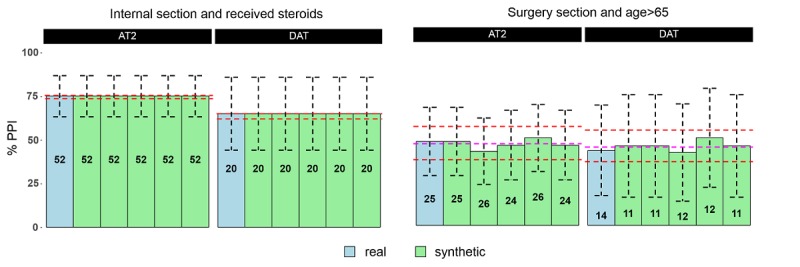
Figure 1
Figure 1
PPI administration (%) for patients receiving the clopidogrel, prasugrel or ticagrelor antiplatelet (AT2) or dual antiplatelet (DAT). The total number of patients in the subgroups are given inside the bars. If no censoring was required (left panel – Internal Section patients that received steroids), proportions of PPI administration calculated from the synthetic sets were essentially identical to the proportions in the real data, and their range across 1000 sets (minimum and maximum in red dotted lines) was very narrow. If censoring was required, as in the case of the Surgery Section, results varied across the synthetic sets, and their ranges were wider (right panel – Surgery Section patients older than 65 years). The means across 1000 sets (purple lines) show small biases.
Figure 2
Figure 2
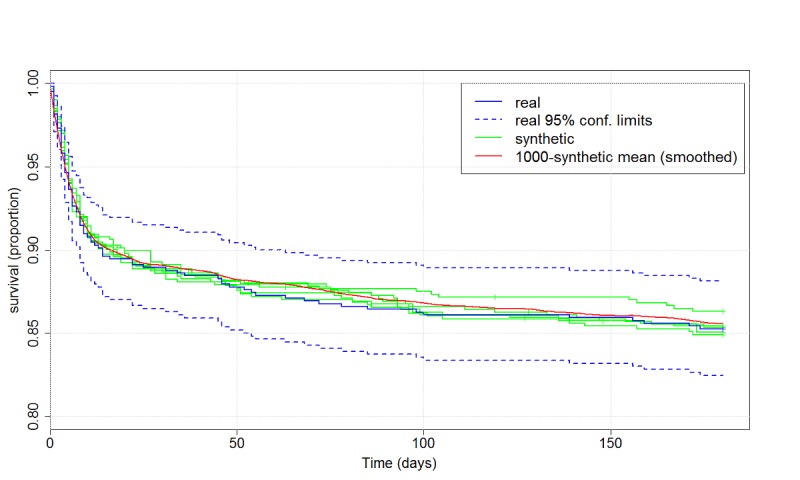
Kaplan-Meier 180-day event-free (CHF/mortality) survival curves after primary PCI, estimated from the real data with 95% confidence limits (blue) and from five repeatedly generated synthetic datasets (green). Survival curves based on synthetic data were similar to curves based on real data, and the mean curve based on 1000 synthetic sets was similar to the curve obtained from the real data.
Figure 3
Figure 3
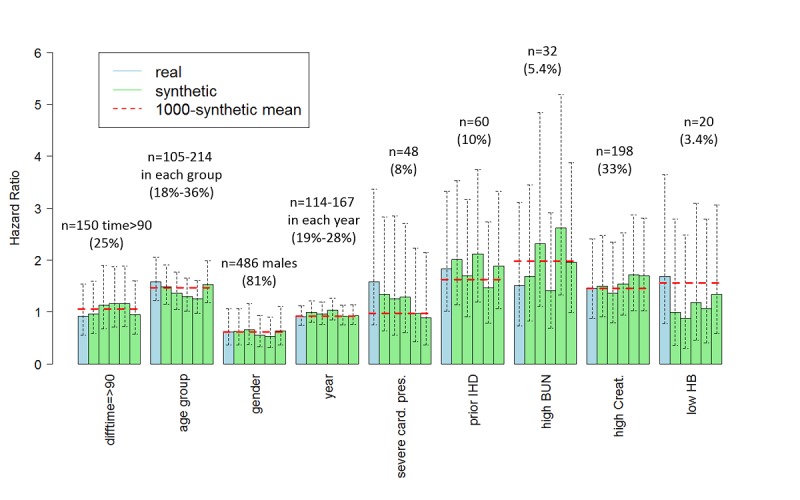
Hazard ratios with 95% confidence intervals for CHF or mortality within 180 days of primary PCI based on real data (blue) and on five synthetic datasets (green). For each variable, the number of cases and percentage in the real data is given. Conclusions were typically consistent between the real and the synthetic data, and across the synthetic sets. In the case of increased risk with age, some variability was observed. The mean result across 1000 synthetic sets (dotted red line) for results with high confidence, was close to the result from the real data, implying small bias.
Figure 4
Figure 4
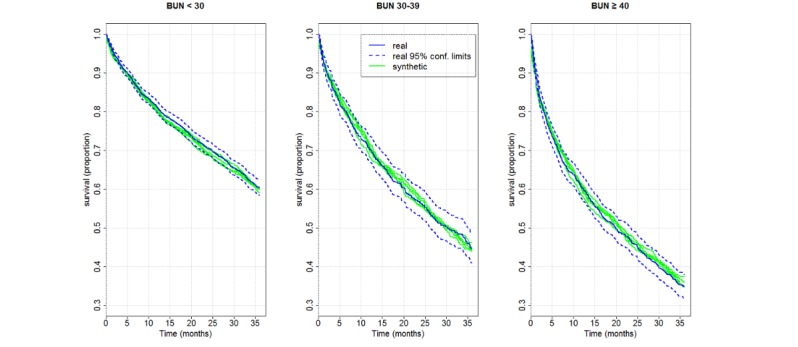
Kaplan-Meier three-year survival curves by admission BUN level, as estimated from the real data (in blue) and from five repeatedly generated synthetic datasets (in orange). The survival curves estimated from the synthetic sets were very close to the curve estimated from the real data.
Figure 5
Figure 5
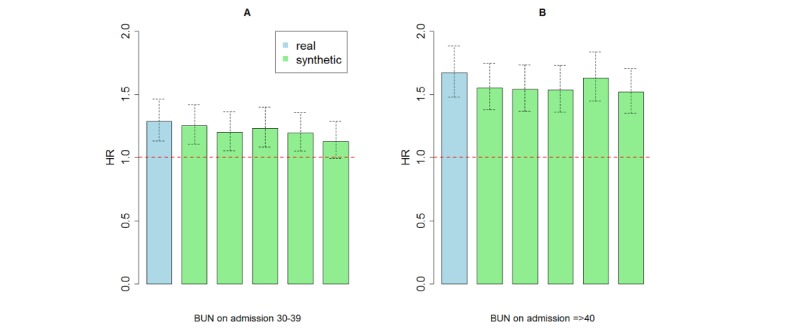
Hazard ratios with confidence intervals by admission BUN level, obtained by Cox proportional hazard regression based on real data and on five synthetic datasets. Hazard ratios relative to the reference group of BUN below 30 based on real data were 1.29 for patients with BUN between 30 and 39 (panel A) and 1.67 for patients with BUN 40 or above (panel B). Hazard ratios estimated from synthetic data were slightly lower. The width of confidence intervals was consistent between the real and the synthetic data, and across the synthetic sets.
Figure 6
Figure 6
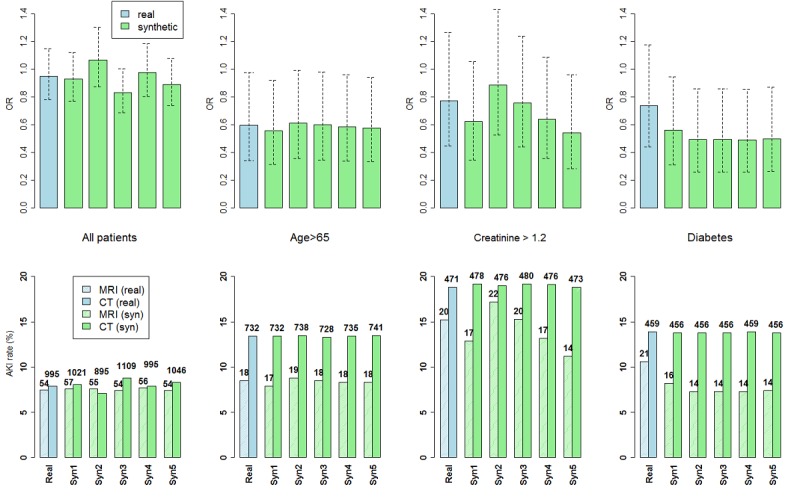
Acute kidney injury (AKI) rates (lower panel) and odds ratios with 95% confidence intervals (upper panel) in four different subgroups for the real data and five repeatedly generated synthetic datasets (Syn1-Syn5). The number of patients in the data for each subgroup is shown above the rate bars. Results obtained from the synthetic data were generally consistent with those obtained from the real data. AKI rates were well estimated for patients older than 65 years of age, and the borderline statistical difference remained consistent; AKI rate estimates were less stable for patients with high creatinine, yet the conclusion of no statistical difference was consistent; Odds ratios for diabetic patients were under-estimated due to under-estimated AKI rates for the very small number of diabetic patients that underwent MRI.
Figure 7
Figure 7
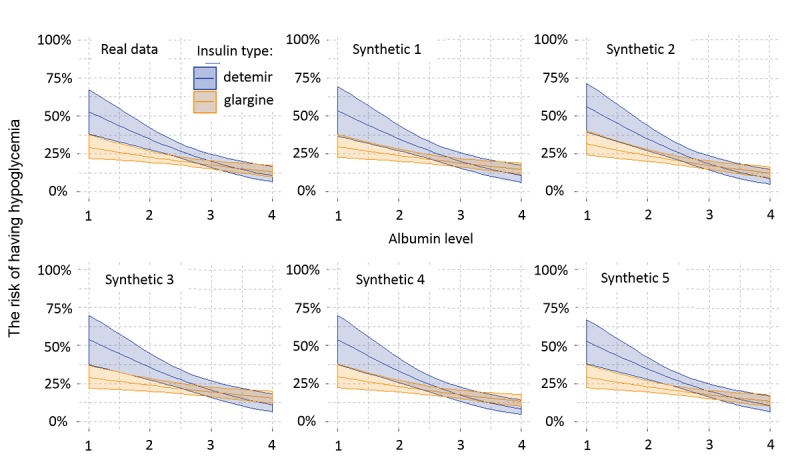
Risk predictions with 95% confidence intervals for detemir and glargine insulin treatments for a range of albumin values, based on the real data (top left) and five synthetic datasets (other panels). The risks estimated from the synthetic sets were highly similar to the curves estimated from the real data, and consistently indicated association of detemir use with a higher prevalence of hypoglycemic events in patients with hypoalbuminemia.
Figure 8
Figure 8
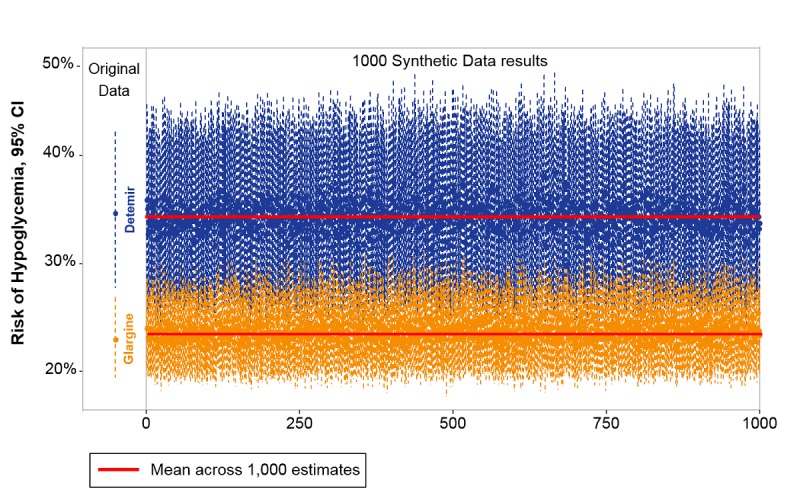
Risk predictions at albumin 2 gr/dL for 1000 repeatedly generated synthetic sets, compared to estimates obtained from the real sets (thin dotted line on the left marks the confidence intervals with the point estimates marked on the line). All synthetic sets predicted a higher hypoglycemia rate for detemir, and all were within the confidence limits of the estimates from the real data. The synthetic data estimates, as showed by their means (thick red lines), are biased from the real data estimates by –0.003 for detemir and by +0.006 for glargine.

References

    1. Garfinkle SL. National Institute of Standards and Technology. 2015. Oct, [2020-01-20]. De-Identification of Personal Information https://nvlpubs.nist.gov/nistpubs/ir/2015/NIST.IR.8053.pdf.
    1. Graham C. The Information Commissioner's Office (ICO) 2012. [2020-01-20]. Anonymization: Managing Data Protection Risk Code of Practice https://ico.org.uk/media/for-organisations/documents/1061/anonymisation-....
    1. Walonoski J, Kramer M, Nichols J, Quina A, Moesel C, Hall D, Duffett C, Dube K, Gallagher T, McLachlan S. Synthea: an approach, method, and software mechanism for generating synthetic patients and the synthetic electronic health care record. J Am Med Inform Assoc. 2017 Aug 30; doi: 10.1093/jamia/ocx079. - DOI - PMC - PubMed
    1. Anderson R. Under threat: patient confidentiality and NHS computing. Drugs Alcohol Today. 2006;6(4):13–7. doi: 10.1108/17459265200600060. - DOI
    1. Ohm P. Broken promises of privacy: responding to the surprising failure of anonymization. UCLA Law Rev. 2010;57:1701. https://ssrn.com/abstract=1450006

LinkOut - more resources