


Optimizing Antihypertensive Medication Classification in Electronic Health Record-Based Data: Classification System Development and Methodological Comparison
- PMID: 32130152
- PMCID: PMC7068459
- DOI: 10.2196/14777
Optimizing Antihypertensive Medication Classification in Electronic Health Record-Based Data: Classification System Development and Methodological Comparison
Abstract
Background: Computable phenotypes have the ability to utilize data within the electronic health record (EHR) to identify patients with certain characteristics. Many computable phenotypes rely on multiple types of data within the EHR including prescription drug information. Hypertension (HTN)-related computable phenotypes are particularly dependent on the correct classification of antihypertensive prescription drug information, as well as corresponding diagnoses and blood pressure information.
Objective: This study aimed to create an antihypertensive drug classification system to be utilized with EHR-based data as part of HTN-related computable phenotypes.
Methods: We compared 4 different antihypertensive drug classification systems based off of 4 different methodologies and terminologies, including 3 RxNorm Concept Unique Identifier (RxCUI)-based classifications and 1 medication name-based classification. The RxCUI-based classifications utilized data from (1) the Drug Ontology, (2) the new Medication Reference Terminology, and (3) the Anatomical Therapeutic Chemical Classification System and DrugBank, whereas the medication name-based classification relied on antihypertensive drug names. Each classification system was applied to EHR-based prescription drug data from hypertensive patients in the OneFlorida Data Trust.
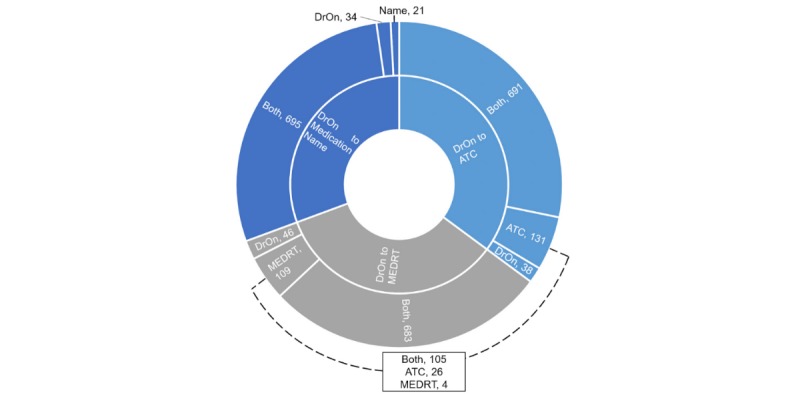
Results: There were 13,627 unique RxCUIs and 8025 unique medication names from the 13,879,046 prescriptions. We observed a broad overlap between the 4 methods, with 84.1% (691/822) to 95.3% (695/729) of terms overlapping pairwise between the different classification methods. Key differences arose from drug products with multiple dosage forms, drug products with an indication of benign prostatic hyperplasia, drug products that contain more than 1 ingredient (combination products), and terms within the classification systems corresponding to retired or obsolete RxCUIs.
Conclusions: In total, 2 antihypertensive drug classifications were constructed, one based on RxCUIs and one based on medication name, that can be used in future computable phenotypes that require antihypertensive drug classifications.
Keywords: RxNorm; antihypertensive agents; classification; electronic health records; phenotype.
©Caitrin W McDonough, Steven M Smith, Rhonda M Cooper-DeHoff, William R Hogan. Originally published in JMIR Medical Informatics (http://medinform.jmir.org), 27.02.2020.
Conflict of interest statement
Conflicts of Interest: WRH is one of the creators of DrOn.
Figures
References
-
- Klann JG, Abend A, Raghavan VA, Mandl KD, Murphy SN. Data interchange using i2b2. J Am Med Inform Assoc. 2016 Sep;23(5):909–15. doi: 10.1093/jamia/ocv188. http://europepmc.org/abstract/MED/26911824 - DOI - PMC - PubMed
-
- Fleurence RL, Curtis LH, Califf RM, Platt R, Selby JV, Brown JS. Launching PCORnet, a national patient-centered clinical research network. J Am Med Inform Assoc. 2014;21(4):578–82. doi: 10.1136/amiajnl-2014-002747. http://europepmc.org/abstract/MED/24821743 - DOI - PMC - PubMed
-
- PCORnet PCORnet. [2020-01-03]. PCORnet Common Data Model (CDM) https://pcornet.org/wp-content/uploads/2019/09/PCORnet-Common-Data-Model....
-
- Klann JG, Joss MA, Embree K, Murphy SN. Data model harmonization for the All Of Us Research Program: Transforming i2b2 data into the OMOP common data model. PLoS One. 2019;14(2):e0212463. doi: 10.1371/journal.pone.0212463. http://dx.plos.org/10.1371/journal.pone.0212463 - DOI - PMC - PubMed
-
- Wei W, Denny JC. Extracting research-quality phenotypes from electronic health records to support precision medicine. Genome Med. 2015;7(1):41. doi: 10.1186/s13073-015-0166-y. https://genomemedicine.biomedcentral.com/articles/10.1186/s13073-015-0166-y - DOI - PMC - PubMed
Grants and funding
LinkOut - more resources
Full Text Sources
