Severe dengue categories as research endpoints-Results from a prospective observational study in hospitalised dengue patients
- PMID: 32130212
- PMCID: PMC7055818
- DOI: 10.1371/journal.pntd.0008076
Severe dengue categories as research endpoints-Results from a prospective observational study in hospitalised dengue patients
Abstract
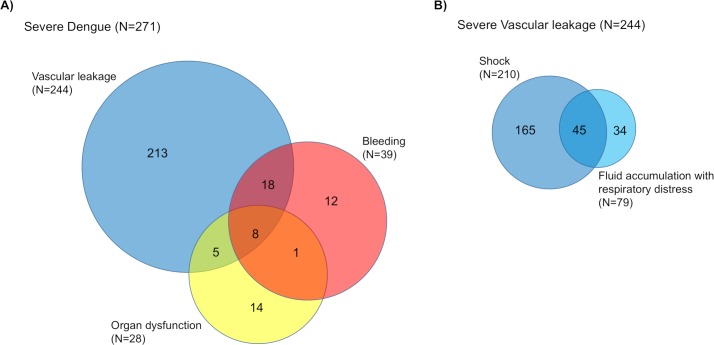
Severe dengue was perceived as one clinical disease entity until the WHO 2009 classification stratified it into severe vascular leakage, severe bleeding, and severe organ dysfunction. The objectives of this study were to investigate the potential use of severe dengue categories as endpoints for intervention research. 271 patients with severe dengue among 1734 confirmed dengue patients were followed prospectively in this hospital-based observational study in Latin America and Asia. We compared the distribution of severe dengue categories according to gender and age (below/above 15y), and determined the relative frequency and the overlap of severe dengue categories in the same patients. In a next step, we extended the analysis to candidate moderate severity categories, based on recently suggested definitions which were adapted for our purposes. Severe vascular leakage occurred in 244 (90%), severe bleeding in 39 (14%), and severe organ dysfunction in 28 (10%) of 271 severe dengue patients. A higher frequency of severe leakage was seen in children or adolescents (<15y) compared to adults. More than 80% of the severe leakage cases, and 30-50% of the cases with severe bleeding or severe organ dysfunction, were defined as severe on the basis of that feature alone. In 136 out of 213 patients with severe leakage alone, neither moderate bleeding manifestation nor hepatic involvement was recorded. On the other hand, moderate leakage manifestations were detected in 4 out of 12 cases that were classified as severe based on bleeding alone. A major proportion of severe dengue patients exhibited clinical manifestations of severe vascular leakage only, which may constitute a useful endpoint for intervention research or pathophysiology studies. Severe bleeding and severe organ manifestation were recorded less frequently and exhibited a higher degree of overlap with severe leakage. Severe bleeding without leakage may be associated with individual predisposition or the presence of comorbidities. More detailed assessments are needed to explore this hypothesis. Candidate moderate disease endpoints were investigated and need to be further validated.
Conflict of interest statement
I have read the journal's policy and the authors of this manuscript have the following competing interests: Dr. Wills reports personal fees from Takeda Vaccines Inc, outside the submitted work, for her work as a member of the Data Monitoring Committee for their dengue vaccine trials. None of the other authors had anything to disclose.
Figures
References
-
- WHO. Dengue: Guidelines for Diagnosis, Treatment, Prevention and Control. New Edition ed Geneva: WHO; 2009. - PubMed
Publication types
MeSH terms
Grants and funding
LinkOut - more resources
Full Text Sources
Medical