


Parallel pitch processing in speech and melody: A study of the interference of musical melody on lexical pitch perception in speakers of Mandarin
- PMID: 32130244
- PMCID: PMC7055904
- DOI: 10.1371/journal.pone.0229109
Parallel pitch processing in speech and melody: A study of the interference of musical melody on lexical pitch perception in speakers of Mandarin
Erratum in
-
Correction: Parallel pitch processing in speech and melody: A study of the interference of musical melody on lexical pitch perception in speakers of Mandarin.PLoS One. 2023 Mar 13;18(3):e0283262. doi: 10.1371/journal.pone.0283262. eCollection 2023. PLoS One. 2023. PMID: 36913397 Free PMC article.
Abstract
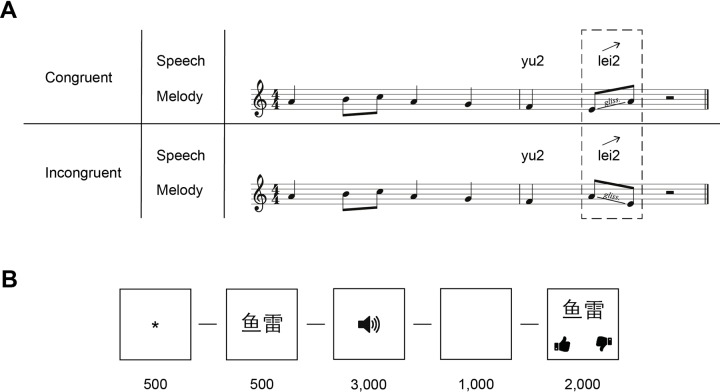
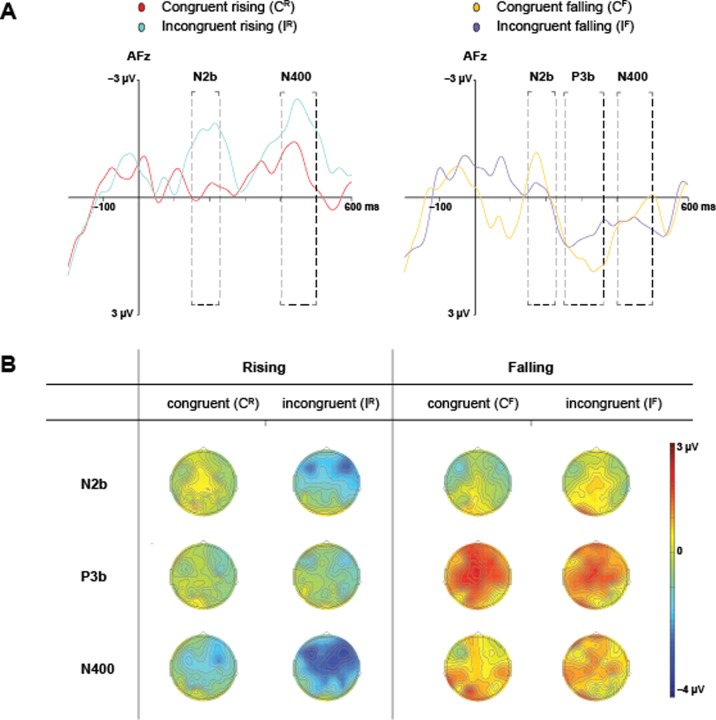
Music and language have long been considered two distinct cognitive faculties governed by domain-specific cognitive and neural mechanisms. Recent work into the domain-specificity of pitch processing in both domains appears to suggest pitch processing to be governed by shared neural mechanisms. The current study aimed to explore the domain-specificity of pitch processing by simultaneously presenting pitch contours in speech and music to speakers of a tonal language, and measuring behavioral response and event-related potentials (ERPs). Native speakers of Mandarin were exposed to concurrent pitch contours in melody and speech. Contours in melody emulated those in speech were either congruent or incongruent with the pitch contour of the lexical tone (i.e., rising or falling). Component magnitudes of the N2b and N400 were used as indices of lexical processing. We found that the N2b was modulated by melodic pitch; incongruent item evoked significantly stronger amplitude. There was a trend of N400 to be modulated in the same way. Interestingly, these effects were present only on rising tones. Amplitude and time-course of the N2b and N400 may suggest an interference of melodic pitch contours with both early and late stages of phonological and semantic processing.
Conflict of interest statement
The authors have declared that no competing interests exist.
Figures
References
-
- Gerardi GM, Gerken L. The Development of Affective Responses to Modality and Melodic Contour. Music Percept. 1995;
-
- Gagnon L, Peretz I. Mode and tempo relative contributions to “happy-sad” judgements in equitone melodies. Cognition and Emotion. 2003. - PubMed
-
- Patel AD. Sharing and Nonsharing of Brain Resources for Language and Music. In: Language, Music, and the Brain. 2015.
Publication types
MeSH terms
LinkOut - more resources
Full Text Sources
