


WISP1 and TLR4 on Macrophages Contribute to Ventilator-Induced Lung Injury
- PMID: 32130574
- PMCID: PMC7170822
- DOI: 10.1007/s10753-019-01103-0
WISP1 and TLR4 on Macrophages Contribute to Ventilator-Induced Lung Injury
Erratum in
-
Correction to: WISP1 and TLR4 on Macrophages Contribute to Ventilator-Induced Lung Injury.Inflammation. 2021 Jun;44(3):1205. doi: 10.1007/s10753-020-01381-z. Inflammation. 2021. PMID: 33188466 Free PMC article. No abstract available.
Abstract
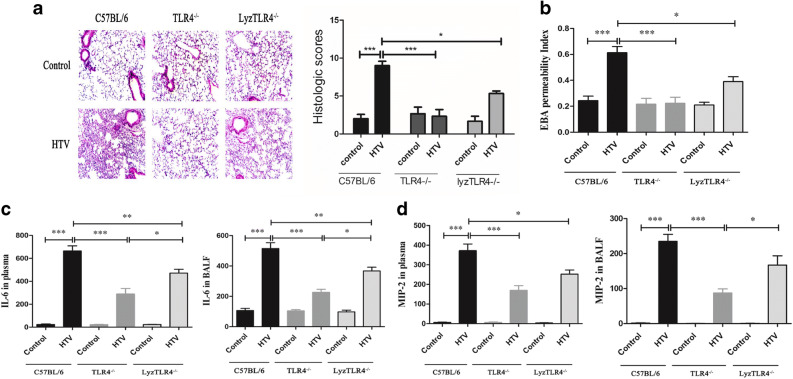
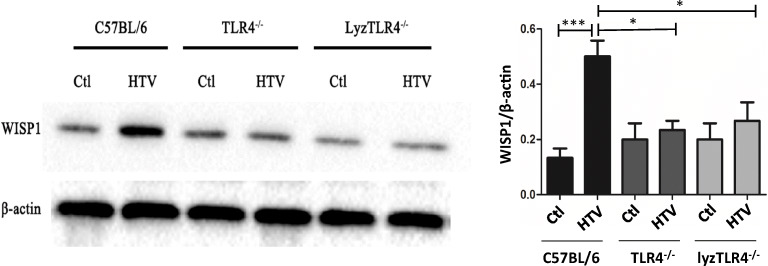
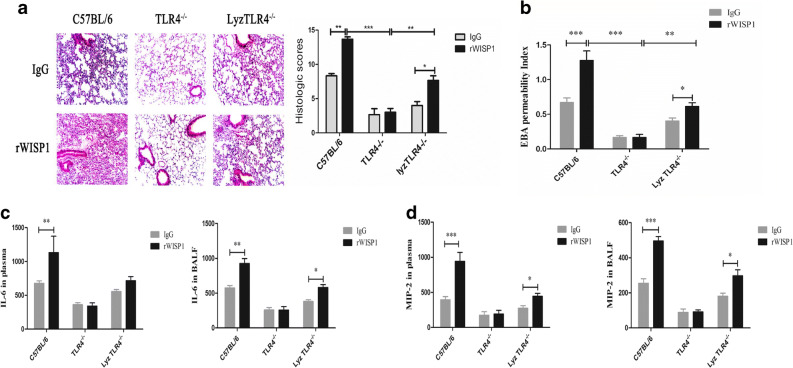
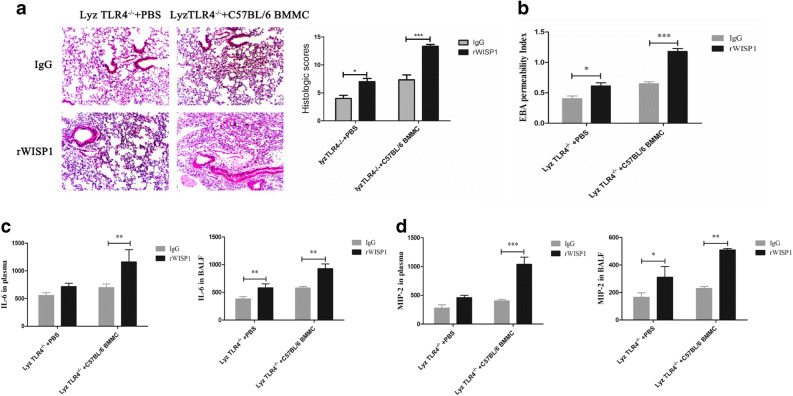
Injurious mechanical ventilation has been shown to directly affect pulmonary and systemic immune responses. How these responses propagate or attenuate remains unknown. The goal of this study was to further determine whether toll-like receptor (TLR) 4 and WNT1-inducible signaling pathway protein 1 (WISP1) could contribute to injurious mechanical ventilation, especially focusing on the role of macrophages during experimental ventilator-induced lung injury. A prospective, randomized, and controlled animal study was designed, and male, wild-type (WT) C57BL/6 mice, TLR4 knockout (TLR4-/-), and lyzTLR4 knockout (lyzTLR4-/-) mice aging 8~12 weeks were used. Animals were anesthetized and randomized to spontaneous breathing (SB) group or to high tidal volume (VT, 20 ml/kg) mechanical ventilation (HTV) group. Histological evaluation, alveolar-capillary permeability of Evan's blue albumin (EBA), WISP1 protein levels, macrophage inflammatory protein-2 (MIP-2), and interleukin-6 (IL-6) in plasma and bronchoalveolar lavage fluid (BALF) concentrations were analyzed. HTV group was associated with a significant increase of WISP1 and EBA ratio in C57BL/6 mice, a significant decrease of WISP1 protein levels, and a significant decrease of IL-6, MIP-2 in plasma, and BALF concentrations of pro-inflammatory cytokines in TLR4-/- and lyzTLR4-/- knockout mice. In TLR4-/- mice and lyzTLR4-/- mice, there were also significant differences between SB group and HTV group in terms of H&E score and EBA ratio and level of pro-inflammation cytokines. The entire TLR4-targeted mice could further improve various inflammatory changes and damages when compared with lyzTLR4-targeted mice. What is more, TLR4-/- mice and lyzTLR4-/- mice reacted differently to rWISP1 and/or BMMC treated. TLR4-/- mice had no response to rWISP1, while lyzTLR4-/- mice still showed drastic response to both treatments. TLR4 and WISP1, especially the former one, on macrophages could contribute to releasing of pro-inflammatory cytokines during ventilator-induced lung injury. Injurious mechanical ventilation may result in an immune response which is similar to that of infection.
Keywords: TLR4; WISP1; lung injury; mechanical ventilation.
Conflict of interest statement
The authors declare that they have no conflict of interest.
Figures
References
-
- Vaneker M, Joosten LA, Heunks LM, Snijdelaar DG, Halbertsma FJ, van Egmond J, Netea MG, van der Hoeven J, Scheffer GJ. Low-tidal-volume mechanical ventilation induces a toll-like receptor 4-dependent inflammatory response in healthy mice. Anesthesiology. 2008;109:465–472. doi: 10.1097/ALN.0b013e318182aef1. - DOI - PubMed
-
- Stuber F, Wrigge H, Schroeder S, Wetegrove S, Zinserling J, Hoeft A, et al. Kinetic and reversibility of mechanical ventilation-associated pulmonary and systemic inflammatory response in patients with acute lung injury. Intensive Care Medicine. 2002;28:834–841. doi: 10.1007/s00134-002-1321-7. - DOI - PubMed
MeSH terms
Substances
Grants and funding
LinkOut - more resources
Full Text Sources
Research Materials
