


The pharmacology course for preclinical students using team-based learning
- PMID: 32130849
- PMCID: PMC7066433
- DOI: 10.3946/kjme.2020.151
The pharmacology course for preclinical students using team-based learning
Abstract
Purpose: A pharmacology course in undergraduate medical education aims to enable students to cultivate the ability of applying drugs in the clinical context using basic scientific knowledge. Although team-based learning could be a useful approach, the literature on pharmacology education using team-based learning is limited. This study aims to evaluate the effectiveness of a pharmacology course using team-based learning.
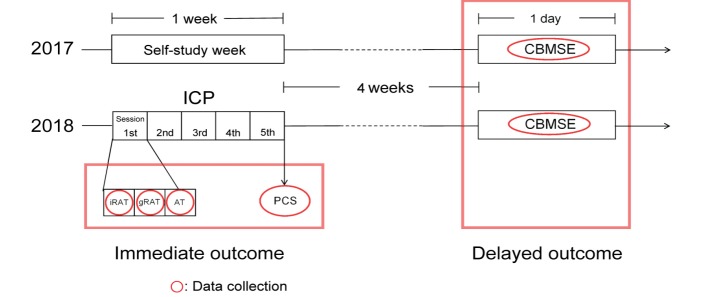
Methods: We developed an "integrated clinical pharmacology" course for first-year medical students. All 49 students enrolled in the course. Individual and group scores were recorded for each session, and a post-course survey was conducted after the course. We compared the performance of the current class to that of a previous class based on scores in a nationwide test conducted at the end of every year.
Results: The reactions of the students were generally positive, with the exception of their perception of the preparatory burdens for the individual test. Throughout the team-based learning sessions, the achievement at the group level was significantly higher than at the individual level. In the nationwide test, however, when we divided students into high and low achiever groups, only the low achievers demonstrated significant improvement compared to the cohort from the previous year.
Conclusion: The study demonstrates that team-based learning could be an effective way of teaching pharmacology to medical students in the preclinical stage. Although most of the students were actively engaged regardless of their preparedness, low-achieving students in particular seemed to gain more benefits than high achievers regarding the acquisition of knowledge.
Keywords: Pharmacology; Program evaluation; Team-based learning.
Conflict of interest statement
No potential conflict of interest relevant to this article was reported.
Figures
References
-
- Woods NN, Neville AJ, Levinson AJ, Howey EH, Oczkowski WJ, Norman GR. The value of basic science in clinical diagnosis. Acad Med. 2006;81(10 Suppl):S124–S127. - PubMed
-
- Kulasegaram KM, Martimianakis MA, Mylopoulos M, Whitehead CR, Woods NN. Cognition before curriculum: rethinking the integration of basic science and clinical learning. Acad Med. 2013;88(10):1578–1585. - PubMed
-
- Kulasegaram K, Manzone JC, Ku C, Skye A, Wadey V, Woods NN. Cause and effect: testing a mechanism and method for the cognitive integration of basic science. Acad Med. 2015;90(11 Suppl):S63–S69. - PubMed
-
- Dolmans D, Michaelsen L, van Merriënboer J, van der Vleuten C. Should we choose between problem-based learning and team-based learning? No, combine the best of both worlds! Med Teach. 2015;37(4):354–359. - PubMed
-
- Haramati A. Educating the educators: a key to curricular integration. Acad Med. 2015;90(2):133–135. - PubMed
MeSH terms
LinkOut - more resources
Full Text Sources
