. 2020 Mar 3;30(9):2859-2868.e5.
doi: 10.1016/j.celrep.2020.02.010.

High-Throughput Screens of PAM-Flexible Cas9 Variants for Gene Knockout and Transcriptional Modulation

Affiliations

High-Throughput Screens of PAM-Flexible Cas9 Variants for Gene Knockout and Transcriptional Modulation

Mateusz Legut et al. Cell Rep. .

Abstract

A key limitation of the widely used CRISPR enzyme S. pyogenes Cas9 is the strict requirement of an NGG protospacer-adjacent motif (PAM) at the target site. This constraint can be limiting for genome editing applications that require precise Cas9 positioning. Recently, two Cas9 variants with a relaxed PAM requirement (NG) have been developed (xCas9 and Cas9-NG), but their activity has been measured at only a small number of endogenous sites. Here, we devise a high-throughput Cas9 pooled competition screen to compare the performance of Cas9 variants at thousands of genomic loci for gene knockout, transcriptional activation, and inhibition. We show that PAM flexibility comes at a substantial cost of decreased DNA targeting and cleavage. Of the PAM-flexible variants, we find that Cas9-NG outperforms xCas9 regardless of genome engineering modality or PAM. Finally, we combine xCas9 mutations with those of Cas9-NG, creating a stronger transcriptional modulator than existing PAM-flexible Cas9 variants.

Keywords: CRISPRa; CRISPRi; Cas9; PAM flexible; mutagenesis; pooled CRISPR screens; protospacer-adjacent motif; xCas9-NG.


Conflict of interest statement

Declaration of Interests The New York Genome Center and New York University have applied for patents relating to the work in this article. N.E.S. is an advisor to Vertex.

Figures
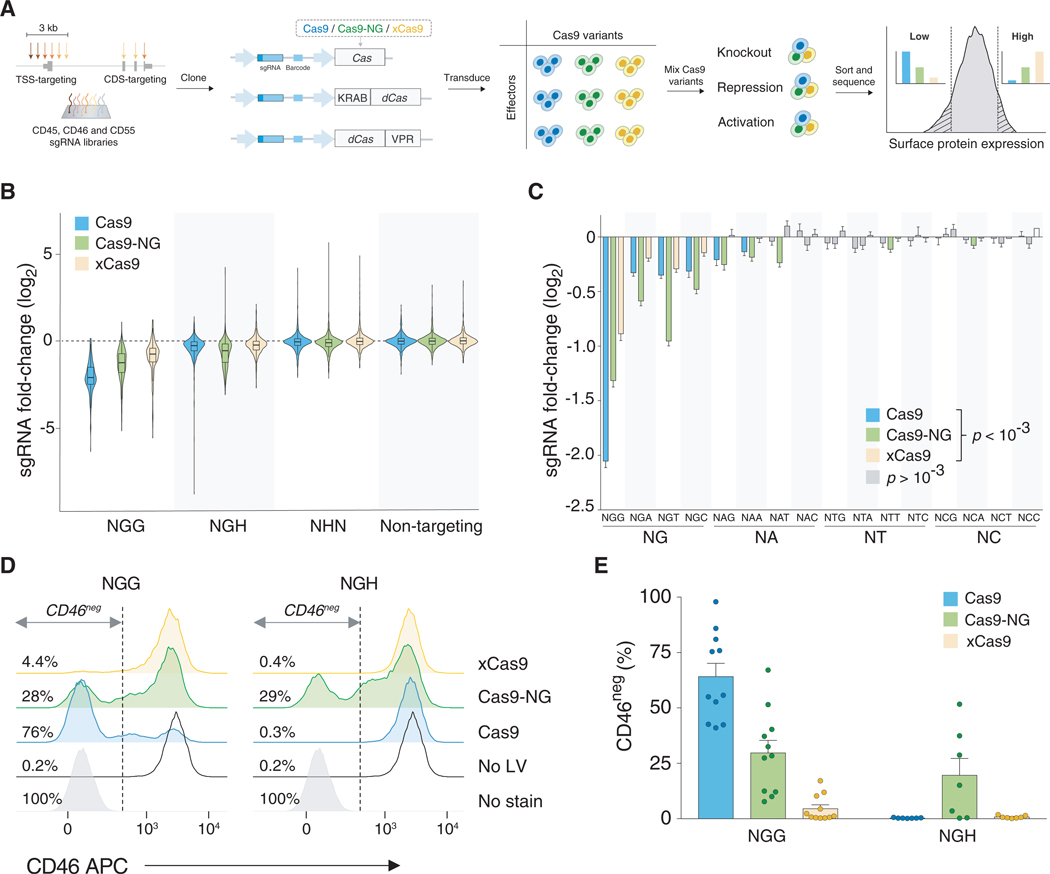
Figure 1.
Figure 1.. A High-Throughput, Pooled Competition Assay for PAM-Flexible Cas9 Variants
(A) Gene-specific sgRNA libraries were cloned into lentiviral plasmids containing barcoded Cas9 effectors. After library transduction, K562 cells were sorted by target gene expression level into high- and low-expressing bins, and the relative frequency of sgRNA-Cas9 barcode pairs in both bins was compared. (B) Fold change of sgRNA representation in cell populations expressing high levels of the target gene compared with low-expressing cells, combined for all three genes tested. Only sgRNAs targeting CDS exons are shown. (C) Fold change of sgRNA representation grouped by 2 and 3 nt PAMs. Statistical significance was determined by comparing fold change of sgRNAs associated with a particular PAM with a respective non-targeting control using two-tailed Student’s t test with Bonferroni correction for multiple hypothesis testing. Error bars indicate standard error of the mean. Only statistically significant PAM/Cas9 combinations are shown in color. (D) CD46ne9 gate, indicated with a dashed line, was set on the basis of K562 autofluorescence. Numbers displayed next to histograms indicate the percentage of cells in CD46neg gate. LV, lentivirus. (E) Quantification of CD46 knockout in K562 cell line by lentiviral transduction of Cas9 nucleases and sgRNAs associated with NGG or NGH PAMs. Error bars indicate standard error of the mean.
Figure 2.
Figure 2.. Time Course of CD46 Knockout by Cas9 Variants
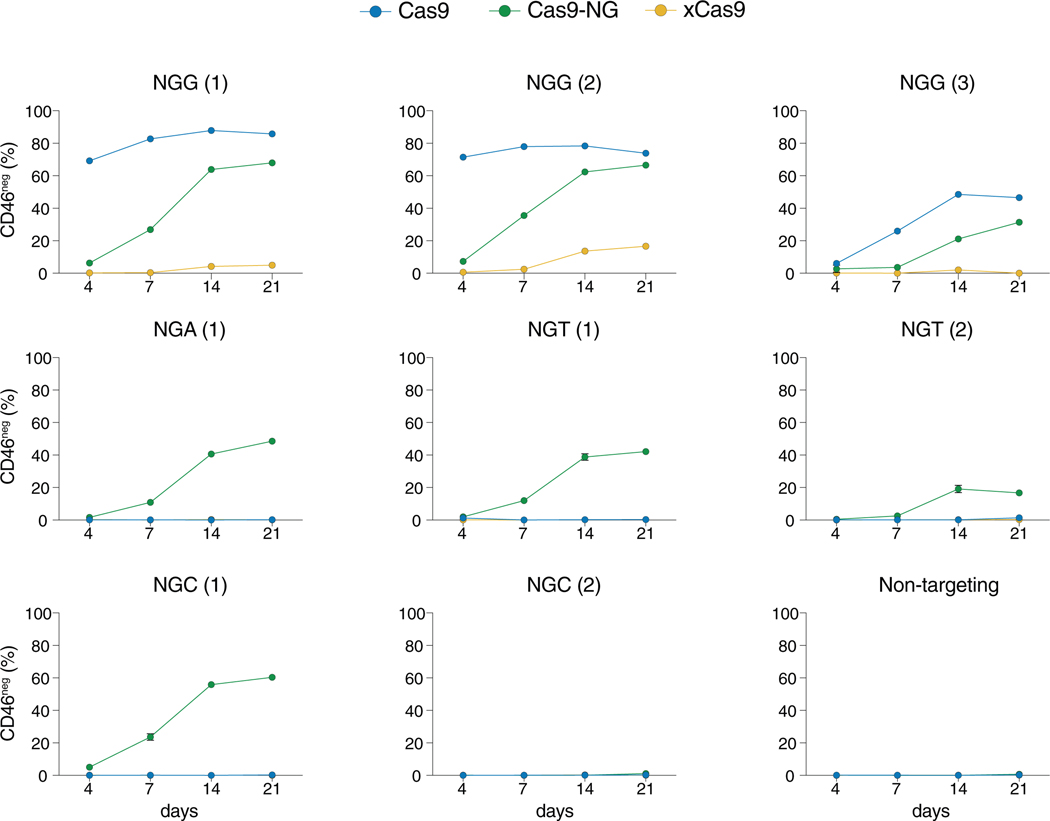
CD46+ A375 cells were transduced with lentivirus encoding the indicated Cas9 variants and sgRNAs targeting CD46 coding sequences. Target site PAMs are as indicated in each panel title. Following selection, CD46 negative cells were quantified by flow cytometry on the basis of the gate set on the unstained population at days 4, 7, 14, and 21. Standard error of the mean is shown (n = 3 replicate transductions).
Figure 3.
Figure 3.. Characterization of Indel Mutations Produced by Active Cas9 Variants
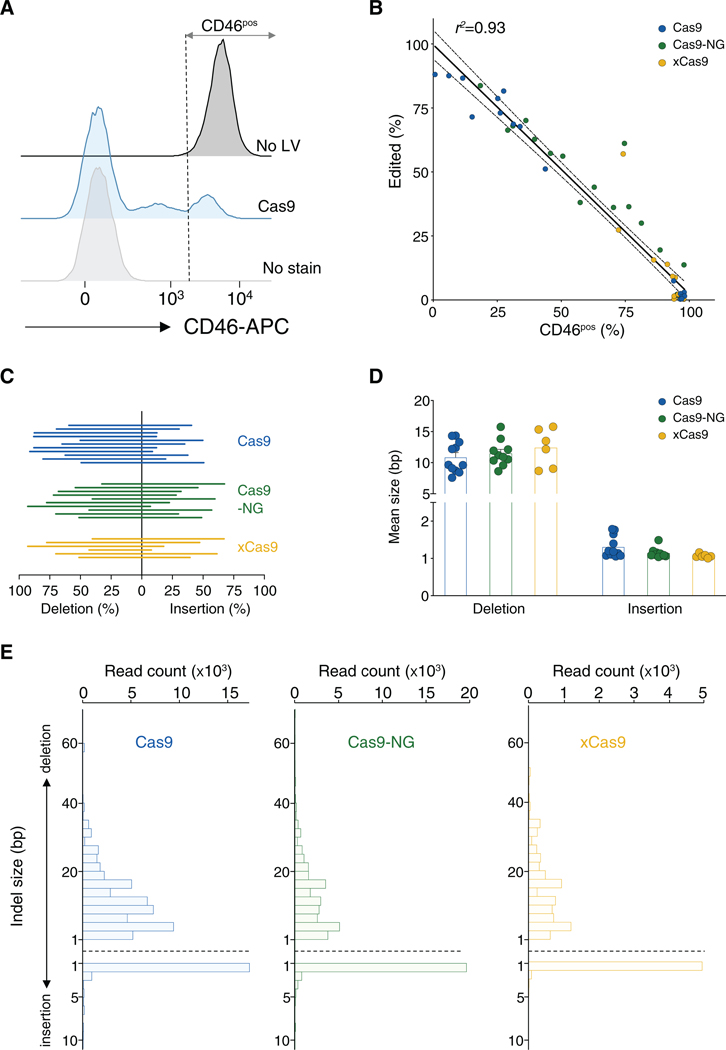
(A) Gating strategy for enumeration of K562 cells expressing the WT level of CD46 protein. No LV, no lentivirus. (B) Correlation between the frequency of alleles containing indels and the frequency of cells expressing the WT levels of CD46 protein. Dashed lines indicate 95% confidence intervals around the linear regression curve. NGG and NGH sgRNAs are included. r2 is the Pearson coefficient of determination. (C) Relative frequency of deletions and insertions among edited alleles. Each line represents one sgRNA. Only NGG sgRNAs with >5% edited alleles are included. (D) Mean deletion and insertion sizes per Cas9 variant. Each data point represents the mean indel size for one sgRNA. Error bars indicate SEM. Only NGG sgRNAs with >5% edited reads are included. (E) Indel sizes (among edited reads) for each Cas9 variant.
Figure 4.
Figure 4.. CRISPRi and CRISPRa Transcriptional Modulation Using PAM-Flexible Cas9 Variants
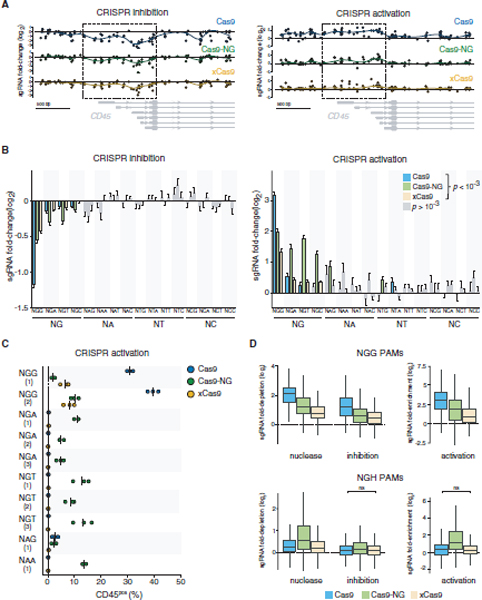
(A) Fold change of sgRNAs targeting the 3 kb region surrounding the primary TSS of CD45 gene. Only sgRNAs associated with an NGG PAM are displayed here (n = 123 sgRNAs). The regions with the strongest NGG sgRNA activity (indicated with dashed lines) were used to select sgRNAs (all PAMs) for subsequent analyses. CD45 transcript isoforms (PTPRC-204, PTPRC-215, PRPRC-201, PTPRC-209, PTPRC-206, and PTPRC-207) are shown in gray. (B) Fold-change of sgRNA representation grouped by 2 and 3 nt PAM categories. Statistical significance was determined by comparing fold change of sgRNAs associated with a particular PAM with a respective non-targeting control using two-sided Student’s t test with Bonferroni correction. Error bars indicate standard error of the mean. Only statistically significant PAM/Cas9 combinations are shown in color. CRISPRi: n = 2,165 sgRNAs; CRISPRa: n = 1,980 sgRNAs. (C) CD45 expression following CRISPR activation In the CD45neg human A375 cell line. Only sgRNAs resulting In >1% CD45pos cells with at least one Cas9 variant are displayed (see Figure S6 for data from all sgRNAs tested). Mean and individual values from three independent experiments are shown. For NAG and NAA PAMs, only one of three sgRNAs tested resulted in >1% CD45pos cells. (D) Comparison of WT Cas9 and two PAM-flexible Cas9 variants across all three modalities tested in high-throughput screens. Fold-enrichment was calculated on the basis of the sgRNA frequency in the top bin over bottom bin; fold depletion was calculated on the basis of the sgRNA frequency in the bottom bin overtop bin. Only non-significant comparisons (ns, p > 0.05) are indicated; all other differences (between enzymes, within modalities) are significant.
Figure 5.
Figure 5.. Cas9-NG Mutations Partially Rescue xCas9 Nuclease Activity and Result in an Improved PAM-Flexible Cas9 Enzyme for Transcriptional Activation
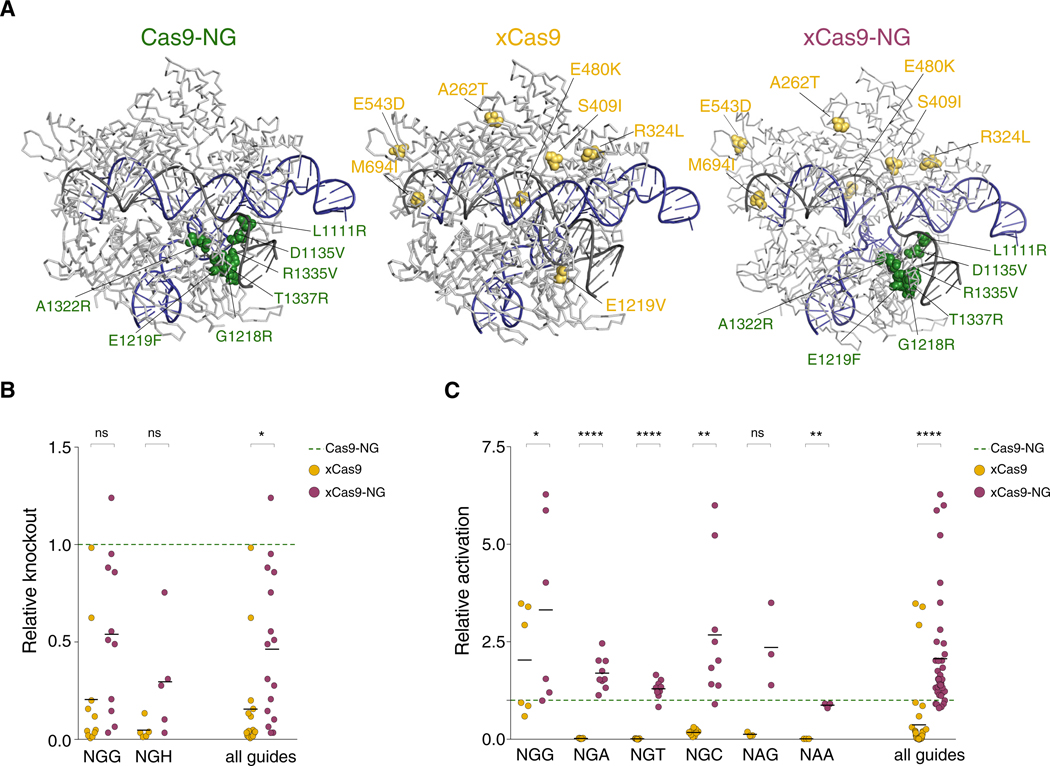
(A) Crystal structures of Cas9 mutants. xCas9 mutations are shown on a WT Cas9 structure (PDB: 4un3; Anders et al., 2014). xCas9-NG mutations are displayed on a Cas9-NG structure (PDB: 6ai6; Nishimasu et al., 2018). The sgRNA is shown in black, and the target DNA is shown in blue. (B and C) Knockout (B) and activation (C) activity for individual sgRNAs with target sites with the indicated PAMs. Each xCas9 or xCas9-NG experiment was normalized to Cas9-NG on a per-sgRNA basis. Only sgRNAs resulting in >1% knockout or activation are shown. Non-normalized data for xCas9 and Cas9-NG are displayed in Figures 1E and 4C and are included here for comparison with xCas9-NG. ns, p > 0.05; *p < 0.05, **p < 0.01, and ****p < 0.0001

References

    1. Adli M. (2019). The CRISPR tool kit for genome editing and beyond. Nature Communications 9, 1–13. - PMC - PubMed
    1. Anders C, Niewoehner O, Duerst A, and Jinek M. (2014). Structural basis of PAM-dependent target DNA recognition by the Cas9 endonuclease. Nature 513, 569–573. - PMC - PubMed
    1. Chavez A, Tuttle M, Pruitt BW, Ewen-Campen B, Chari R, Ter-Ova-nesyan D, Haque SJ, Cecchi RJ, Kowal EJK, Buchthal J, et al. (2016). Comparison of Cas9 activators in multiple species. Nat. Methods 13, 563–567. - PMC - PubMed
    1. Chen B, Gilbert LA, Cimini BA, Schnitzbauer J, Zhang W, Li G-W, Park J, Blackburn EH, Weissman JS, Qi LS, and Huang B. (2013). Dynamic imaging of genomic loci in living human cells by an optimized CRISPR/Cas system. Cell 155, 1479–1491. - PMC - PubMed
    1. Clement K, Rees H, Canver MC, Gehrke JM, Farouni R, Hsu JY, Cole MA, Liu DR, Joung JK, Bauer DE, and Pinello L. (2019). CRISPResso2 provides accurate and rapid genome editing sequence analysis. Nat. Biotechnol 37, 224–226. - PMC - PubMed

Publication types