Functional ability and quality of life in critical illness survivors with intensive care unit acquired weakness: A secondary analysis of a randomised controlled trial
- PMID: 32131082
- PMCID: PMC7056321
- DOI: 10.1371/journal.pone.0229725
Functional ability and quality of life in critical illness survivors with intensive care unit acquired weakness: A secondary analysis of a randomised controlled trial
Abstract
Introduction: Intensive care unit acquired weakness (ICUAW) may contribute to functional disability in ICU survivors, yet performance-based data for general ICU patients are lacking. This study explored functional outcomes of (1) and risk factors for (2) weakness at ICU discharge.
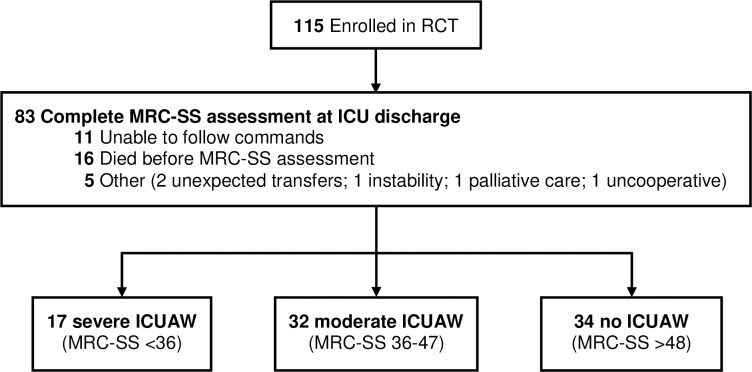
Methods: Data from a randomised controlled trial that investigated two early exercise regimes in previously independent, ventilated adults (n = 115) without any significant outcome-differences were used for the present analysis. ICUAW was clinically diagnosed in cooperative participants (n = 83) at ICU discharge with the Medical Research Council sum-score (MRC-SS) using a cut-off <48 for moderate or <36 for severe weakness. Primary outcomes were the 6-Minute Walk Test and Functional Independence Measure at hospital discharge. Secondary outcomes included health-related quality of life after six months. Risk factors during the ICU stay were explored for their effect on MRC-SS with linear regression.
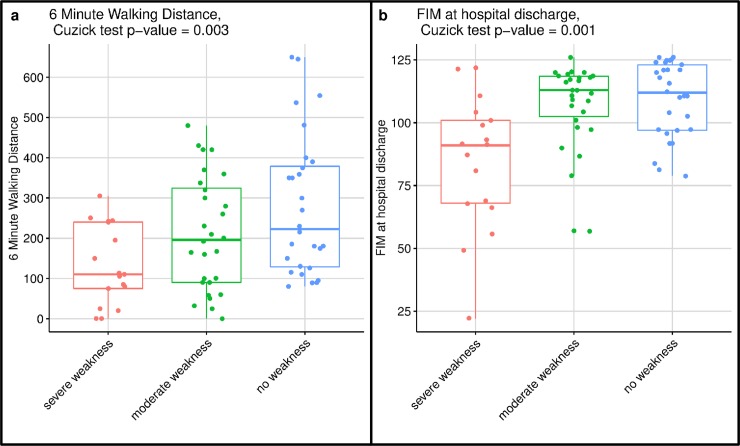
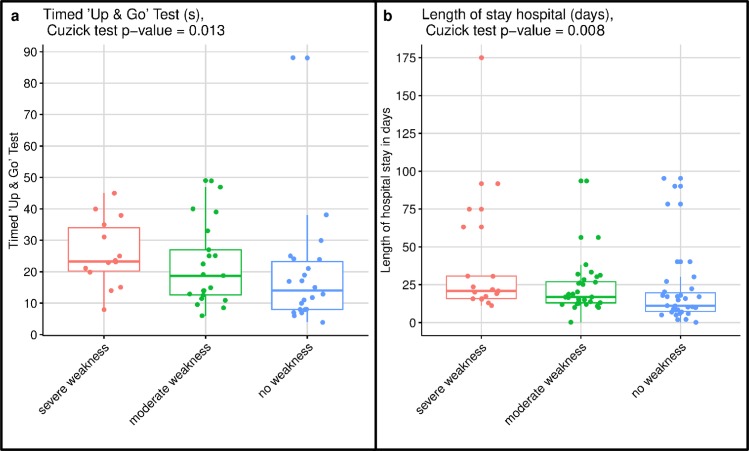
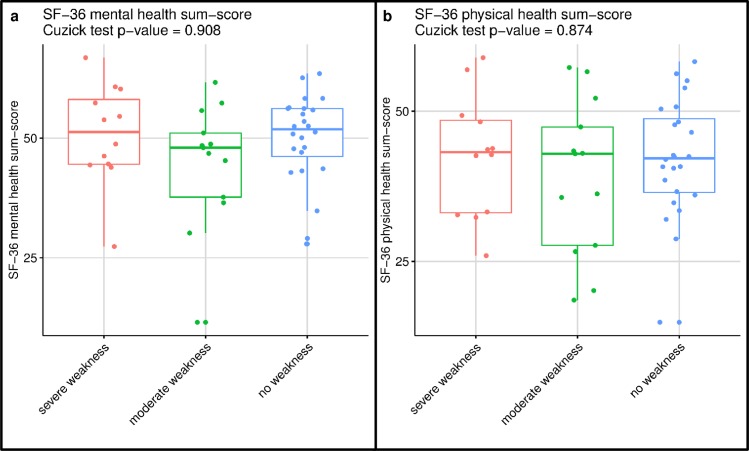
Results: Functional outcomes and length of hospital stay significantly differed in patients with severe, moderate to no weakness (6-Minute Walk test: p = 0.013; 110m [IQR 75-240], 196m [90-324.25], 222.5m [129-378.75], Functional Independence Measure: p = 0.001; 91[IQR 68-101], 113[102.5-118.5], 112[97-123], length of stay after ICU discharge: p = 0.008; 20.9d [IQR 15.83-30.73], 16.86d [13.07-27.10], 11.16d [7.35-19.74]). However, after six months participants had similar values for quality of life regardless of their strength at ICU discharge (Short-Form 36 sum-scores physical health: p = 0.874, mental health: p = 0.908). In-bed immobilisation was the most significant factor associated with weakness at ICU discharge in the regression models (MRC-SS: -24.57(95%CI [-37.03 to -12.11]); p<0.001).
Conclusions: In this general, critically ill cohort, weakness at ICU discharge was associated with short-term functional disability and prolonged hospital length of stay, but not with quality of life, which was equivalent to the values for patients without ICUAW within six months. Immobilisation may be a modifiable risk factor to prevent ICUAW. Prospective trials are needed to validate these results.
Trial registration: German Clinical Trials Register (DRKS) identification number: DRKS00004347, registered on September 10, 2012.
Conflict of interest statement
SE, GL, MLV, CHGB declare that they have no competing interests. II is affiliated with CTU Bern, University of Bern, which has a staff policy of not accepting honoraria or consultancy fees. However, CTU Bern is involved in design, conduct, or analysis of clinical studies funded by not-for-profit and for-profit organizations. In particular, pharmaceutical and medical device companies provide direct funding to some of these studies. For an up-to-date list of CTU Bern’s conflicts of interest see http://www.ctu.unibe.ch/research/declaration_of_interest/index_eng.html. SMJ reports the following potential conflicts of interest: The Department of Intensive Care Medicine has, or has had in the past, research contracts with Orion Corporation, Abbott Nutrition International, B. Braun Medical AG, CSEM SA, Edwards Lifesciences Services GmbH, Kenta Biotech Ltd, Maquet Critical Care AB, Omnicare Clinical Research AG and research & development/consulting contracts with Edwards Lifesciences SA, Maquet Critical Care AB, and Nestlé. The money was paid into a departmental fund; SMJ received no personal financial gain. The Department of Intensive Care Medicine has received unrestricted educational grants from the following organizations for organizing a quarterly postgraduate educational symposium, the Berner Forum for Intensive Care (until 2015): Fresenius Kabi, gsk, MSD, Lilly, Baxter, astellas, AstraZeneca, B | Braun, CSL Behring, Maquet, Novartis, Covidien, Nycomed, Pierre Fabre Pharma AG (formerly known as RobaPharm), Pfizer, Orion Pharma, Bard Medica S.A., Abbott AG, Anandic Medical Systems. The Department of Intensive Care Medicine has received unrestricted educational grants from the following organizations for organizing bi-annual postgraduate courses in the fields of critical care ultrasound, management of ECMO and mechanical ventilation: Pierre Fabre Pharma AG (formerly known as RobaPharm), Pfizer AG, Bard Medica S.A., Abbott AG, Anandic Medical Systems, PanGas AG Healthcare, Orion Pharma, Bracco, Edwards Lifesciences AG, Hamilton Medical AG, Fresenius Kabi (Schweiz) AG, Getinge Group Maquet AG, Dräger Schweiz AG, Teleflex Medical GmbH. No author was employed by any of these companies. None of the companies played a role in this study. Our relationship with the companies does not alter our adherence to PLOS ONE policies on sharing data and materials.
Figures