Are You In or Are You Out? Provider Note Sharing in Pediatrics
- PMID: 32131116
- PMCID: PMC7056394
- DOI: 10.1055/s-0040-1701679
Are You In or Are You Out? Provider Note Sharing in Pediatrics
Abstract
Background: The OpenNotes initiative launched an international movement aimed at making health care more transparent by improving communication with, and access to, information for patients through provider note sharing. Little has been written either on provider note sharing in pediatric and adolescent populations or on the impact of system default settings versus voluntary provider note sharing.
Objective: We describe our journey as a pediatric integrated delivery network to default share notes in ambulatory specialty practices not only with parent proxies but also with teens and discuss the methods that led to a successful implementation.
Methods: Retrospective analysis of every ambulatory shareable medical provider note written in pediatric subspecialty clinics within an integrated pediatric delivery network from April 2017 through March 2019.
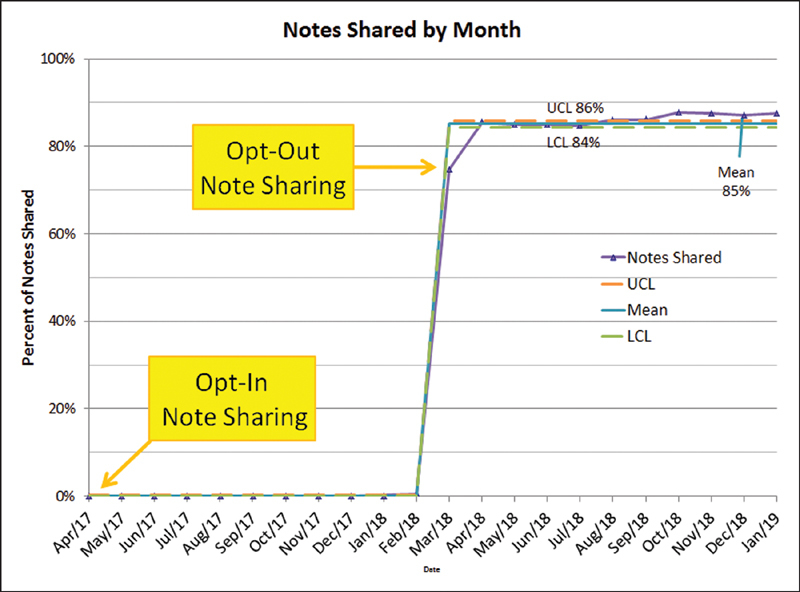
Results: From April 2017 to February 2018, a total of 221,655 notes were shareable based on organizational policies, yet only 224 (0.1%) were actually shared with patients and families. After implementing a system of default release of notes from March 2018 to January 2019, a total of 224,960 notes were shareable, of which 191,379 (85%) were shared.
Conclusion: Requiring providers to take an action to share notes (opt-in) results in few notes being shared while requiring providers to take an action to not share notes (opt-out) results in high levels of note sharing. We demonstrate that default release of notes in pediatric organizations to both proxies and teens is not only achievable but also likely to lead to increased provider note sharing with patients without obvious negative impact on providers or the organization.
Georg Thieme Verlag KG Stuttgart · New York.
Conflict of interest statement
None declared.
Figures

References
-
- Walker J, Darer J D, Elmore J G, Delbanco T. The road toward fully transparent medical records. N Engl J Med. 2014;370(01):6–8. - PubMed
-
- Weinert C. Giving doctors' daily progress notes to hospitalized patients and families to improve patient experience. Am J Med Qual. 2017;32(01):58–65. - PubMed
-
- Sarabu C, Pageler N, Bourgeois F. OpenNotes: toward a participatory pediatric health system. Pediatrics. 2018;142(04):e20180601. - PubMed
-
- OpenNotes.org. Pediatrics & Adolescents. Available at:https://www.opennotes.org/tools-resources/for-health-care-providers/pedi.... Accessed 2019