


Influence of Protein Type on the Antimicrobial Activity of LAE Alone or in Combination with Methylparaben
- PMID: 32131440
- PMCID: PMC7143257
- DOI: 10.3390/foods9030270
Influence of Protein Type on the Antimicrobial Activity of LAE Alone or in Combination with Methylparaben
Abstract
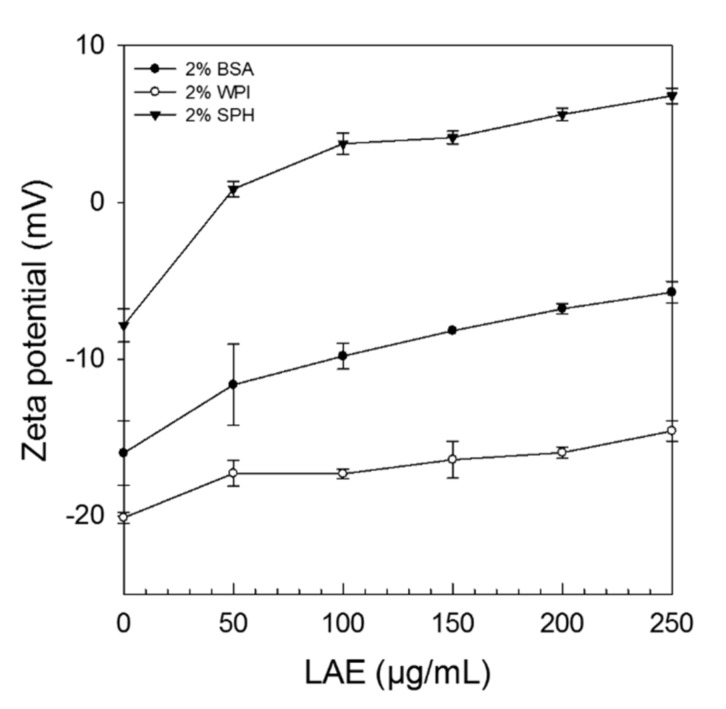
The cationic surfactant Lauric arginate (LAE) has gained approval for utilization in meat products (limit: 200 mg/kg). However, as for other antimicrobials, its activity is reduced when applied to complex food matrices. The current study therefore aims to better understand protein-antimicrobial agent-interactions and their influence on the antimicrobial activity of (i) LAE and (ii) methylparaben against Listeria innocua and Pseudomonas fluorescens in defined model systems (pH 6). Antimicrobials were utilized alone or in combination with nutrient broth containing either no protein or 2% bovine serum albumin, whey protein isolate, or soy protein hydrolysate. LAE was found to form complexes with all proteins due to electrostatic attraction, determined using microelectrophoretic and turbidity measurements. Minimal lethal concentrations of LAE were remarkably increased (4-13 fold) in the presence of proteins, with globular proteins having the strongest impact. Combinations of LAE (0-200 µg/mL) with the less structure-sensitive component methylparaben (approved concentration 0.1%) remarkably decreased the concentrations of LAE needed to strongly inhibit or even kill both, L. innocua and P. fluorescens in the presence of proteins. The study highlights the importance of ingredient interactions impacting microbial activity that are often not taken into account when examining antimicrobial components having different structure sensitivities.
Keywords: Lauric arginate; cationic surfactant; food antimicrobials; methylparaben; protein interaction; structure sensitivity.
Conflict of interest statement
The authors declare no conflict of interest.
Figures




References
-
- Banerjee M., Sarkar P.K. Antibiotic resistance and susceptibility to some food preservative measures of spoilage and pathogenic microorganisms from spices. Food Microbiol. 2004;21:335–342. doi: 10.1016/S0740-0020(03)00073-X. - DOI
-
- Davidson P.M., Harrison M.A. Resistance and adaptation to food antimicrobials, sanitizers, and other process controls. Food Technol. 2002;56:69–78.
-
- Suksathit S., Tangwatcharin P. Activity of organic acid salts in combination with Lauric arginate against Listeria monocytogenes and Salmonella Rissen. Sci. Asia. 2013;39:346–355. doi: 10.2306/scienceasia1513-1874.2013.39.346. - DOI
-
- Becerril R., Manso S., Nerin C., Gómez-Lus R. Antimicrobial activity of Lauroyl Arginate Ethyl (LAE), against selected food-borne bacteria. Food Control. 2013;32:404–408. doi: 10.1016/j.foodcont.2013.01.003. - DOI
Grants and funding
LinkOut - more resources
Full Text Sources
