


Predicting the need for supportive services after discharged from hospital: a systematic review
- PMID: 32131817
- PMCID: PMC7057581
- DOI: 10.1186/s12913-020-4972-6
Predicting the need for supportive services after discharged from hospital: a systematic review
Abstract
Background: Some patients admitted to acute care hospital require supportive services after discharge. The objective of our review was to identify models and variables that predict the need for supportive services after discharge from acute care hospital.
Methods: We performed a systematic review searching the MEDLINE, CINAHL, EMBASE, and COCHRANE databases from inception to May 1st 2017. We selected studies that derived and validated a prediction model for the need for supportive services after hospital discharge for patients admitted non-electively to a medical ward. We extracted cohort characteristics, model characteristics and variables screened and included in final predictive models. Risk of bias was assessed using the Quality in Prognostic Studies tool.
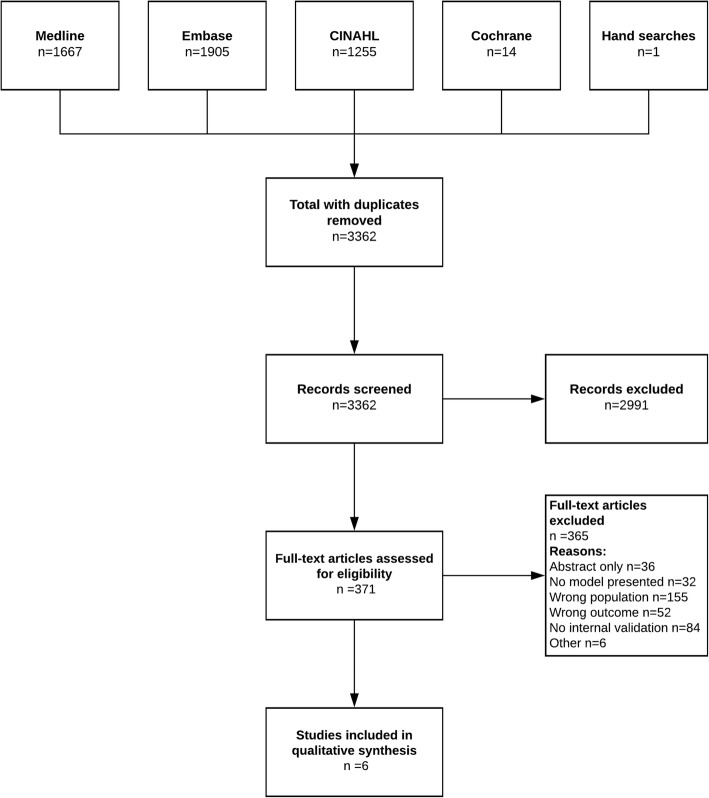
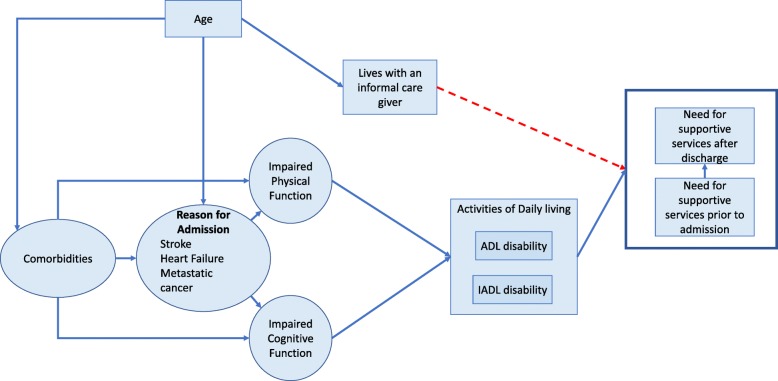
Results: Our search identified 3362 unique references. Full text review identified 6 models. Models had good discrimination in derivation (c-statistics > 0.75) and validation (c-statistics > 0.70) cohorts. There was high quality evidence that age, impaired physical function, disabilities in performing activities of daily living, absence of an informal care giver and frailty predict the need for supportive services after discharge. Stroke was the only unique diagnosis with at least moderate evidence of an independent effect on the outcome. No models were externally validated, and all were at moderate or higher risk of bias.
Conclusions: Deficits in physical function and activities of daily living, age, absence of an informal care giver and frailty have the strongest evidence as determinants of the need for support services after hospital discharge.
Trial registration: This review was registered with PROSPERO #CRD42016037144.
Keywords: Assisted living; Discharge; Home care; Residential facilities.
Conflict of interest statement
The authors declare that they have no competing interests.
Figures
References
-
- Kleinpell RM, Fletcher K, Jennings BM. Reducing Functional Decline in Hospitalized Elderly. In: Hughes RG, editor. Patient Safety and Quality: An Evidence-Based Handbook for Nurses. Rockville (MD): Agency for Healthcare Research and Quality; 2008. - PubMed
-
- Covinsky KE, Palmer RM, Fortinsky RH, Counsell SR, Stewart AL, Kresevic D, Burant CJ, Landefeld CS. Loss of independence in activities of daily living in older adults hospitalized with medical illnesses: increased vulnerability with age. J Am Geriatr Soc. 2003;51(4):451–458. doi: 10.1046/j.1532-5415.2003.51152.x. - DOI - PubMed
Publication types
MeSH terms
LinkOut - more resources
Full Text Sources
Other Literature Sources
